Governments Rethink The Problems
p. 17 · Read in the full issue
Problems Of The SPC
By Stuart Inder.
The five member nations of the South Pacific Commission are having to rethink the details of proposals made last year to give an important new voice on the SPC to Islands people.
IS a result of legislative difficulties and changing attitudes the pro osals, put forward at a review con srence in London last July, will not dw be carried out.
But it is possible that some of le more important proposals will be ilvaged and made to work in a ifferent way, which will result in le Islanders getting a much larger ly in SPC affairs *han they have DW.
Last year’s London conference, hich was attended by the UK, the
US, France, NZ and Australia, dis cussed a scheme for drastically over hauling the Commission’s charter (drawn up in 1947).
It was proposed among other things to re-organise the Research Council and to set up an additional body called a Regional Council, which could meet every year and which would have delegates elected by Islands legislatures. This Council would be in a position to take a close interest in SPC direction.
The London conference also dis cussed a new financial formula of contributions, and the admission of Western Samoa as a full member following her independence. The conference broke up on a note of optimism.
By October, however, when the Commission met in Noumea, it was obvious that there were serious diffi culties in the way of the proposals being carried out by the member governments. France and the US especially were unable to get approv ing bills through their legislatures in time, and the passage of the bills themselves could be guaranteed to raise other difficulties.
Since then it has become clear that the complications of getting five Powers to agree to new sets of pro posals that could have deep ramifica tions in other ways are too much for there to be an easy solution. Ap parently none of the Powers is willing to risk throwing open the SPC charter to an extent which could one day allow political control of their own territories to slip away from them.
All are agreed that the SPC is not political, and that its main role is to provide technical assistance—to be a library of technical brains the territories may call on as their technical and scientific problems grow.
None of them wants the SPC as a possible nucleus of some loose South Seas federation—nor do they want to greatly sharpen its teeth, for it might use the teeth to bite the hand that feeds it.
Nevertheless, it is possible to do a
great many things within the frame work of the present charter—just so long as all the member governments are agreeable.
It is probably possible to have a Regional Council without altering the charter, by developing such a body as a kind of select committee of the South Pacific Conference. The Conference could continue to meet and discuss general matters on a pre set agenda every three years, as it does now, but the select committee mignt meet annually and frame recommendations for the Commis sion, It is along these lines that a number of member governments are now thinking.
Samoan Membership
Meanwhile, the new financial ar rangements seem to have worked themselves out well enough—tem porarily, anyhow—although the plac ing by Congress of a lower American “ceiling” than was expected caused some embarrassment among Ameri can officials and may cause some difficulties with the SPC budget if it remains on in the next few years.
The Commission’s failure to find a formula to admit Samoa after 18 months of effort has also caused em barrassment in some places, with the result that in late February there was another London conference of the Big Five aimed at finally solving the problem.
Reports from London indicate that a formula has been approved which will enable Western Samoa to obtain full membership by the next meeting of the Commission in October.
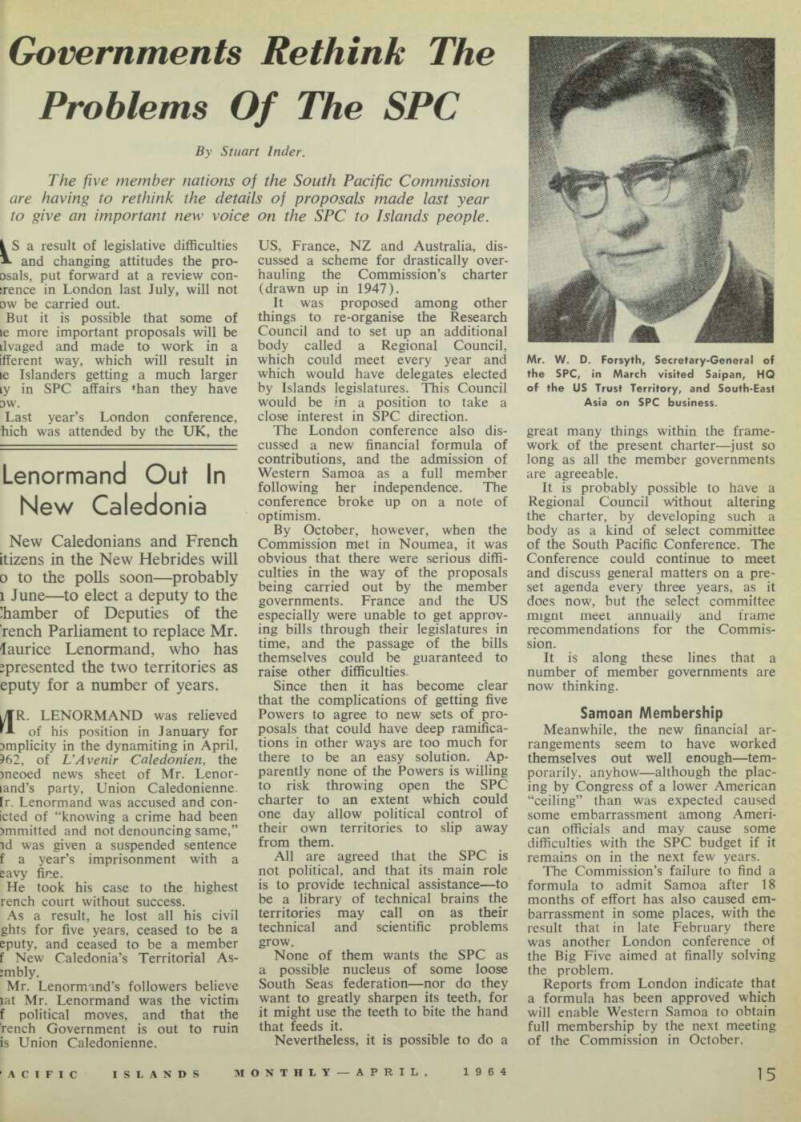
Mr. W. D. Forsyth, Secretary-General of the SPC, in March visited Saipan, HQ of the US Trust Territory, and South-East Asia on SPC business.