Common-Roll Election
pp. 11-131 · Read in the full issue
It's A Patchwork Quilt
Result For First
P-NG Election Survey by Judy Tudor.
Results to April 1 in the Papua-New Guinea elections — and counting of preferences and absentee votes will be con cluded only after this is in print-—are interesting for the candi dates who appear likely to lose as much as for those who seem likely to succeed.
EXPERTS have already been at tempting to see some sort of >olitical pattern in the results of the )rimary count, but all that really merges is a crazy-paving of local sectional foibles; and the ;ood old New Guinea idea that when n doubt leave it to the Kiap (Goy ;rnment officer). Or the ex-Kiap, in his case.
In short, things have turned out ather as expected by Territorians, ifficial and otherwise, who closely jbserved the voting. They believed hat just about anything could hap ien, and just about everything has.
See-saw Voting
Natives in many electorates voted n blocs, as communities or clans, for ;he candidates they knew, and as a result the fortunes of some candi dates see-sawed several times during counting. For example, in the special electorate of South Markham, Lloyd Hurrell was trailing his two op ponents until the votes from Men yamya came in and put him slightly ahead. Mr. Hurrell is now a Wau coffee planter but he was formerly the Assistant District Officer who took government to the Menyamya area. He did a good job—and the Kukukukus from there apparently have not forgotten.
The same sort of bloc voting in the Moresby Open Electorate— where no less than 12 candidates stood —appeared to have put paid to the chances of Oala Oala Rarua, of Port Moresby. He was being beaten by sheer weight of numbers—and possibly a little Port Moresby Euro pean prejudice—by an unknown in terpreter from primitive Goilala called Erika Rarupa, His chances rose later when it was seen that though the urban voters marked pre ferences, most Goilalas did not.
It could mean Still that sophisticated natives around Port Moresby will have no representative of their own in the new House of Assembly, while Oala Oala Rarua, who many people see as Prime Minister material, has to wait another four years for another chance.
Whatever personal opinions there are about this young man, he is welleducated, intelligent, eminently presentable and head and shoulders above most of the native members who are going to sit in the House.
Further, he is politically ambitious.
The place for Oala Oala Rurua and his ambitions is in the House of Assembly; not reduced to some back-
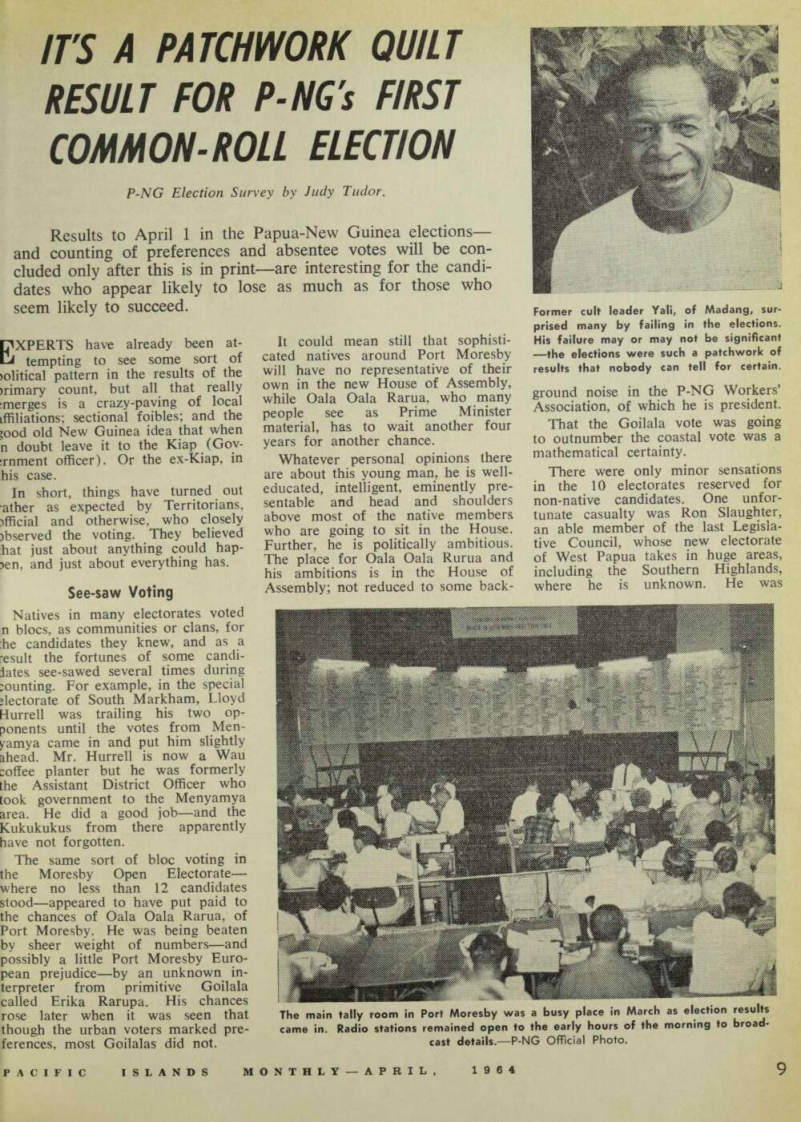
Former cult leader Yali, of Madang, sur prised many by failing in the elections.
His failure may or may not be significant —the elections were such a patchwork of results that nobody can tell for certain. ground noise in the P-NG Workers’
Association, of which he is president.
That the Goilala vote was going to outnumber the coastal vote was a mathematical certainty.
There were only minor sensations in the 10 electorates reserved for non-native candidates. One unfor tunate casualty was Ron Slaughter, an able member of the last Legisla tive Council, whose new electorate of West Papua takes in huge areas, including the Southern Highlands, where he is unknown. He was
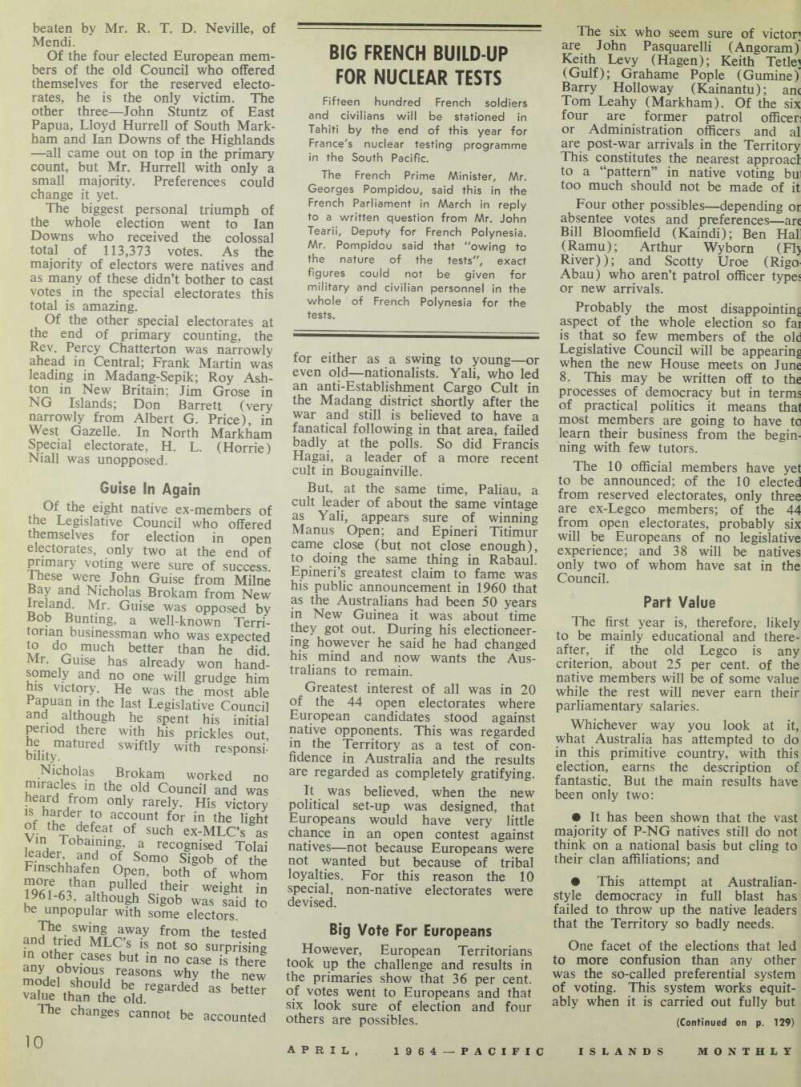
The main tally room in Port Moresby was a busy place in March as election results came in. Radio stations remained open to the early hours of the morning to broad cast details.— P-NG Official Photo.
beaten by Mr. R. T. D. Neville, of Mendi.
Of the four elected European mem bers of the old Council who offered themselves for the reserved electo rates, he is the only victim. The other three—John Stuntz of East Papua, Lloyd Hurrell of South Mark ham and lan Downs of the Highlands —all came out on top in the primary count, but Mr. Hurrell with only a small majority. Preferences could change it yet.
The biggest personal triumph of the whole election went to lan Downs who received the colossal total of 113,373 votes. As the majority of electors were natives and as many of these didn’t bother to cast votes in the special electorates this total is amazing.
Of the other special electorates at the end of primary counting, the Rev. Percy Chatterton was narrowly ahead in Central; Frank Martin was leading in Madang-Sepik; Roy Ash ton in New Britain: Jim Grose in NG Islands; Don Barrett (very narrowly from Albert G. Price), in West Gazelle. In North Markham Special electorate, H. L. (Home) Niall was unopposed.
Guise In Again Of the eight native ex-members of the Legislative Council who offered themselves for election in open electorates, only two at the end of primary voting were sure of success.
These were John Guise from Milne Bay and Nicholas Brokam from New Ireland. Mr. Guise was opposed by Bob Bunting, a well-known Terri tonan businessman who was expected to d o much better than he did.
Mr. Guise has already won hand somely and no one will grudge him his victory. He was the most able Papuan in the last Legislative Council and although he spent his initial period there with his prickles out, bflit y matUred SWifUy With res P° nsi - Nicholas Brokam worked no miracles in the old Council and was • e l rd I rom only rarel y- His victory !S harder to account for in the light v; n th t de ? eat of such ex-MLC’s as Vm Tobainmg, a recognised Tolai leader, and of Somo Sigob of the Finschhafen Open, both o£ whom ?9fiTfi1 ha uK PUI K d c. their wei * ht “ 61-63. although Sigob was said to be unpopular with some electors. an! 1 ? - * way from th e tested and tned MLC s is not so surprising m other cases but in no case is there * ny ? b u OU ? J reasons why the new ™°ue el .h S anl d eo e id. reBarded 35 be “ er The changes cannot be accounted
for either as a swing to young—or even old—nationalists. Yali, who led an anti-Establishment Cargo Cult in the Madang district shortly after the war and still is believed to have a fanatical following in that area, failed badly at the polls. So did Francis Hagai, a leader of a more recent cult in Bougainville.
But, at the same time, Paliau, a cult leader of about the same vintage as Yali, appears sure of winning Manus Open; and Epineri Titimur came close (but not close enough), to doing the same thing in Rabaul.
Epineri’s greatest claim to fame was his public announcement in 1960 that as the Australians had been 50 years in New Guinea it was about time they got out. During his electioneer ing however he said he had changed his mind and now wants the Aus tralians to remain.
Greatest interest of all was in 20 of the 44 open electorates where European candidates stood against native opponents. This was regarded in the Territory as a test of con fidence in Australia and the results are regarded as completely gratifying.
It was believed, when the new political set-up was designed, that Europeans would have very little chance in an open contest against natives—not because Europeans were not wanted but because of tribal loyalties. For this reason the 10 special, non-native electorates were devised.
Big Vote For Europeans
However, European Territorians took up the challenge and results in the primaries show that 36 per cent, of votes went to Europeans and that six look sure of election and four others are possibles.
The six who seem sure of victor are John Pasquarelli (Angoram) Keith Levy (Hagen); Keith Teller (Gulf); Grahame Pople (Gumine)* Barry Holloway (Kainantu); anc Tom Leahy (Markham). Of the six four are former patrol officer: or Administration officers and al are post-war arrivals in the Territory This constitutes the nearest approach to a “pattern” in native voting bui too much should not be made of it Four other possibles—depending or absentee votes and preferences—are Bill Bloomfield (Kaindi); Ben Hal! (Ramu); Arthur Wyborn (Fl> River)); and Scotty Uroe (Rigo- Abau) who aren’t patrol officer types or new arrivals.
Probably the most disappointing aspect of the whole election so fax is that so few members of the old Legislative Council will be appearing when the new House meets on June 8. This may be written off to the processes of democracy but in terms of practical politics it means that most members are going to have to learn their business from the begin ning with few tutors.
The 10 official members have yet to be announced; of the 10 elected from reserved electorates, only three are ex-Legco members; of the 44 from open electorates, probably six will be Europeans of no legislative experience; and 38 will be natives only two of whom have sat in the Council.
Part Value The first year is, therefore, likely to be mainly educational and there after, if the old Legco is any criterion, about 25 per cent, of the native members will be of some value while the rest will never earn their parliamentary salaries.
Whichever way you look at it, what Australia has attempted to do in this primitive country, with this election, earns the description of fantastic. But the main results have been only two: • It has been shown that the vast majority of P-NG natives still do not think on a national basis but cling to their clan affiliations; and • This attempt at Australian style democracy in full blast has failed to throw up the native leaders that the Territory so badly needs.
One facet of the elections that led to more confusion than any other was the so-called preferential system of voting. This system works equit ably when it is carried out fully but
(Continued on p. 129)
quite late in the day in P-NG it was decided that if a voter only marked number one, the vote would be valid.
Preferential voting therefore be came a hit-and-miss affair, left to the whim of the voter, so that while some candidates in some areas are now going to get the benefit of pre ference, some others, in areas where native voters didn’t bother, will, through no fault of their own, get no benefit from it at all.
It is equally true, of course, that if it had been necessary to mark ballot papers in complete order of preference, the number of informal votes would have been tremendous.
The simplest solution, which would have done away with much of the confusion, would have been to make it a first-past-the-post ballot.
The change of heart prior to the elections that decreed that voters could choose whether they voted pre ferential or not, has also had legal complications (see story on p. 11).
Voting was not compulsory but 65 per cent, elected to vote. The per centage was very much less than this in the special electorates which many natives regarded as “something be long Master”. According to our calculations only about half the voters on the roll cast a vote for these electorates—and over a fifth of them were those cast for Mr. lan Downs, in the Highland electorate.