Pacific Commerce and Produce
pp. 122-125 · Read in the full issue
P-NG Timber Exports to Japan Not AH Plain Sailing
Nowhere in the South Pacific has Japan's recent interest in Islands timber had such a startling effect as in New Guinea. After years of virtual hand-to-mouth operations in which many mills could hardly earn a crust, the New Guinea timber business is now looking forward to a boom—thanks to guaranteed markets in Japan.
fFHE Japanese are pleased too, for the Territory’s commercial forests of 120,000 square miles, con taining more than 100,000 million super feet of merchantable logs, are a substantial account on which to draw if South East Asian resources are placed in jeopardy because of politi cal trends, as some of them now are.
Japan, which imports 60 per cent, of its needs from the Philippines and 35 per cent, from North Borneo, realised before anybody else that it would require new sources, and thus she has been active in the South Paci fic timber areas while other suppliers particularly in Australia, have hardly more than pondered the question.
New Guinea and the Solomons have
been the special targets of the Japan ese.
In the last 12 months New Guinea timber has supplied one per cent, of the Japanese market whereas before it supplied virtually nothing. Fifteen months ago only five per cent, of New Guinea timber exports went to Japan, but today 70 per cent, goes there, and the share is growing.
New Guinea timber men hope that New Guinea eventually will supply five per cent, of the Japanese home market.
The Japanese have given the New Guinea industry its first big ex pansion. At the end of the war there were only two sawmills working in the Territory, and timber production
in 1950-51 was only 18 million supeu feet of log. Today, more than 70 sawmills produce more than 80 mil-1 lion super feet a year. The Adminis- C tration planned for an annual log cutn of 120 million super by 1966, but this will be exceeded thanks to thes Japanese effect on the industry.
The trade mostly is in the hands of three New Britain mills exportinga through Japanese companies. One oft the biggest exporters is New Britain’s Thompson and Wright Limited, off* Cape Hoskins, which sells through as
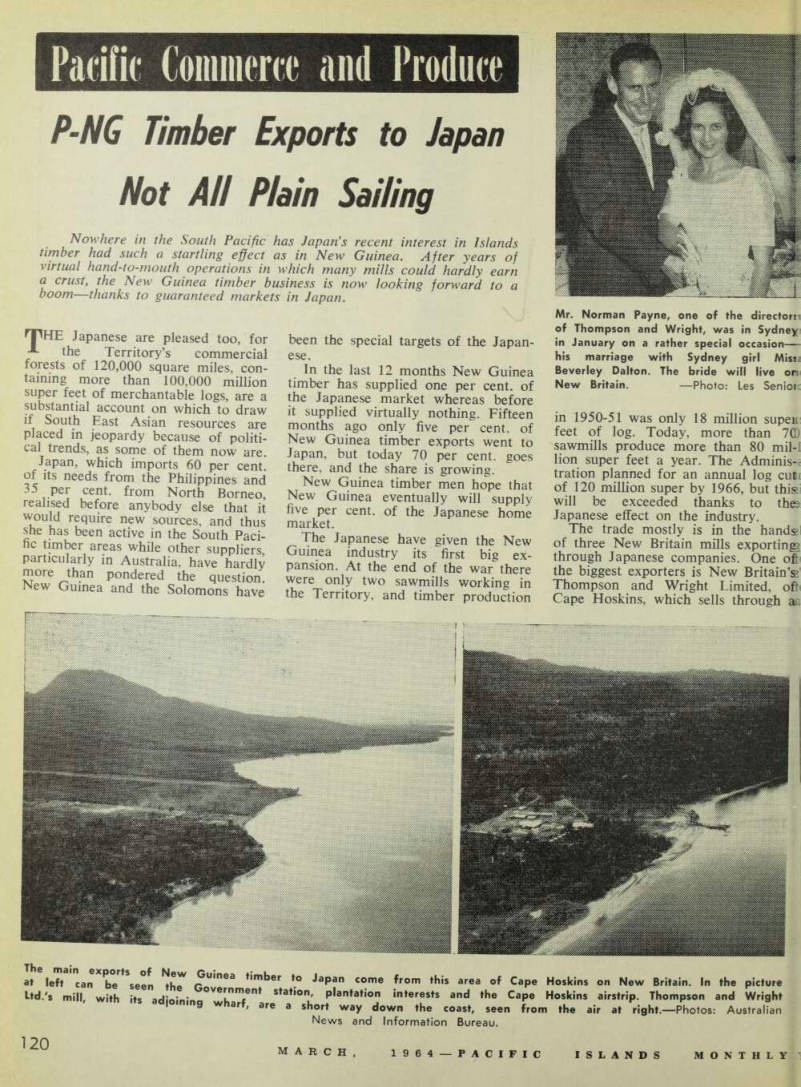
Mr. Norman Payne, one of the director [?] of Thompson and Wright, was in Sydne [?] in January on a rather special occasion— his marriage with Sydney girl Miss [?] Beverley Dalton. The bride will live o [?] New Britain. — Photo: Les Senioic
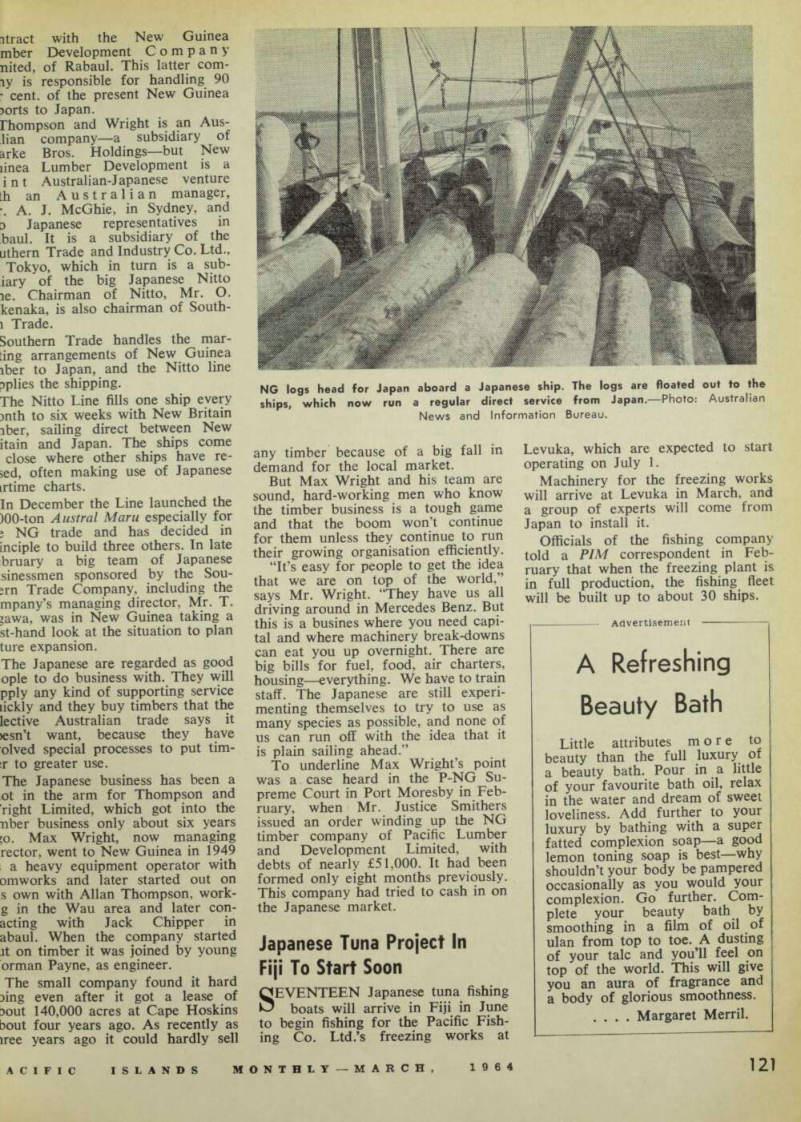
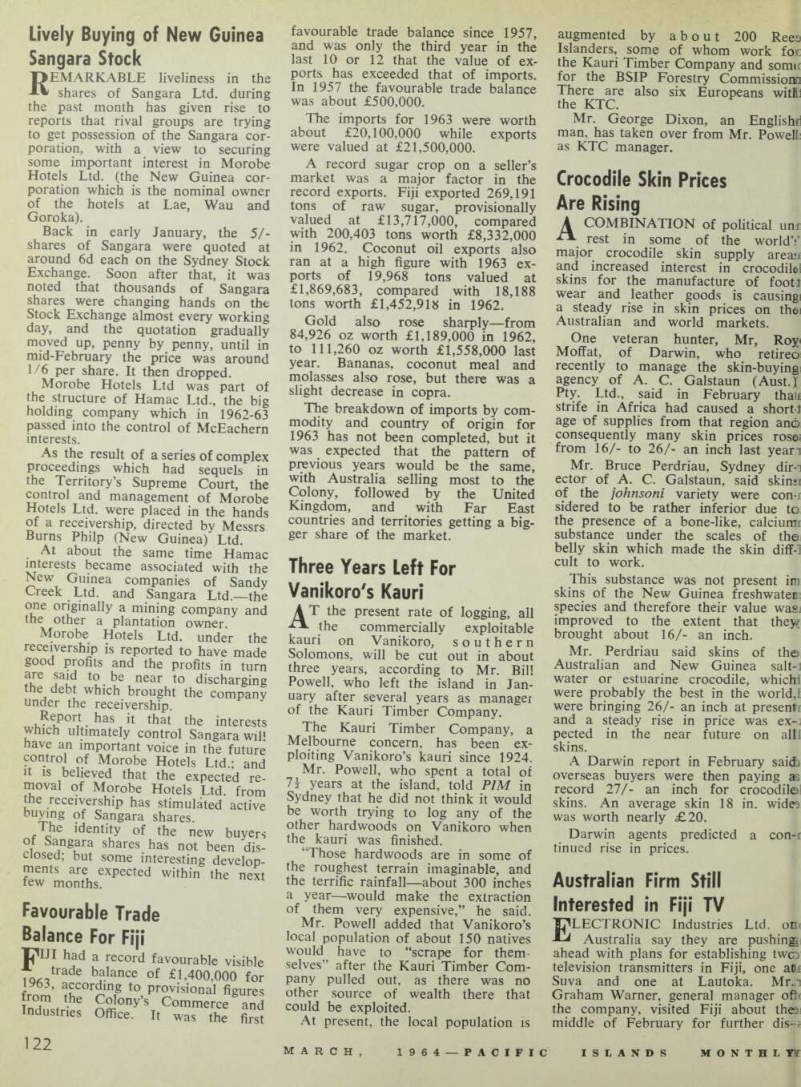
The main exports of New Guinea timber to Japan come from this area of Cape Hoskins on New Britain. In the picture at left can be seen the Gobernment station plantation intersts and the Caoe Hoskins airstrip. Thompson and Wright Ltd.'s mill, with its adjoinng whart, are a short way down the coast, seen from the air at right-Photos: Austrlian New and Information Bureau.
itract with the New Guinea mber Development Company nited, of Rabaul. This latter com ly is responsible for handling 90 ■ cent, of the present New Guinea )orts to Japan.
Fhompson and Wright is an Aus lian company—a subsidiary of arke Bros. Holdings—but New tinea Lumber Development is a int Australian-Japanese venture lh an Australian manager, •. A. J. McGhie, in Sydney, and
a Japanese representatives in
haul. It is a subsidiary of the uthem Trade and Industry Co. Ltd., Tokyo, which in turn is a sub iary of the big Japanese Nitto le. Chairman of Nitto, Mr. O. kenaka, is also chairman of South i Trade.
Southern Trade handles the mar ting arrangements of New Guinea iber to Japan, and the Nitto line pplies the shipping.
The Nitto Line fills one ship every mth to six weeks with New Britain iber, sailing direct between New itain and Japan. The ships come close where other ships have re >ed, often making use of Japanese irtime charts.
In December the Line launched the )00-ton Austral Maru especially for i NG trade and has decided in inciple to build three others. In late bruary a big team of Japanese sinessmen sponsored by the Sou irn Trade Company, including the mpany’s managing director, Mr. T. >awa, was in New Guinea taking a st-hand look at the situation to plan ture expansion.
The Japanese are regarded as good ople to do business with. They will pply any kind of supporting service lickly and they buy timbers that the lective Australian trade says it >esn’t want, because they have olved special processes to put tim ;r to greater use.
The Japanese business has been a ot in the arm for Thompson and right Limited, which got into the nber business only about six years ;o. Max Wright, now managing rector, went to New Guinea in 1949 a heavy equipment operator with omworks and later started out on s own with Allan Thompson, work g in the Wau area and later con acting with Jack Chipper in abaul. When the company started it on timber it was joined by young orman Payne, as engineer.
The small company found it hard Ding even after it got a lease of Dout 140,000 acres at Cape Hoskins bout four years ago. As recently as iree years ago it could hardly sell
any timber because of a big fall in demand for the local market.
But Max Wright and his team are sound, hard-working men who know the timber business is a tough game and that the boom won’t continue for them unless they continue to run their growing organisation efficiently.
“It’s easy for people to get the idea that we are on top of the world,” says Mr. Wright. “They have us all driving around in Mercedes Benz. But this is a busines where you need capi tal and where machinery break-downs can eat you up overnight. There are big bills for fuel, food, air charters, housing—everything. We have to train staff. The Japanese are still experi menting themselves to try to use as many species as possible, and none of us can run off with the idea that it is plain sailing ahead.”
To underline Max Wright’s point was a case heard in the P-NG Su preme Court in Port Moresby in Feb ruary, when Mr. Justice Smithers issued an order winding up the NG timber company of Pacific Lumber and Development Limited, with debts of nearly £51,000. It had been formed only eight months previously.
This company had tried to cash in on the Japanese market.
Japanese Tuna Project In
Fiji To Start Soon
SEVENTEEN Japanese tuna fishing boats will arrive in Fiji in June to begin fishing for the Pacific Fish ing Co. Ltd.’s freezing works at
Levuka, which are expected to start operating on July 1.
Machinery for the freezing works will arrive at Levuka in March, and a group of experts will come from Japan to install it.
Officials of the fishing company told a PIM correspondent in Feb ruary that when the freezing plant is in full production, the fishing fleet will be built up to about 30 ships.
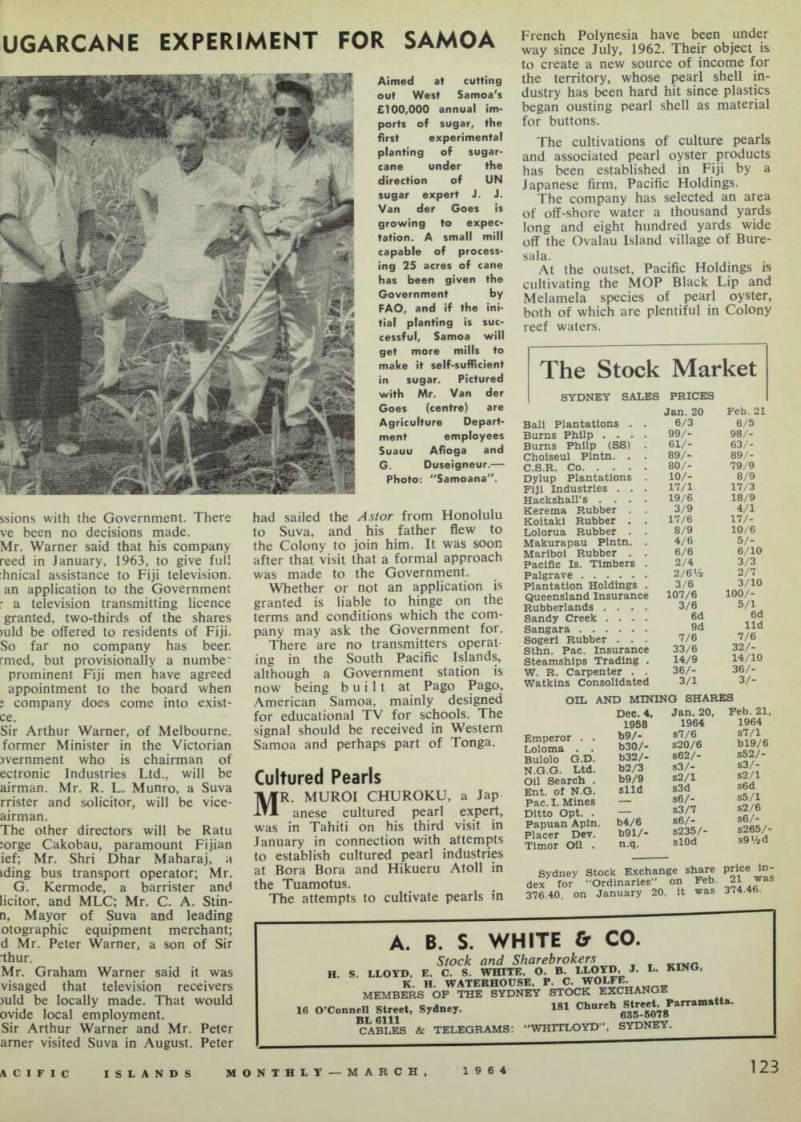
NG logs head for Japan aboard a Japanese ship. The logs are floated out to the ships, which now run a regular direct service from Japan. — Photo: Australian News and Information Bureau.
Lively Buying of New Guinea
Sangara Stock
REMARKABLE liveliness in the shares of Sangara Ltd. during the past month has given rise to reports that rival groups are trying to get possession of the Sangara cor poration, with a view to securing some important interest in Morobe Hotels Ltd. (the New Guinea cor poration which is the nominal owner of the hotels at Lae, Wau and Goroka).
Back in early January, the 5/shares of Sangara were quoted at around 6d each on the Sydney Stock Exchange. Soon after that, it was noted that thousands of Sangara shares were changing hands on the Stock Exchange almost every working day, and the quotation gradually moved up, penny by penny, until in mid-February the price was around 1/6 per share. It then dropped.
Morobe Hotels Ltd was part of the structure of Hamac Ltd., the big holding company which in 1962-63 passed into the control of McEachern interests.
As the result of a series of complex proceedings which had sequels in the Territory’s Supreme Court, the control and management of Morobe Hotels Ltd. were placed in the hands of a receivership, directed by Messrs Burns Philp (New Guinea) Ltd.
At about the same time Hamac interests became associated with the New Guinea companies of Sandy Creek Ltd. and Sangara Ltd.—the one originally a mining company and the other a plantation owner Morobe Hotels Ltd. under the receivership is reported to have made good profits and the profits in turn are said to be near to discharging the debt which brought the company under the receivership.
Report has it that the interests which ultimately control Sangara will have an important voice in the future control of Morobe Hotels Ltd.; and it is believed that the expected re moval of Morobe Hotels Ltd. from the receivership has stimulated active buying of Sangara shares.
The identity of the new buyers of Sangara shares has not been dis closed; but some interesting develop ments are expected within the next few months.
Favourable Trade
Balance For Fiji
‘pUI had a record favourable visible * trade balance of £1,400,000 for 1*63, according to provisional figures from the Colony’s Commerce B and Industries Office. It was the first
favourable trade balance since 1957, and was only the third year in the last 10 or 12 that the value of ex ports has exceeded that of imports.
In 1957 the favourable trade balance was about £500,000.
The imports for 1963 were worth about £20,100,000 while exports were valued at £21,500,000.
A record sugar crop on a seller’s market was a major factor in the record exports. Fiji exported 269,191 tons of raw sugar, provisionally valued at £13,717,000, compared with 200,403 tons worth £8,332,000 in 1962. Coconut oil exports also ran at a high figure with 1963 ex ports of 19,968 tons valued at £1,869,683, compared with 18,188 tons worth £1,452,918 in 1962.
Gold also rose sharply—from 84,926 oz worth £1,189,000 in 1962, to 111,260 oz worth £1,558,000 last year. Bananas, coconut meal and molasses also rose, but there was a slight decrease in copra.
The breakdown of imports by com modity and country of origin for 1963 has not been completed, but it was expected that the pattern of previous years would be the same, with Australia selling most to the Colony, followed by the United Kingdom, and with Far East countries and territories getting a big ger share of the market.
Three Years Left For
Vanikoro's Kauri
AT the present rate of logging, all the commercially exploitable kauri on Vanikoro, southern Solomons, will be cut out in about three years, according to Mr. Bill Powell, who left the island in Jan uary after several years as manager of the Kauri Timber Company.
The Kauri Timber Company, a Melbourne concern, has been ex ploiting Vanikoro’s kauri since 1924.
Mr. Powell, who spent a total of 7i years at the island, told PIM in Sydney that he did not think it would be worth trying to log any of the other hardwoods on Vanikoro when the kauri was finished.
“Those hardwoods are in some of the roughest terrain imaginable, and the terrific rainfall—about 300 inches a year—would make the extraction of them very expensive,” he said.
Mr. Powell added that Vanikoro’s local population of about 150 natives would have to “scrape for them selves” after the Kauri Timber Com pany pulled out, as there was no other source of wealth there that could be exploited.
At present, the local population is
augmented by about 200 Rees Islanders, some of whom work fox the Kauri Timber Company and somu for the BSIP Forestry Commissionc There are also six Europeans witH: the KTC.
Mr. George Dixon, an Englishc man, has taken over from Mr. Powell: as KTC manager.
Crocodile Skin Prices
Are Rising
A COMBINATION of political unr rest in some of the world’;' major crocodile skin supply area;* and increased interest in crocodile! skins for the manufacture of foot! wear and leather goods is causing: a steady rise in skin prices on the Australian and world markets.
One veteran hunter, Mr, Roy' Moffat, of Darwin, who retireo recently to manage the skin-buying agency of A. C. Galstaun (Aust.J Pty. Ltd., said in February thaif strife in Africa had caused a short! age of supplies from that region an 6 consequently many skin prices rose: from 16/- to 26/- an inch last yean Mr. Bruce Perdriau, Sydney dir ector of A. C. Galstaun, said skinsi of the johnsoni variety were con sidered to be rather inferior due to the presence of a bone-like, calciunn substance under the scales of the belly skin which made the skin diff-i cult to work.
This substance was not present im skins of the New Guinea freshwaten; species and therefore their value wasj improved to the extent that they; brought about 16/- an inch.
Mr. Perdriau said skins of tho Australian and New Guinea salt-; water or estuarine crocodile, which! were probably the best in the world,l were bringing 26/- an inch at present! and a steady rise in price was ex-; pected in the near future on all I skins.
A Darwin report in February said) overseas buyers were then paying as record 27/- an inch for crocodile skins. An average skin 18 in. wides was worth nearly £2O.
Darwin agents predicted a con-i tinued rise in prices.
Australian Firm Still
Interested in Fiji TV
Electronic industries Ltd. om Australia say they are pushing ahead with plans for establishing two television transmitters in Fiji, one ath Suva and one at Lautoka. Mr,.i Graham Warner, general manager ofh the company, visited Fiji about thes middle of February for further dis-j
Ugarcane Experiment For Samoa
ssions with the Government. There ve been no decisions made.
Mr. Warner said that his company reed in January, 1963, to give full :hnical assistance to Fiji television, an application to the Government * a television transmitting licence granted, two-thirds of the shares mid be offered to residents of Fiji.
So far no company has been rmed, but provisionally a numbe' prominent Fiji men have agreed appointment to the board when ; company does come into exist ce.
Sir Arthur Warner, of Melbourne, former Minister in the Victorian ivernment who is chairman of ectronic Industries Ltd., will be airman. Mr. R. L. Munro, a Suva rrister and solicitor, will be vice airman.
The other directors will be Ratu Jorge Cakobau, paramount Fijian ief; Mr. Shri Dhar Maharaj, a iding bus transport operator; Mr.
G. Kermode, a barrister and licitor, and MLC; Mr. C. A. Stin n, Mayor of Suva and leading olographic equipment merchant; d Mr. Peter Warner, a son of Sir •thur, Mr. Graham Warner said it was visaged that television receivers mid be locally made. That would ovide local employment.
Sir Arthur Warner and Mr. Peter amer visited Suva in August. Peter
had sailed the A star from Honolulu to Suva, and his father flew to the Colony to join him. It was soon after that visit that a formal approach was made to the Government.
Whether or not an application is granted is liable to hinge on the terms and conditions which the com pany may ask the Government for.
There are no transmitters operat ing in the South Pacific Islands, although a Government station is now being built at Pago Pago, American Samoa, mainly designed for educational TV for schools. The signal should be received in Western Samoa and perhaps part of Tonga.
Cultured Pearls
Mr. Muroi Churoku, A Jap
anese cultured pearl expert, was in Tahiti on his third visit in January in connection with attempts to establish cultured pearl industries at Bora Bora and Hikueru Atoll in the Tuamotus.
The attempts to cultivate pearls in
French Polynesia have been under way since July, 1962. Their object is to create a new source of income for the territory, whose pearl shell in dustry has been hard hit since plastics began ousting pearl shell as material for buttons.
The cultivations of culture pearls and associated pearl oyster products has been established in Fiji by a Japanese firm, Pacific Holdings.
The company has selected an area of off-shore water a thousand yards long and eight hundred yards wide off the Ovalau Island village of Bure sala.
At the outset, Pacific Holdings is cultivating the MOP Black Lip and Melamela species of pearl oyster, both of which are plentiful in Colony reef waters.
Aimed at cutting out West Samoa's £lOO,OOO annual im ports of sugar, the
first experimental
planting of sugar cane under the direction of UN sugar expert J. J.
Van der Goes is growing to expec tation. A small mill
capable of process
ing 25 acres of cane has been given the Government by FAO, and if the ini tial planting is suc cessful, Samoa will get more mills to make it self-sufficient in sugar. Pictured with Mr. Van der Goes (centre) are
Agriculture Depart
ment employees
Suauu Afioga and G. Duseigneur.— Photo: "Samoana".