Pacific Shipping And Cruising Yachts
pp. 97-107 · Read in the full issue
Cruising Yachts
French Line To Put New Ships Into Service Soon
Messageries Maritimes, the French shipping line in which the French Government has a 78 per cent, interest, will put four new ships into service on the Europe-Australia run in the next two years and will begin a service to New Zealand.
THE new ships are the 19,000-ton liner UAustralien and three modern cargo ships of 10,000 tons ;ach. UAustralien, expected to cost £6 million, and the three cargo ships arc now being built.
The cargo ships will replace the Euphrates, Iraoudy and Godavery which Messageries Maritimes now charters. They will be capable of 19 knots, will have limited passenger accommodation and de luxe quarters for the crew.
U Australien will carry 400 passengers and will have a top speed of 21 knots. Another vessel of the same type will eventually be built to replace the Tahitien, which was recently refitted. The refit involved fusing the Ist and tourist classes and the 3rd and 4th classes. The Messageries Maritimes ship Caledonien is to be similarly refitted.
The president of Messageries Maritimes, Rear-Admiral Guillaume le Bigot, announced these plans during a tour of the South Pacific in February
during which he visited Noumea, Sydney, Manila and Hong Kong, Admiral le Bigot added that his company would inaugurate a service of six ships a year to New Zealand to load wool and general cargo, and that it would station a vessel in the Pacific to carry cargo for the islands which was too heavy for local schooners to carry, .
• Trader Aground: The
Cook Islands trading ketch Taveuni went aground at Rarotonga on January 17 after her bow lines (thought to have been untied by children diving from her decks) were loosened. The vessel was slewed round by the current broadside to the wharf and dug her bow into the gravel. A few days later, she was further embedded, her holds were flooded, and she was listing badly. rT „ T Tc n
• Bonanzas For Fisher
MEN: Fishermen at Nauru nave been really “getting amongst em
lately. They have been particularly severe on what are known locally as “wee tuna”.
Akiko and Company recorded a haul of 74 on one day in early December. Not long afterwards, Daroa and Company caught 77 tuna in one day; then Derangatamo Akubor and Frank Dorubenang set a record that looked as though it would be hard to beat for a while— -117 in a day.
O Rarotonga Harbour:
The Cook Islands Administration has agreed to complete the development of Avatiu Harbour, Rarotonga. A loan of £lO,OOO from the Economic Fund will be granted without interest.
Currently sheet-piling is being driven along the eastern bank and along the waterfront through a coral shelf. Soon the coral adjacent to the new pile wall will be blasted, to give a clearance of at least 12 feet at the edge.
• Submarine Volcano
ERUPTS: The Gatokai people in the Western Solomons have reported the eruption of a submarine volcano south of Vangunu on January 2 and 3. They say the volcano rose above sea level, and there was a red glow above it in the night sky.
Since then fish in the southern New Georgia area seem to have vanished.
Mr. Bruce Palmer, master of the Rob Roy, reports that he saw thousands of porpoises and big shoals of fish going into the Marovo Lagoon, possibly to escape from the volcanic disturbance.
In mid-December, HMS Cook
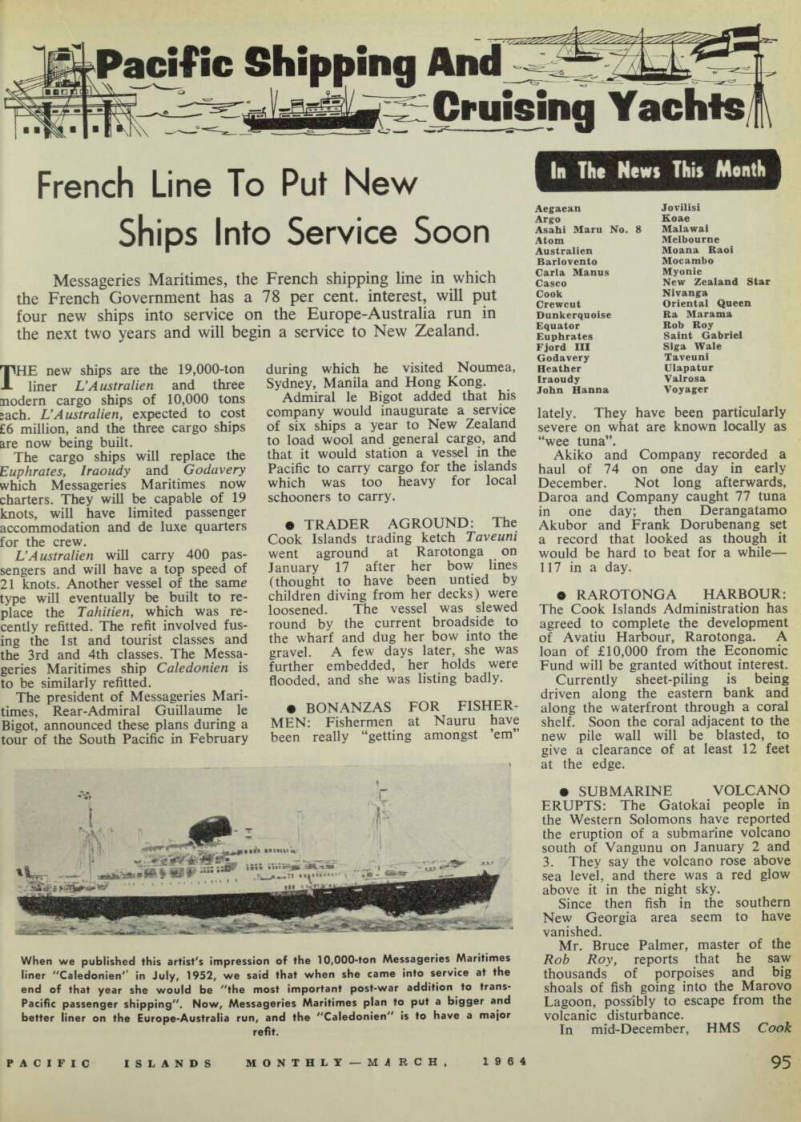
When we published this artist's impression of the 10,000-ton Messageries Maritimes liner "Caledonien'’ in July, 1952, we said that when she came into service at the end of that year she would be "the most important post-war addition to trans pacific passenger shipping". Now, Messageries Maritimes plan to put a bigger and better liner on the Europe-Australia run, and the "Caledonien" is to have a major refit.
iled past the submarine volcano id observed an eruption with a lumn of water rising hundreds of et before falling back into the sea.
About six miles from Munda Bar, e Cook discovered a new submarine ilcano and noted a least depth of I fathoms.
The BSIP’s Chief Geologist, Mr.
C. Grover, says the seismograph the Geological Survey Department owed noticeable variations on the orning of January 2, and that insidering the new volcano near iunda Bar, a recent earth tremor Munda, and the eruption south Vangunu, volcanic activity in the r estern Solomons could be increas g-
• Old Anchor Re
OVERED: An old anchor, which believed to have been used in H 8 to refloat the Burns Philp ship f ocambo, was recovered from the :a at Lord Howe Island in January, he Mocambo was run ashore at ic Malabar end of Ned’s Beach [ter hitting a rock between Soldiers ap and the Admiralty Islets.
The anchor was recovered by a arty organised by Mr. Alan /illiams, and which included Mr. rank Ransome, an expert skin iver.
The party also recovered two ther anchors from the “ship’s nchorage” area. These are believed a have been lost from cargo ships i the past 10 or 12 years.
Mr. Williams proposes to use two f the anchors to make a mooring or a boat he is building. The bird will probably be placed in lylph’s Hole in the lagoon to make safe anchorage for visiting yachts.
• Not Enough Sleep: In
n inquiry in late January into the tranding of the inter-island cutter Aalawai, the Fiji Marine Board ieard a story that is becoming amiliar at its inquiries—that the naster was working long hours vithout sleep.
The master in this case is Luke Vlatemailautoka whose ship hit the eef near Suva Passage about 3.30 i.m. on January 10.
Luke told the board that the SAalawai stranded because he must lave fallen asleep at the helm.
He said the ship had left Maikorokoro, Kadavu, about 7 p.m. an January 9 and about 7.30 p.m. ae was relieved at the helm by one af the crew.
But from that time till 1.30 a.m. an January 10 when he went to relieve the man at the helm, he was on deck. He had no sleep in that
time because they were sailing at night and he did not trust his crew very much.
Detailing his activities in the ship between January 8 and January 10, Luke said that between 10 p.m, on January 8 and the time the Malawai hit the reef at 3.30 a.m. on January 10, he had about two hours’ sleep.
He added that he had no proper sleep between January 2 and January 10.
He had never complained to the owner, Mr. Tim Hurley, about lack 0 f res t. On the other hand, Mr.
Hurley told him several times that he should give himself a rest.
Luke also told the board that he
did not have a look-out man on deck when he resumed duty at 1.30 a m He could see the two leading re d lights at Suva, and did not think he needed a look-out.
Joeli Veileti, the engineer in the Malawai, said the only damage the Malawai suffered when she hit the ree f was to her keel, The board found that the long hours worked by the master and crew had contributed to the stranding of the Malawai and that a formal inquiry was “neither requisite nor expedient”.
In another inquiry—into the
randing of the Government vessel a Marama —the board decided that formal inquiry should be held.
The Ra Marama hit a reef in a assage at Ono-i-Lau on November 5, 1963.
The master, Jovilisi, told the oard that he had twice hit the same ;ef in the same place in the Ra iarama. The first incident was n February 20, 1962, Jovilisi said that on the latest ccasion, he was going through at alf-speed. He considered his ship it the reef because she was meeting 2 mph current and was travelling 30 slowly.
• Suva Berth To Be
iODIFIED: The new Suva ship epair berth, which has been the abject of debate between the Suva 'hamber of Commerce and the jovernment since the berth was n'ished a couple of years ago, will e modified. The main complaint if Chamber of Commerce shipping iterests was that the berth was not [eep enough and could not take ome ships.
Early estimates of the cost of leepening the berth ranged as high is £42,000, a figure which caused he Government, always preaching he need for economy, to shudder.
Now it has been agreed that the acilities can be extended at a cost )f about £3,000. The Public Works Department suggested the extension >f the berth by about 100 ft but hat would have provided only one >erth and would have partially jlocked the entrance to Walu Bay.
Now it has been decided to provide i catwalk joining three existing lolphins which flank the southern ipproach to the slipway. The cat walk will not carry heavy traffic, but will enable electric welders and other ight gear to be placed beside ships.
The provision of a catwalk will allow two ships, each of about 1,000 tons, to be accommodated.
Present estimates are that between 90 and 115 ships use the repair facilities at least once a year, and a lot of them use them twice a year.
• Visit To Matthew
ISLAND: The French Naval vessel Dunkerquoise took Mr. Roland Priam, of the New Hebrides Con dominium Mines Department, and Mr. Andrew Mitchell, of the British Geological Survey in Vila, on a visit to Matthew Island on January 23.
But a heavy swell made it too danger ous for them to land.
Matthew Island is about 150 miles south-east of Aneityum, the southernmost island in the New Hebrides. It is actively volcanic and is rarely visited—the last visitor being the Dankerquoise in July, 1962 (PIM, Sept 1962, p 126).
Mr. Priam, who was aboard the Danker quoise on the last occasion, has reported that the island still looks pretty much the same now as it did then, but that the number of birds nesting on the island has dropped considerably. He added that sulphureous steam was still rising from the crater of the western peak.
E Miniature United
NATONS, The Scripps Oceanographic Institute’s reseach vessel Argo paid a call at Rarotonga in January in the course of a cruise of the South Pacific to study volcanic
action in the area. She carries a crew of 33, plus 14 scientists from the United States, USSR, West Germany, and East Germany, The scientists are collecting rock samples from the various islands and are taking a complicated series ° f heaj measurements which Jill
eventual'yenablethemtodetermme
such things as how long. ago Raro ton«a w f an a , volca "°' The Argo, formerly a US Navy submarine vessel, can cruise tor up to 60 days without putting into port,
—, , Ddattdc Nam
A • G S C HARBOURS DAM AGED: The harbours at Bamki and Betio were seriously damaged in De cember during a 40-knot westerly gale which blew throughout the Gil bert and Ellice Islands Colony for almost seven days, At Betio, high waves broke about
Storm Damage: A
40-knot westerly
gale broke about 30 ft. of concrete near the end of the eastern mole at Betio Harbour, GEIC, in December (see be low) and gave Public Works Department labourers a big re pair job. The gap was patched with drums and stones. — Photo: David Lopian.
) ft of concrete near the end of le eastern mole; and at Bairiki, there as a break on the eastern arm— X)ut 20 ft of concrete being imaged.
Further trouble caused by the wes rly, which began on December 15, as the suspension of the runs of :heduled mail launches between airiki and Betio. These mail unches are the only links between lese two headquarters islets of arawa Atoll, apart from walking on ic reef at low tide.
The two Colony ships RCS ivanga and MV Moana Raoi were impelled to drift off Tarawa on ac >unt of the gale, as surf breaking ;ross the entrance made it impos ble for them to enter the harbour, oth ships were returning from voy »es to the Ellice Islands, and South id Central Gilberts.
The Moana Raoi managed to enter arawa lagoon on the morning oi ecember 20 after sheltering from le gale on the eastern side of [aiana. The Nivanga got in on the : ternoon of the same day, having *ifted off Temaiku.
Many coconut palms were blown iwn at Bairiki and Betio during the orm. One palm tree at Betio fell i the main power lines causing a
temporary power shortage. Another fell on top of a house—no one was inside—and completely crushed it.
At Bairiki, the London Missionary Society church was blown down on the third day of the storm.
• Trading Ship On Reef:
The 300-ton island trader Karu, with about 50 people on board, ran aground on a reef close to shore near the northern tip of Buka Island on January 24.
Early in February it was still un certain whether she could be sal vaged.
The Kara was bound from Rabaul to Bougainville when she struck the reef shortly before daylight.
The passengers were taken ashore for safety while two ships, the Michael and Saposo, sped from Sohano to try to tow the Kara off.
They reached the scene that after noon, but could not shift the stricken ship.
The skipper, Captain B. M. “Jim”
Ritchie, of Rabaul, was later reported as saying that there was no hope of saving the ship.
Kara, owned by G.&M. Shipping Co. Ltd., of Rabaul, was originally an Army supply vessel. She was built during the war.
• Carla Manus Re
FLOATED: The island trading vessel Carla Manus was refloated on Feb ruary 5 from a reef five miles from Rabaul, New Britain.
The ship, valued at £25,000, ran aground on December 20 while try ing to free another vessel from a reef closer inshore. ( PIM , Feb. p. 99.) The Carla Manus, of 78 tons gross, is owned by Mr. Jack Thurston, of Rabaul.
One of the salvagers, Mr. W.
rard, reported that the vessel was dly damaged during the nearly six icks she was aground, and that re irs would be “pretty expensive”.
Early in February, the Carla anus was on a slipway in Rabaul that strong patches could be put er the holes in her hull until she uld be properly repaired.
• High Seas Murder: An
iglish seaman, John Vincent, aged , has been charged in New Zealand th the murder of David Alan >we, chief steward of the Blue Star tie freighter New Zealand Star lile the ship was bound from nama to Suva.
Superintendent W. W. T. Caldwell d Detective Corporal S. Naidu, th of the Fiji Police, travelled th the New Zealand Star when she iled from Suva for Napier at the d of January.
• New Wharf For Daru;
new £BO,OOO wharf being built at am in the Western District of ipua-New Guinea is expected to be mpleted in July. It will be able to ke ships up to 250 ft long. A slip ay to be built next to the wharf will : able to accommodate ships of up 600 tons.
• Keen Boatbuilders: The
tuth Pacific Commission Boat lilding School at Auki, BSIP, has »w completed seven 26-ft ships ice the courses began in July, 1960. ic Islanders who have enrolled for e courses have come from many aces in the Pacific.
Twenty-one out of the first 22 ipils are now working as boat lilders.
The workshop is big enough for ur large cutters to be built at the me time, as well as the power achines and tools needed. It was ;elf built by the first trainees.
The director-instructor of the hool, Mr. C. R. Fisher, is patient
and tireless in his work, and this seems to have brushed off on to the Islanders.
The first jobs to be completed were three fishing boats. The last four were touring launches. One of the touring launches was allocated to the BSIP Department of Agriculture last November.
The training system is based on practical tuition from the very first day so that the trainee immediately feels interested, and day by day can see the result of his labour.
This system was first tested at two small schools in Papua when the late
Sir Hubert Murray was Lieutenant- Governor. Mr. Fisher was in charge of one school and Mr. Swinfield of the other, Mr. Swinfield, who is an Aus tralian naval architect, designed the ships being built at Auki.
The keel of a 52-foot vessel now under construction was laid in October,
• Vila Wharf Raises
POSER: The enlargement of wharf facilities at Vila and possible changes in the orientation of the town if the wharf should be moved from its
resent position were discussed at the Gla Cultural Centre in January allowing lectures on town planning y Professor Kennedy and Mr. Dart, f Auckland University’s department f town and country planning.
Their visit to Vila was arranged y the South Pacific Commission, ibout 60 British, French and New lebridean residents attended their jctures.
In the discussions after the jctures, it was also stated that ratfic on the Vila waterfront was apidly becoming a problem and fould have to be looked into soon, nd that there may be a need for Lich buildings as a town hall and market.
• Famous Schooner Up
OR SALE: The well-known 50ear-old Islands trading schooner 'iare Taporo is up for sale in Auck md.
Her former master for more than 0 years, Captain Andy Thomson, ame out of retirement at his Cook slands plantation to bring the vessel 3 Auckland from Rarotonga.
The Tiare Taporo, of 173 tons, as always been owned by A. B. )onald Ltd., who have replaced her 4th the motor vessel Abatere.
• Big P-Ng Shipbuilding
ONTRACT: The P-NG Admini tration has awarded an £BO,OOO hipbuilding contract to Rabaul’s oboi Shipbuilding Company, which
secured it in competition with Aus tralian tenderers.
This is the first time the Admini stration has let such a substantial contract to a local shipbuilding company.
The contract calls for the building of four general purpose wooden vessels of from 46 to 56 ft in length.
Sydney Naval architect, Mr.
Arthur Swinfield, designed the vessels. They will form part of a five-year shipbuilidng programme to provide replacements for vessels which will eventually become un suitable for use. • NO BUYER YET: Fiji busi nessman Mr. Barry Philp has not yet found a buyer for the Japanese fishing ship Asahi Maru No. 8, which went aground and was abandoned on a reef near Sigatoka in February, 1962. A syndicate headed by Mr. Philp bought the wreck and salvaged it after nine months’ effort.
The Asahi Maru No. 8 was built in Japan in 1961. Of 280 gross tons, she has a 6-cylinder diesel engine which has done less than 6,000 hours. The asking price is £22,500 Fijian currency.
• Work Starts On Apia
HARBOUR: Four American super visors, up to 20 New Zealanders and about 100 Samoans Will be employed for the next two years on the new harbour project at Apia, Western Samoa. The works project manager is Mr. H. C. Washburn, a graduate of the University of Idaho,
who has had experience in the con struction of several big dams.
Material for the project will come from New Zealand, Australia, the United States and possibly Japan.
Preliminary work began in mid- January.
• Visit To Norfolk: The
cruise ship Oriental Queen (which has a duty-free shop operated by K. A. Prentice, of Norfolk Island, on board) arrived at Norfolk on February 2 for a two-day visit. She carried 11 motor vehicles for delivery at the island.
On February 2, 200 of the 400 passengers landed for a tour of the island and four cars were un loaded. However, heavy weather set in later that day and no further cars could be unloaded.
The Oriental Queen left for Auckland at 1 p.m. next day with a number of disappointed passengers.
Yachts
Man Drowned:
Dr. George Lapin, a 42-year-old cruis ing yachtsman and dentist, of Long Beach, California, was drowned while spearfishing on the reef off Korotoga,
Fiji, on January 27. Dr. Lapin arrived in Fiji on December 5 in his yacht Fjord 111.
On the night of the yacht’s arrival in Fiji waters, she went aground on Narai Reef. Dr. Lapin and his three crew members were rescued by the Royal Navy survey ship HMS Cook, which also helped to refloat Fjord 111. ( PIM, January, p. 109).
The three members of Dr. Lapin’s crew left for New Zealand in December. Dr. Lapin remained while his yacht was repaired.
On the day he was drowned, Dr.
Lapin was spearfishing with two others about a mile from the new Reef Lodge. He and his companions had reached a deep gully, known as Ousey’s Gully, on the edge of the reef which local people say is one of the most dangerous stretches of the Korotoga Reef area.
Dr. Lapin was caught in a vicious tidal rip and swept into a corner.
His companions tried to reach him, but the current was too strong.
After his companions raised the alarm, Fijian villagers and police spent 16 hours searching for his body, which was finally found in 65 ft of water, not far from where he had disappeared.
FROM NEW ZEALAND: Yvonne Dahl, 20, and Dennis Lobb, 21, hit the headlines in New Guinea newspapers in January when they reached Rabaul from New Zealand in the 23 ft. cutter "Crewcut". They were then planning to return to NZ via the Solomons and possibly the New Hebrides and New Caledonia. But shortly after wards "Crewcut" was put up for sale at £l,800 or the nearest offer.