Suwarrow's Crusoe
pp. 85-87 · Read in the full issue

Goes Back To Civilisation
rom W. H. Percival, in Rarotonga New Zealander Tom Neale is ack again on Rarotonga after pending more than three years i almost total isolation on emote and uninhabited uwarrow atoll. He has made o plans to return there. 4S Tom, now aged 61, walked down the gangplank of MV 'odmer on January 19 he looked fit nd well. His few personal belongings icluded some poultry, and a 12 ft ailing boat.
Lonely and beautiful Suwarrow has ascinated Tom Neale from the day e first visited the atoll in mid-1945. le was then engineer on A. B. )onald Ltd.’s schooner Tiare Taporo.
A World War I veteran, Tom had een seaman, planter, storekeeper nd beachcomber, with most of his working life spent in French Oceania nd the Cook Islands when he re olved that he would return to Su warrow to live in self-sufficient soli ade as soon as possible. His chance id not come for seven years.
In October, 1952, he landed at Su warrow with 50 lb of flour, a 70 lb ack of sugar, 40 lb of ship’s biscuits nd a small quantity of tea, coffee nd baking powder, some fishing ear, tools and cats. This was to be is home.
He built a garden and killed off he wild pigs that threatened to de troy it. His cats severely reduced he large population of small native ats. He lived in a three-roomed wooden house which had been built firing the war, and was plentifully upplied with water from three large anks.
"Happy Exile"
Fish, crayfish and coconuts were •art of his regular diet.
Tom led a happy exile’s life of 21 nonths until July, 1954, when he de eded to return to Rarotonga again to ee what was happening elsewhere.
But in 1956, he was back at Su warrow, this time on behalf of the 3ook Islands’ Administration. He ook a census of the Manihiki pearl hell divers who had begun to work iuwarrow’s vast lagoon and pre-
vented them from cutting down trees and burning off the land. He found that thousands of noddies, terns and frigate birds had made Suwarrow their home, and the atoll had been proclaimed a bird sanctuary.
Tom would have liked to stay on alone for a couple of years after the divers left, but he felt he was in sufficiently equipped for such a ven ture, and he returned to Rarotonga to build up his resources.
He did that over the next few years and in November, 1960, he stepped ashore on Anchorage Island, Su warrow’s largest motu. This time he brought with him a 12 ft sailing boat he had built himself at Rarotonga, as well as all the essentials for survival on an atoll—matches, bush-knives, paraffin for his hurricane lamp, a fish spear, and soap.
Once again he set himself up in the three-roomed house, built an open air bathroom, a run for his 30 chickens, and planted another garden.
He Becomes Famous This was to be the beginning of another long stretch of solitude. But a month later, on December 10, his peaceful existence was disturbed by a helicopter from the American Naval vessel, Glacier, an icebreaker bound for the Antarctic. The aircraft had landed to inspect “uninhabited” Su warrow.
A much-garbled report of the American meeting with “hermit” Tom Neale appeared in New Zealand and Australian newspapers, and as a re sult in April, 1961, Tom had another visitor—Noel Barber, a correspon dent for London’s Daily Mail. Barber had specially chartered a schooner at Pago Pago to interview “The Crusoe of Suwarrow”. The story he wrote was syndicated around the world.
Noel Barber arrived with plentiful
supplies and Tom enjoyed a glass of beer and his first cigarette since De cember. Barber gave him fresh bread, butter, a 4 lb joint of beef, tobacco, books and six bottles of whisky. Tom is not a heavy drinker but thereafter he enjoyed a nip of whisky after turn ing in at night.
Tom showed his guest over his house, which contained his “office”, his bedroom, and a neat little kitchen.
He showed him the cookhouse he had built outside, his poultry, and his garden which produced bananas, kumara, breadfruit, papaw, tomatoes and Indian spinach.
Tom says he was utterly happy on his island.
His only fear was of hurricanes, or of breaking a limb and not getting medical attention for it.
When the weather looked bad, he carefully buried his tools so he could retrieve them after the storm, for without tools, he would be lost. But no hurricanes hit the atoll, and he always avoided personal risks.
Never Lonely
He says he never felt lonely. There was always enough to keep him busy —jobs like feeding the fowls, caring for his cats, fishing, gardening, keep ing the bush cut back from his house.
The only time he felt “a little moody” was when he ran out of to bacco and had to live for months without a smoke.
After Barber’s visit, Tom’s subse quent visitors were few, although he often sighted yachts which passed Suwarrow bound from Rarotonga to Tonga, or New Zealand to Tahiti.
They seldom stopped. In fact, no ships called for 14 months after Noel Barber’s visit. Then a Cook Islands’ trading schooner called en-route from Pukapuka to Rarotonga to check on
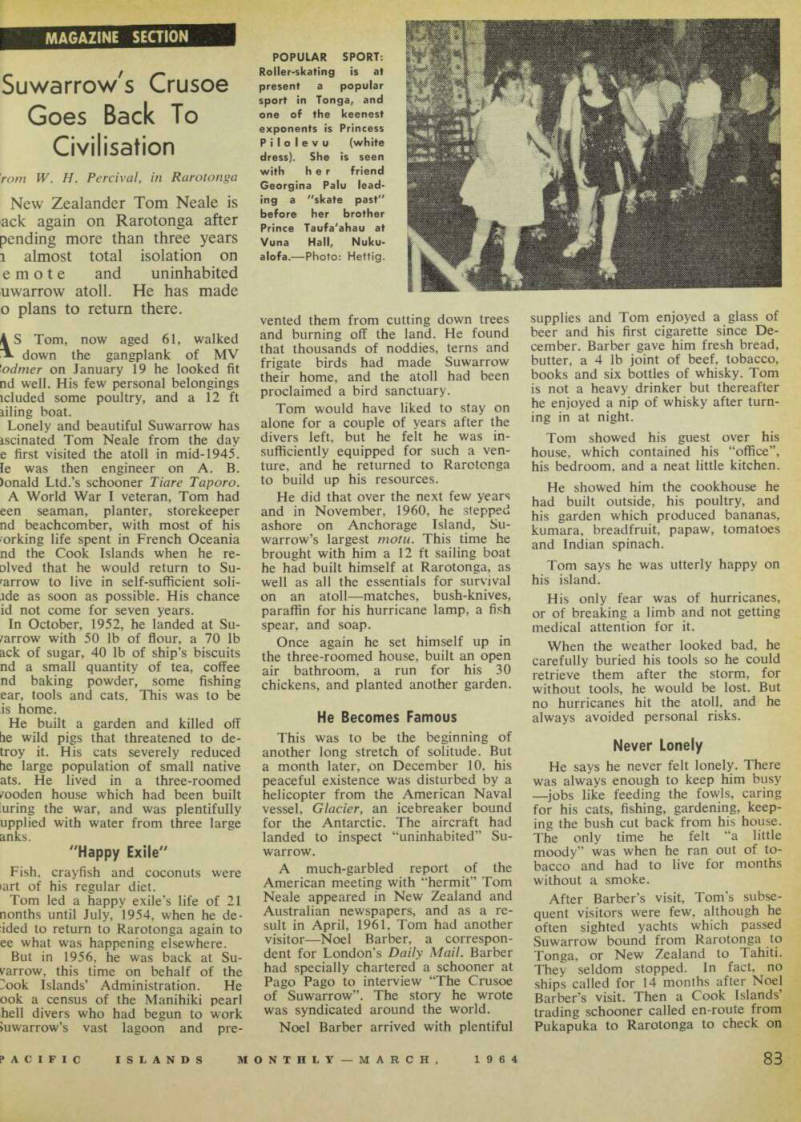
Popular Sport:
Roller-skating is at present a popular sport in Tonga, and one of the keenest exponents is Princess Piloevu (white dress). She is seen with her friend Georgina Palu lead ing a "skate past" before her brother Prince Taufa'ahau at Vuna Hall, Nuku alofa.—Photo: Hettig.
a rumour that Tom Neale was dead.
Tom was very much alive and still happy.
On October 11, 1962, the yacht Yasme 111, with “ham” radio skipper Danny Weil and his wife on board, called at Suwarrow.
They had brought Tom some stores, books and seeds, although somebody had forgotten to put his mail on board.
Weil’s yacht was equipped with three radio transmitters and five re ceivers so Tom Neale was able to make contact with his friends in Rarotonga over the air.
Misadventure Tom had now been at Suwarrow for almost two years on this stay and had experienced only one mis adventure. He was fishing in the lagoon in his boat when a sudden squall capsized him in about 100 feet of water.
He could have swum to the distant reef, but had no intention of aban doning his boat. After a long, ex hausting struggle, he righted the boat, then discovered he had lost his bailer.
He bailed out with his hands and finally made Anchorage Island after being all the morning in the sea.
Early in 1963, the 99 ft American yacht West Wind called at Suwarrow and her crew spent three days with Tom.
By this time, Tom was beginning to realise that he was getting a little old for his exile’s life, so he regret fully decided he would return to Rarotonga when Suwarrow was again visited by pearl shell divers from Manihiki later in the year.
In May, 1963, the American yacht Tiburon anchored in the lagoon, with Mr, E. Vessey, the owner, his Samoan wife, and their 14-year-old adopted daughter.
They were bound from Pago Pago to Honolulu, but some days after their arrival at Suwarrow the yacht was wrecked in the lagoon when the wind shifted suddenly.
The Vesseys stayed with Tom for 20 days, then HMNZS Pukaki, visit ing the northern Cooks, called in and took them off.
Just before Christmas, the local trading vessel MV Bodmer uplifted about five tons of pearl shell from Suwarrow and returned the divers to Manihiki. Tom was aboard when she arrived back in Rarotonga in January.
Now he faces the problems of find ing somewhere to live and re-adjust ing himself to the ways of modern civilisation.