Yesterday
p. 80 · Read in the full issue
On February 21, 1944, simultaneously with a Japanese admission that the American Fleet had struck a devastating blow at Truk, in the Carolines, it was announced in Tokyo that the Japanese Army and Navy chiefs-oj-staff had been relieved of their jobs. General Hideki To jo, the Japanese Premier, took over the top Army post himself.
OTHER news items in PIM of 20 years ago included the following: On March 2 American troops made a surprise landing on the Admiralty Islands, 240 miles north of Madang. This, PIM said, had tightened the Allied blockade of the remaining Japanese bases in the South-west Pacific, and had also relieved the Allied supply-line from the constant threat of a flank attack. * * * The appointment was an nounced of the Hon. Mata’afa as a third Fautua (Samoan adviser to the New Zealand Government).
The two other Fautua, Tamasese and Malietoa, had held office for some years. * * * The death occurred on Feb ruary 21, 1944, of Mr. O. F.
“Fred” Nelson, leader of the Mau (Samoan National Movement).
In recognition of gallant and distinguished service in the South west Pacific, Major David Trench, who served in Fiji and Tonga before going to the Solomons, had been awarded the Military Cross. (The recipient of the award is now Sir David Trench, Governor-designate of Hong Kong and British High Commissioner for the Western Pacific). * * In Fiji, an Indian wholesale storekeeper, P. J. Patel, was sentenced to six months’ imprison ment and fined £4OO on a charge of having sold textile piecegoods at excessive prices, the excess profit being £7B. * * * Two anthropologists from Sydney University, Miss Camilla Wedgwood and Dr. lan Hogbin, were appointed to the Australian Army Directorate of Research with the rank of Lieutenant- Colonel to gather material in New Guinea on which the Australian Government intended to base its native educational policy. * * * An article signed with the initials W. M. E. spoke glowingly of the hospitality that a New Zealand Army garrison had received on Norfolk Island. To an island depleted by evacuees to Australia, the garrison had brought new life, the writer said. ❖ % In January and February, Tahiti had been in the throes of its longest, uninterrupted storm since the famous downpour of 1889 when Papeete became a veritable Venice. “During more than a fortnight”, PlM’s corres pondent reported, “our roadways have been rivers, our rivers torrents and the countryside a quaking bog”.
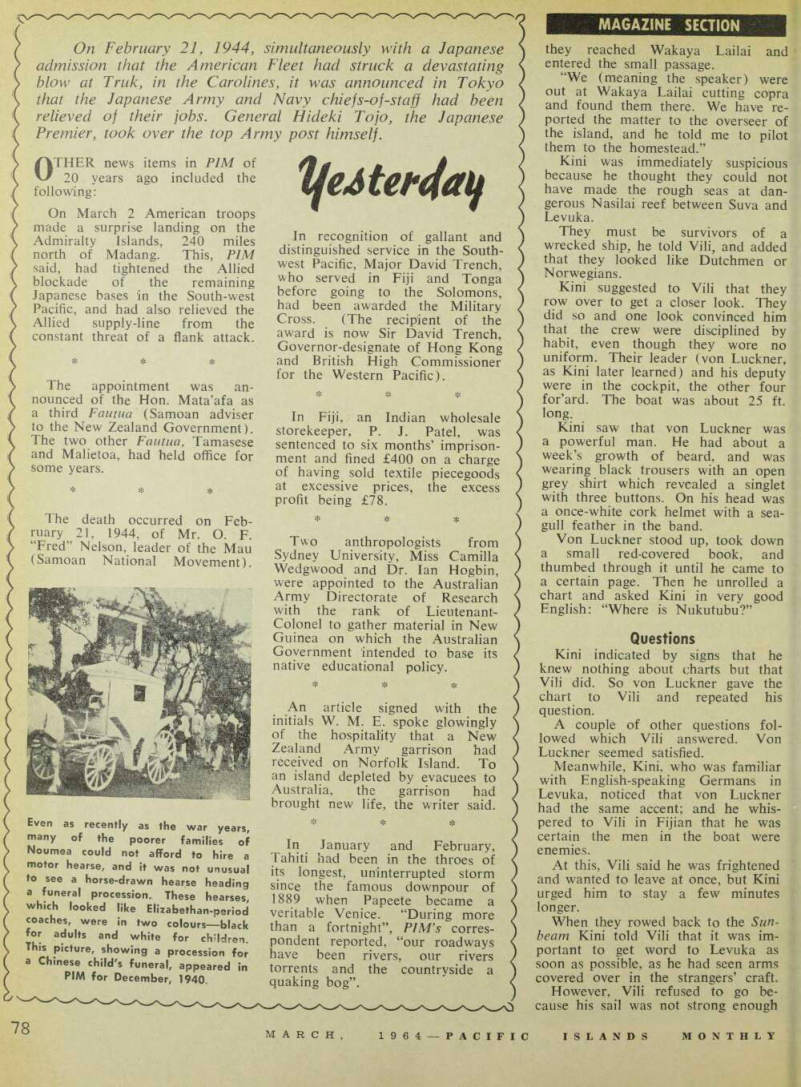
Even as recently as the war years, many of the poorer families of Noumea could not afford to hire a motor hearse, and it was not Unusual to see a horse-drawn hearse heading a funeral procession. These hearses, which looked like Elizabethan-period coaches, were in two colours—black for adults and white for children.
This picture, showing a procession for a Chinese child's funeral, appeared in PIM for December, 1940.