Magazine Section
pp. 79-83 · Read in the full issue
Pacific Islands Monthly
[?]Kini Mcpherson Was Not
The Brilliant Type,
But He Was Too Smart
For Count Von Luckner
By J. McFadyen, in Suva.
Captain Kini McPherson was not the brilliant type when t comes to science or mathematics, but as a seaman he was second to none.
F|NE glance at the sky, and he could tell you what the wind vas going to do; a glance at the :olour of the sea in the passages and agoons, and he could tell you the ictual depth.
Rain he could foretell with ac :uracy by the feel of the atmosphere
and humidity; while he never forgot the names of discharged crew.
I first met Kini in 1920 at Levuka, the old Fiji capital. He was shaking with laughter at the time, and tears were coursing down his cheeks from half-closed eyes. Even so his eyes struck me as the most “remembering” eyes I had ever seen.
This opinion was confirmed when we met again 12 years later, for he not only remembered my name, but he recalled the clothes I had been wearing, the name of the person who had introduced us and the circum stances of that first meeting.
For many years after that, Kini and I were shipmates—l being the engineer in the schooner he skip pered. Those years were enriched with tales of his younger days, which I often made notes of—questioning him later when I wanted to verify any particular point.
Master of Cutter Like all adventurers, he had a special favourite among his adven tures, and although he would never admit it, I gathered that it was his battle of wits with Count von Luckner in 1917.
Kini was then 28 years old and was master of the cutter Sunbeam owned by Henry Palmer, of Levuka.
The cutter ran to all parts of Fiji delivering cargoes and bringing copra
and other tropical goods to Levuka for shipment overseas.
When Kini’s adventures with von Luckner began, Kini was at Wakaya Island with Vili, a boyhood friend, who was skipper of a small boat called Dakuiviti, which was anchored nearby.
There was a strong wind and the seas were running high, and Kini and Vili were waiting to see if con ditions would improve before they decided whether to go on to the Lau Islands.
They had just finished a plate of bully beef and rice on board the Sun beam when they were surprised to see a small boat with montague rig enter Batimadari Passage and make for the anchorage near the shore. There were six white men and a Fijian on board, Vili knew the Fijian and called out to ask where the strangers had come from.
The pilot replied: “They are from Suva where their steamer is dis charging cargo. They went out sail ing, but the wind became too strong.
So they sailed before the wind, not knowing how to turn back, until
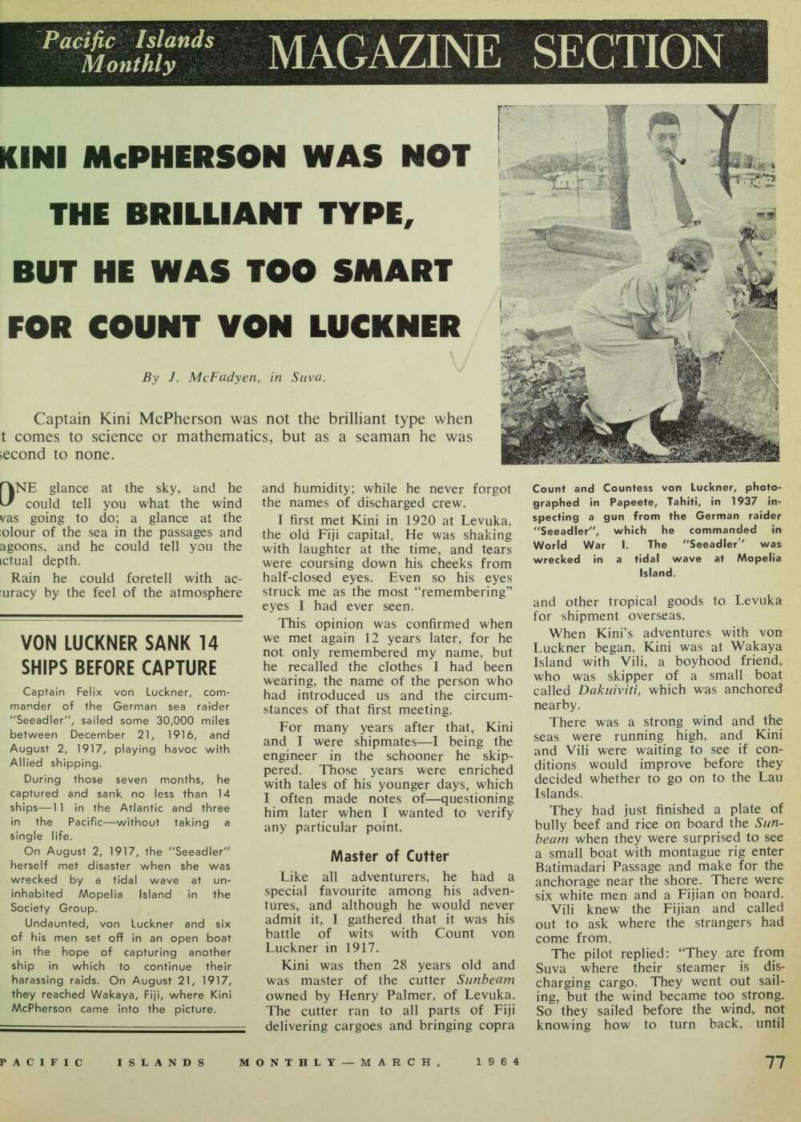
Count and Countess von Luckner, photo graphed in Papeete, Tahiti, in 1937 in specting a gun from the German raider "Seeadler", which he commanded in World War I. The "Seeadler" was wrecked in a tidal wave at Mopelia Island.
they reached Wakaya Lailai and entered the small passage.
“We (meaning the speaker) were out at Wakaya Lailai cutting copra and found them there. We have re ported the matter to the overseer of the island, and he told me to pilot them to the homestead.”
Kini was immediately suspicious because he thought they could not have made the rough seas at dan gerous Nasilai reef between Suva and Levuka.
They must be survivors of a wrecked ship, he told Vili, and added that they looked like Dutchmen or Norwegians.
Kini suggested to Vili that they row over to get a closer look. They did so and one look convinced him that the crew were disciplined by habit, even though they wore no uniform. Their leader (von Luckner, as Kini later learned) and his deputy were in the cockpit, the other four for’ard. The boat was about 25 ft. long.
Kini saw that von Luckner was a powerful man. He had about a week’s growth of beard, and was wearing black trousers with an open grey shirt which revealed a singlet with three buttons. On his head was a once-white cork helmet with a sea gull feather in the band.
Von Luckner stood up, took down a small red-covered book, and thumbed through it until he came to a certain page. Then he unrolled a chart and asked Kini in very good English; “Where is Nukutubu?”
Questions Kini indicated by signs that he knew nothing about charts but that Vili did. So von Luckner gave the chart to Vili and repeated his question.
A couple of other questions fol lowed which Vili answered. Von Luckner seemed satisfied.
Meanwhile, Kini, who was familiar with English-speaking Germans in Levuka, noticed that von Luckner had the same accent; and he whis pered to Vili in Fijian that he was certain the men in the boat were enemies.
At this, Vili said he was frightened and wanted to leave at once, but Kini urged him to stay a few minutes longer.
When they rowed back to the Sun beam Kini told Vili that it was im portant to get word to Levuka as soon as possible, as he had seen arms covered over in the strangers’ craft.
However, Vili refused to go be cause his sail was not strong enough
o withstand the strong wind and leas then running.
“All right, Vili, you give me an sxtra hand and I will go,” Kini said.
Vili gave him a boy named Charlie o help his crew of three.
Meanwhile, Piufau Roberts, the Rotuman overseer of the Wakaya island plantation, and several Fijian vorkers had taken out the estate )unt to ferry von Luckner and his nen ashore.
Noticing this, Kini pulled over in lis dinghy to tell Roberts of his ntention to sail to Levuka.
“A cava e sa lomomu e na ka iqo?” Kini shouted as one of the Fijians carried von Luckner from the mnt to the beach. “What’s on your nind regarding this affair?”
Von Luckner pricked up his ears, md Kini continued (in Fijian): “1 im going to Naova (a native name : or Ovalau) but you tell him (von Luckner) that I am sailing for the Lau Islands.”
Roberts promised to do this, and Kini returned to the Sunbeam to pre iare for the run.
He left just after midday, sailing nto rough seas and strong winds and leading towards the Wakaya light louse to make von Luckner believe le was trying to sail to Lau.
After sailing three or four miles, le headed for Levuka. It was then 12.50 p.m.
Rough Trip
It was a rough trip, requiring ?ood seamanship with the tiller on Kini’s part to prevent the Sunbeam from turning over or breaking her mast.
The cutter berthed at Levuka wharf at 2.05 p.m. which means that the Sunbeam made at least 13 to 14 knots on that famous day as the dis tance from Wakaya to Levuka is 17 to 18 miles.
In his excitement to get the news ashore to his boss, Mr. Palmer, Kini forgot to put his shoes on.
Mr. Palmer, however, was not in his office. So Kini went to Alf McGowan, the local sailmaker, who advised him to telephone the island’s
owner, an old German trader in Levuka!
Another resident. Captain Kadd, told him to go to the police station.
This Kini was in the act of doing when he met the Harbour Master, Captain Robbie, who told him he should report his news to the Customs.
By this time Kini was getting rather tired of the whole business, but he hurried back to the Customs near the wharf.
Levuka Startled Mr. March, the Customs chief, listened to Kini’s tale and told him to wait while he thought the matter out. Meanwhile, a large crowd had gathered, as enlarged versions of Kini’s story had startled Levuka out of its wits.
Presently, a policeman came to Kini, puffing, and asked: “Are you the man who came from Wakaya?”
When Kini replied “yes” he was told that Inspector Hill wanted to see him at once at Totoga police station.
After Kini had told the inspector his story, the inspector rang Suva to “find out if those men are telling the truth”.
This telephone call revealed that no ships had been in Suva for several days.
Inspector Hill also checked on the whereabouts of the steamer Amra, and was told she would be in Levuka the following night.
It was then arranged that Kini should return to Wakaya next day and that Inspector Hill would follow with an armed force in the Amra the morning after.
Blotted Out On Kini’s return to Wakaya, a rain cloud blotted the Sunbeam from sight from the shore, so that von Luckner, if he had been looking out, could never have suspected that the cutter had not come from the direc tion of Lau.
At 5 p.m. that day, the ketch Gleana-A, also owned by Mr.
Palmer, put into the Wakaya anchorage. Kini and his cook rowed
over to her to warn the captain, a Rotuman called Fred Gideon, that the Germans might try to take the ship.
Gideon, in turn, told Kini that he had sighted the Amra making for Levuka by the deep water way, and he added: “I hope to God she arrives in time to save us from these Germans”.
About two hours later, Kini watched von Luckner come out to the Gleana-A in the Dakuiviti dinghy.
Kini kept out of sight as von Luckner spoke to Gideon from the dinghy, eventually asking him to tow his (von Luckner’s) boat to Levuka next day. Gideon, afraid to refuse, agreed.
After von Luckner had gone, Kini told Gideon that he should delay his sailing time as much as possible to allow the Amra time to arrive.
Not Much Sleep “Reef all your sails, have the engineer stall his engines, slow down the hoisting of your anchor, do every thing that will delay your tow,” Kini said.
No one had much sleep that night, and next morning Kini was up early to see what von Luckner was up to.
The Germans were already moving about, and presently one of the crew hoisted the anchor of their launch while von Luckner turned the vessel towards the Gleana-A.
At that moment, almost as if it had been rehearsed, the Amra ap peared from behind Batimadri Point steaming at full speed for the main passage.
Von Luckner could not see her for the moment, but Kini could, and he got into his dinghy and rowed to wards her.
On the way, he passed a boat con
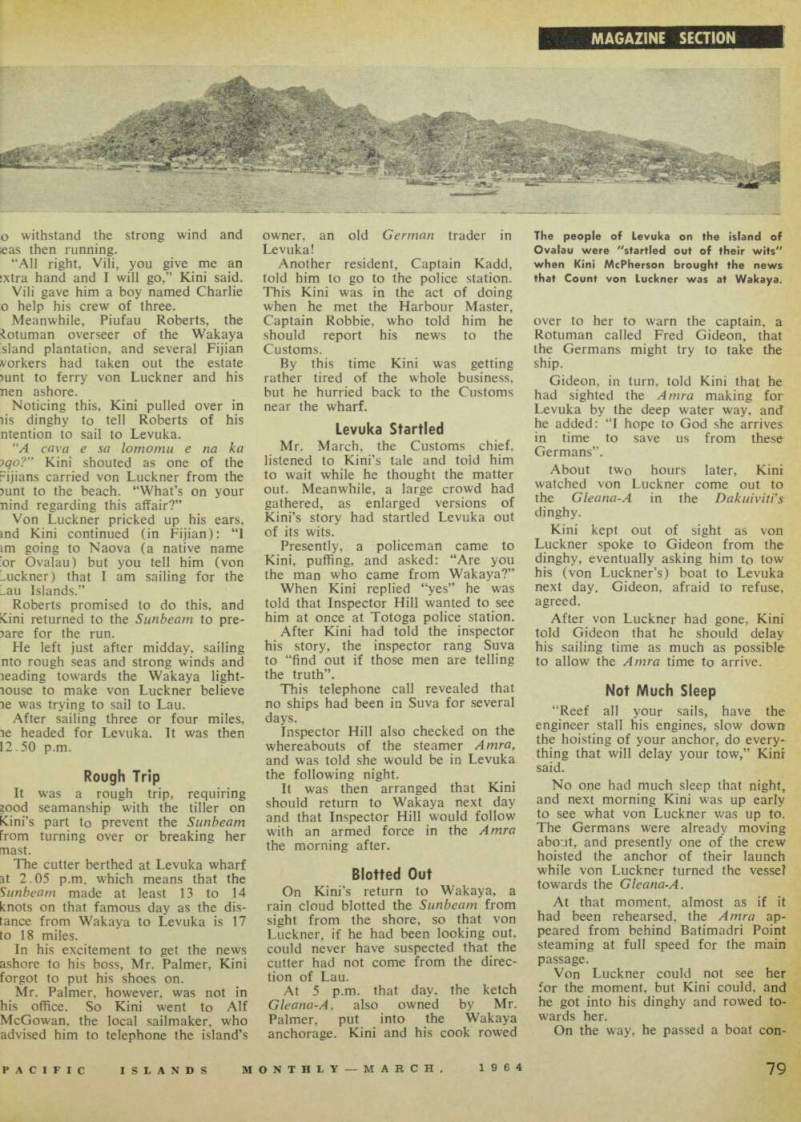
The people of Levuka on the island of Ovalau were "startled out of their wits" when Kini McPherson brought the news that Count von Luckner was at Wakaya.
aining Inspector Hill and several jolicemen. They were rowing juickly towards the Gleana-A.
When Kini told the inspector that he Germans were going to be towed jy the Gleana-A , the inspector called >ut: “I have a better boat to tow hem in.”
Some time afterwards, Kini, with Vlr. C. Ensore, a Taveuni planter, md the captain of the Amra watched :rom the Amra’s bridge as von Luckner and his men were trans ferred, without a struggle, into the lolice craft.
Later, after von Luckner, with >reat surprise, had heard Kini reply n English to Inspector Hill’s con gratulations for his part in the German’s capture, he (von Luckner) isked permission to speak to Kini.
Leaning over the Amra’s rail, he laid admiringly: “You’re a fine ellow, but very lucky.” Kini had qual admiration, when he heard the ull story, for the unlucky von Luckner.
Rewarded Over in Levuka, Kini was hailed i hero, and meetings were held at vhich his deed was often told. When le returned there himself, he was landed a cheque in the town hall is a token of appreciation from the Levuka people.
Three years later, he was given £2l/10/- for his part in the capture if the famous sea raider.
When von Luckner came to the Pacific just before World War 11, fCini prepared to greet him with fine mats, a tabua (whale’s teeth), and ither gifts. But their paths never :rossed again as von Luckner did not visit Fiji on his trip.
Kini eventually died in the native ward at Suva Hospital among the Fijians he loved and sailed with.
Throughout his life his copper brown complexion had always tricked strangers, but he had white blood in his veins.