[?]Et Airport At
p. 69 · Read in the full issue
[?]Arotonca May Be
[?]Eal's Answer
The French Government’s decision last December to cancel TEAL’s traffic rights in Tahiti :ould result in the airport at
Rarotonga being extended to
ake international traffic and in he island being developed as a ourist centre.
NEW ZEALAND’S new Minister for Island Territories, Mr. J.
R. Hanan, and six other NZ parlia nentarians will investigate these natters when they visit the Cook Islands in March.
However, Mr. Hanan made it dear in Auckland in January that he New Zealand Government would lot push tourism on the Cook [slanders if they did not want it.
“I haven’t it officially from any one in the Cook Islands that they vant tourism,” Mr. Hanan said. ‘I do know that they are extending he airstrip at Rarotonga, but to get rig planes in you’d have to seal the drip and we wouldn’t want to do that unless tourists were going to use it.
“Tourists could, in turn, bring other secondary industries to the Cooks. We are not sure, however, that they want this.”
Vital Staging Point An international airport at Raro tonga would provide TEAL with the vital staging point it needs in the eastern Pacific to enable it to go ahead with plans to open a southern route to North America.
It would also make TEAL independent of the whims of the French Government over Tahiti traffic rights, and would obviate the necessity of renegotiating such rights.
Furthemore, an international air port at Rarotonga could boost the almost non-existent tourist industry in the Cook Islands. This could provide that Group, which is poor in natural resources, with a major source of income.
The existing airstrip at Rarotonga, which is unsealed, is now being extended from 5,000 to 6,000 ft. To make it suitable for the Lockheed Electras which TEAL now has, it would have to be sealed; and to accommodate the DCS jets which TEAL will acquire in 1965, would
require a further sealed extension to 8,000 ft.
The whole job would probably cost between £500,000 and £750,000.
Rarotonga is about 1,700 miles from Auckland—several hundred miles less than the distance to Tahiti, but roughly on the same line. £ „ . , The idea of extending Rarotonga s airport and developing tourism in that island has been part of TEALs thinking for years, but the impasse t u e Fr if nCh , ov .f Tahiti traffic rights has changed it from a vague pipe dream to a matter for urgent consideration.
TEAL’s general manager, Mr. F.
A. Reeves, said in late December that the Coral Route to Tahiti was “an integral part” of TEAL’s South Pacific tourist promotion programme.
But by the end of January he was whistling a quite different tune.
A jet standard runway at Rarotonga, he said then, would be an alternative to returning to Tahiti and it would be important in the
development of package tours in the South Pacific. ‘We want to develop the South Pacific and package tours are the he went on.
Rarotonga, considered a much mor f, beautiful place than Tahiti, would fill a very important role.
The sooner we get package deals we „ established the sooner we can more of that all important over §eas exc h ange ”
FOOTNOTE: If the NZ Govern ment deddes to bring Rarotonga’s airstrip up to jet standard, the Cook j s i a nders are unlikely to oppose the idea. According to the Cook Islands News, the Leader of Government Business, Mr. D. C. Brown, and the Deputy Resident Commissioner, Mr. m. Hegan, told a top NZ official in January that Rarotonga should be considered as “a very worthwhile alternative” if TEAL continued to be denied the use of Tahiti’s airport, The NZ official is Mr. F. H. Corner, Deputy Secretary of the External Af fairs Department.
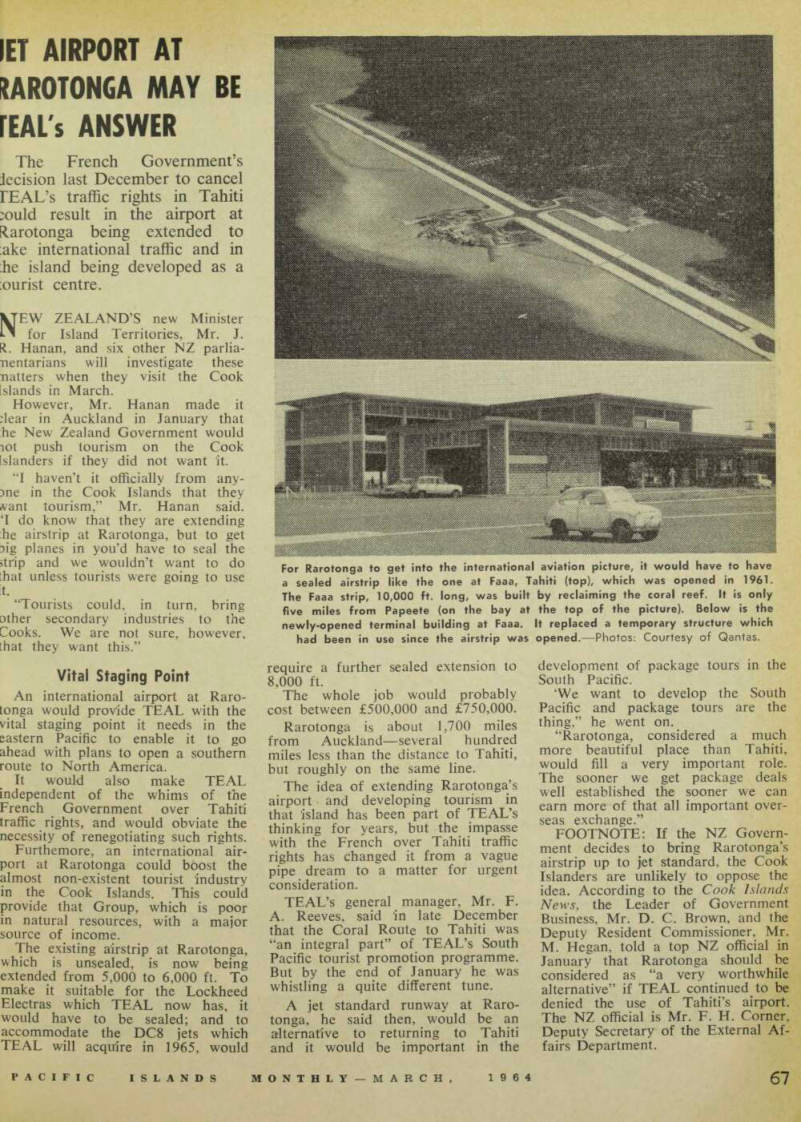
For Rarotonga to get into the international aviation picture, it would have to have a sealed airstrip like the one at Faaa, Tahiti (top), which was opened in 1961.
The Faaa strip, 10,000 ft. long, was built by reclaiming the coral reef. It is only five miles from Papeete (on the bay at the top of the picture). Below is the newly-opened terminal building at Faaa. It replaced a temporary structure which had been in use since the airstrip was opened.— Photos; Courtesy of Qantas.