How "American"
pp. 65-67 · Read in the full issue
Is American Samoa?
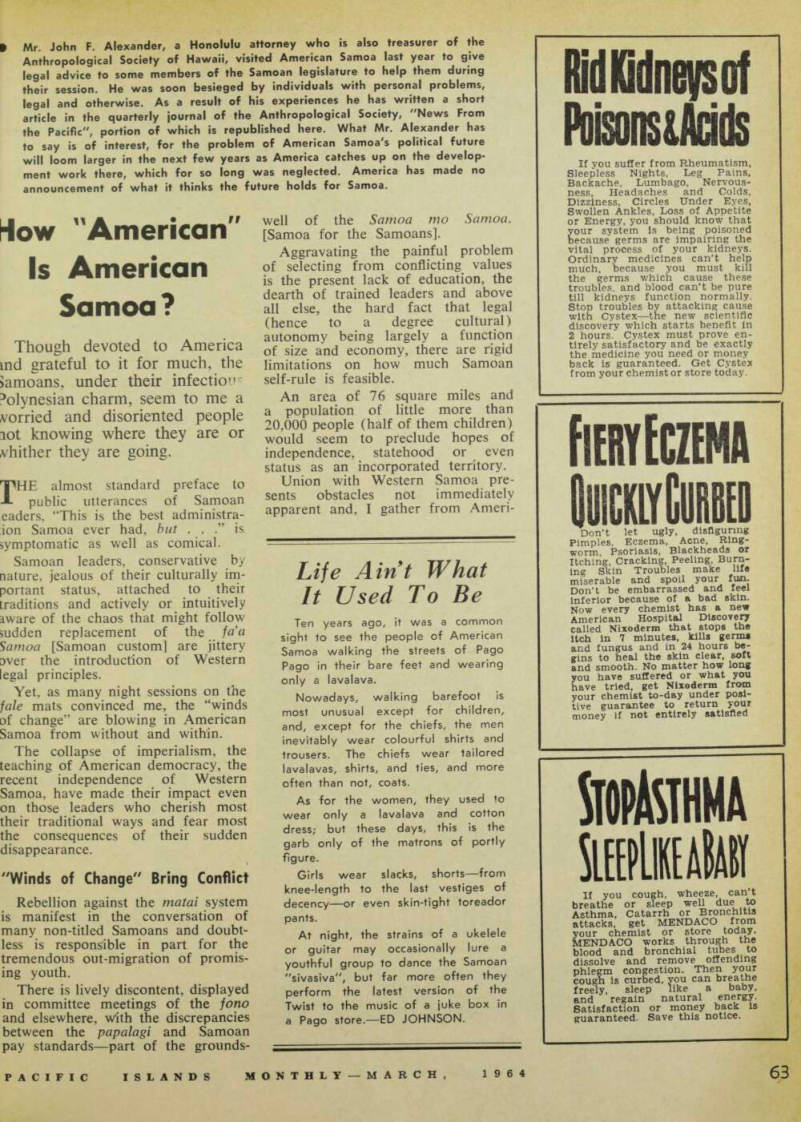
» Mr. John F. Alexander, a Honolulu attorney who is also treasurer of the Anthropological Society of Hawaii, visited American Samoa last year to give legal advice to some members of the Samoan legislature to help them during their session. He was soon besieged by individuals with personal problems, legal and otherwise. As a result of his experiences he has written a short article in the quarterly journal of the Anthropological Society, "News From the Pacific", portion of which is republished here. What Mr. Alexander has to say is of interest, for the problem of American Samoa's political future will loom larger in the next few years as America catches up on the develop ment work there, which for so long was neglected. America has made no announcement of what it thinks the future holds for Samoa.
Though devoted to America ind grateful to it for much, the Jamoans, under their infectious 3 olynesian charm, seem to me a
vorried and disoriented people
lot knowing where they are or
vhither they are going.
THE almost standard preface to public utterances of Samoan eaders, “This is the best administra ;ion Samoa ever had, but . . .” is symptomatic as well as comical.
Samoan leaders, conservative by nature, jealous of their culturally im portant status, attached to their traditions and actively or intuitively aware of the chaos that might follow sudden replacement of the fa’a Samoa [Samoan custom] are jittery over the introduction of Western legal principles.
Yet, as many night sessions on the fale mats convinced me, the “winds of change” are blowing in American Samoa from without and within.
The collapse of imperialism, the teaching of American democracy, the recent independence of Western Samoa, have made their impact even on those leaders who cherish most their traditional ways and fear most the consequences of their sudden disappearance.
"Winds of Change" Bring Conflict Rebellion against the matai system is manifest in the conversation of many non-titled Samoans and doubt less is responsible in part for the tremendous out-migration of promis ing youth.
There is lively discontent, displayed in committee meetings of the fono and elsewhere, With the discrepancies between the papalagi and Samoan pay standards—part of the grounds
well of the Samoa mo Samoa. [Samoa for the Samoans].
Aggravating the painful problem of selecting from conflicting values is the present lack of education, the dearth of trained leaders and above all else, the hard fact that legal (hence to a degree cultural) autonomy being largely a function of size and economy, there are rigid limitations on how much Samoan self-rule is feasible.
An area of 76 square miles and a population of little more than 20,000 people (half of them children) would seem to preclude hopes of independence, statehood or even status as an incorporated territory.
Union with Western Samoa pre sents obstacles not immediately apparent and, I gather from Ameri
a and Western Samoans, may not desired by either.
Further compounding their Acuities is the Samoans’ distance miles and importance from the litres of American legislative, ministrative and judicial activity. £ and distance have put Samoa, i a vis its American overlords, in position which could be called ehind God’s back”.
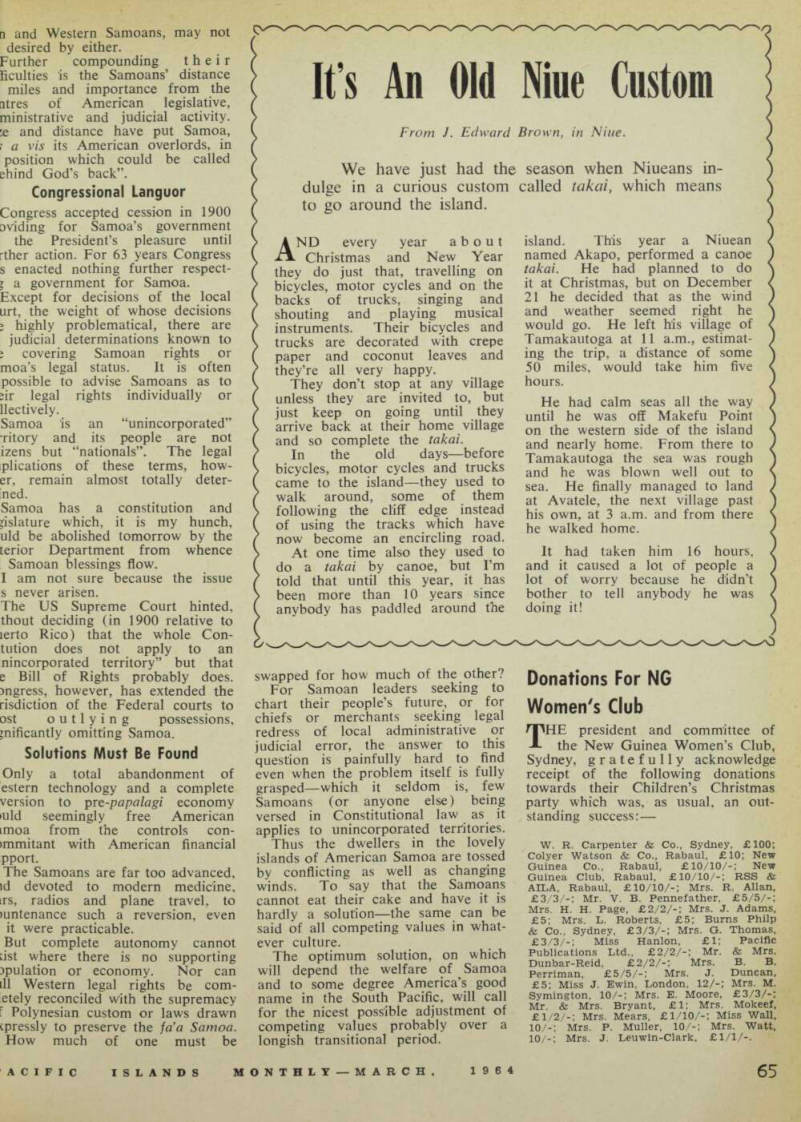
Congressional Languor
Congress accepted cession in 1900 oviding for Samoa’s government the President’s pleasure until rther action. For 63 years Congress s enacted nothing further respect l a government for Samoa.
Except for decisions of the local urt, the weight of whose decisions j highly problematical, there are judicial determinations known to ; covering Samoan rights or moa’s legal status. It is often possible to advise Samoans as to ;ir legal rights individually or llectively.
Samoa is an “unincorporated” ritory and its people are not izens but “nationals”. The legal plications of these terms, bow er, remain almost totally deter bed.
Samoa has a constitution and pslature which, it is my hunch, uld be abolished tomorrow by the terior Department from whence Samoan blessings flow.
I am not sure because the issue s never arisen.
The US Supreme Court hinted, thout deciding (in 1900 relative to ierto Rico) that the whole Con tution does not apply to an nincorporated territory” but that e Bill of Rights probably does, mgress, however, has extended the risdiction of the Federal courts to ost outlying possessions, piificantly omitting Samoa.
Solutions Must Be Found Only a total abandonment of estern technology and a complete version to pre-papalagi economy ►uld seemingly free American imoa from the controls con unmitant with American financial pport.
The Samoans are far too advanced, id devoted to modern medicine, irs, radios and plane travel, to mntenance such a reversion, even it were practicable.
But complete autonomy cannot dst where there is no supporting or economy. Nor can ill Western legal rights be com etely reconciled with the supremacy f Polynesian custom or laws drawn cpressly to preserve the fa’a Samoa.
How much of one must be
swapped for how much of the other?
For Samoan leaders seeking to chart their people’s future, or for chiefs or merchants seeking legal redress of local administrative or judicial error, the answer to this question is painfully hard to find even when the problem itself is fully grasped—which it seldom is, few Samoans (or anyone else) being versed in Constitutional law as it applies to unincorporated territories.
Thus the dwellers in the lovely islands of American Samoa are tossed Uy mnflirtina as well as changing by conflicting as wen as cnangmg winds. To say that the Samoans cannot eat their cake and have it is fiarrllv a solution the same Can be nardiy a solution me same ean uc said of all competing values in wnatever culture.
The optimum solution, on which will depend the welfare of Samoa and to some degree America’s good name in the South Pacific, will call for the nicest possible adjustment of competing values probably over a longish transitional period.
Donations For NG
Women's Club
THE president and committee of the New Guinea Women’s Club,
Sydney, gratefully acknowledge
receipt of the following donations towards their Children’s Christmas party which was, as usual, an out
standing success:—
W. R. Carpenter & Co., Sydney, £100; Colyer Watson & Co., Rabaul, £10; New Guinea Co., Rabaul, £lO/10/-; New Guinea Club, Rabaul, £lO/10/-; RSS & AILA, Rabaul, £lO/10/-; Mrs. R. Allan, £3/3/-; Mr. V. B. Pennefather, £5/5/-; Mrs. H. H. Page, £2/2/-; Mrs. J. Adams, £5; Mrs. L. Roberts, £5; Burns Philp & Co., Sydney, £3/3/-; Mrs. G. Thomas, £3/3/-; Miss Hanlon, £1; Pacific Publications Ltd., £2/2/-; Mr. & Mrs.
Dunbar-Reid, £2/2/-; Mrs. B. B.
Perriman, £5/5/-; Mrs. J. Duncan. £5; Miss J. Ewin, London, 12/-; Mrs. M.
Symington, 10/-; Mrs. E. Moore, £3/3/-; Mr. & Mrs. Bryant, £1; Mrs. Mokeef, £l/2/-; Mrs. Mears, £l/10/-; Miss Wall, 10/-: Mrs. P. Muller, 10/-: Mrs. Watt. 10/-; Mrs. J. Leuwin-Clark, £l/1/-.