Territories TALK-TALK
pp. 53-57 · Read in the full issue
With Tolala
If Territorial official statistics are correct (and there is no reason to assume otherwise for, unlike their commercial counter parts, official statisticians have no “promotional incentive to be other than honest ”) the P-NG Territory does not show the in crease in livestock which one would expect in such a vaunted progressive agricultural country.
recently at some X figures concerning rural in iistries in P-NG as at June 30, ?63, I was prompted to look up an Id report to the League of Nations >r the 1938-39 period from the NG (excluding Papua, of course), he comparative figures are rather iteresting:
Not forgetting, of course, that uring the War II years most live tock on plantations was destroyed.
Another interesting item in those tatistics was on copra production: otal exported from TNG was 3,345 tons; from P-NG in 1963 it 'as 72,499 tons. But if you go by alues that is another matter. TNG eceived only £727,949 for its xported copra, but P-NG raked in a 00l £4,718,000. Nearly four million
quid more for a decrease of 846 tons!
Where Are They?
Some years ago a friend in Sydney gave me some good advice.
He said; “Keep off the back page of The Sydney Morning Herald and the front page of Truth and you’ll be jake”.
Each week-day morning I first turn to the obituaries on the back page (and, unfortunately, as time goes on there are more old Territorians’ names), then I consult “Granny” (who is not Column 8 now but Column 10).
Another section which I always peruse is the “Personal and Missing Friends”, stuck away deep down amongst the numerous ads. I am not expecting to read of a firm of solicitors seeking my own where abouts to tell me I have come into an amount of money, but they might be looking for a friend of mine.
Anyway, in the 1/2/64 issue there were inquiries for: George W.
Farrow, late of NZ and Madang, to contact D. Coglan of Eudlo,
Queensland, and another seeking Helen Mary Madigan, who resided in P-NG for a while in 1958-59, to contact the Public Curator, Port Moresby.
Over to you, George and Helen.
An Old Programme Reports in New Guinea news papers over the past few months indicate that amateur theatricals and
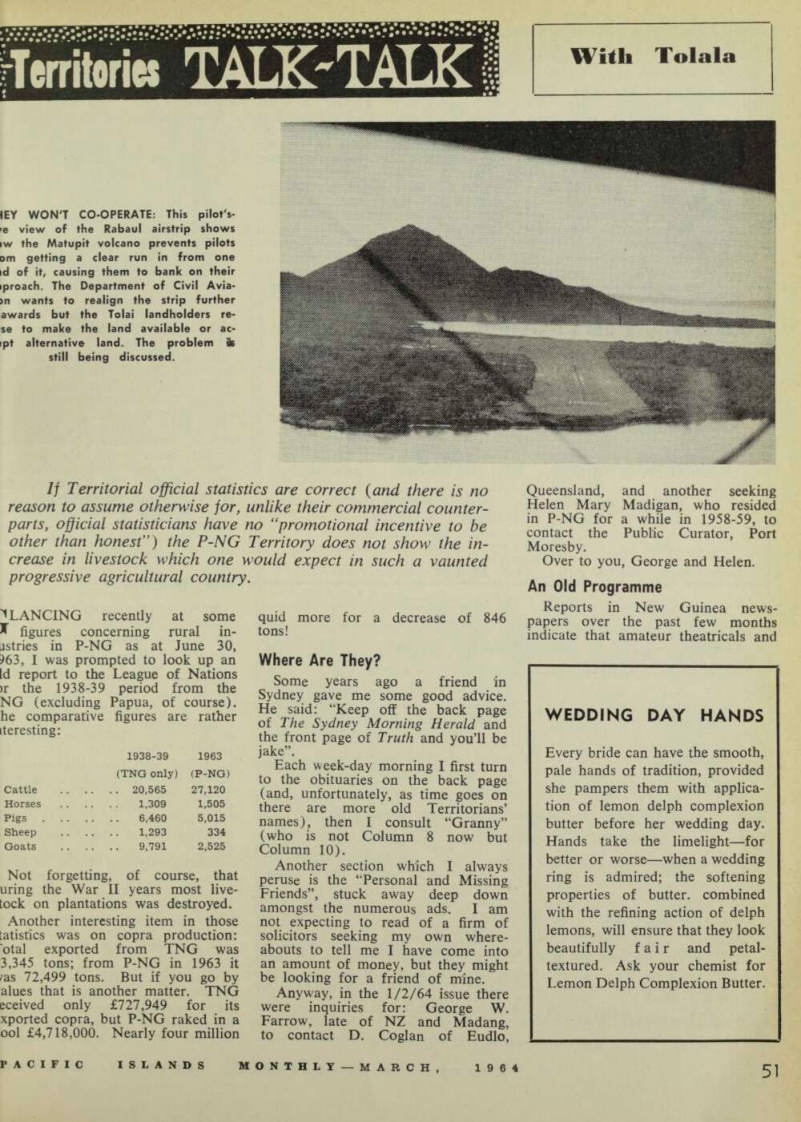
[?]EY WON'T CO-OPERATE: This pilot's [?]e view of the Rabaul airstrip shows [?]w the Matupit volcano prevents pilots [?]om getting a clear run in from one [?]d of it, causing them to bank on their
[?]proach. The Department of Civil Avia
[?]n wants to realign the strip further [?]awards but the Tolai landholders re se to make the land available or ac [?]pt alternative land. The problem is still being discussed.
kj'kjm.,m 1938-39 1963 (TNG only) (P-NG) Cattle 20,565 27,120 Horses 1,309 1,505 Pigs 6,460 5,015 Sheep 1,293 334 Goats 9,791 2,525
concert parties are as active as in the old pre-War II days—if not more so.
There is always some deserving cause which benefits from their activities and, fortunately there are always some talented (and near talented) folk prepared to demon strate their histrionic abilities or vocal or instrumental aptitudes, apart from their charitable desires to be a Do-Gooder for someone receiving a nasty jolt in life’s arena, or some organisation which is scraping the bottom of the bucket for equipment or overhead expenses.
In the early thirties, before the
days of Rotary, Apex or the Lions, Rabaul had a natural-born Do- Gooder organiser, one Freddie Schmahl, who was a translator in the Lands Department. He formed an organisation known as the TONGAS (Territory of New Guinea Aid Society) and to Freddie and his co-workers much credit is due for the assistance given lame dogs over stiles.
Concerts were staged, playlets pro duced and some really excellent shows presented to an appreciative audience, usually in the Regent picture theatre. The two enthusiastic and gifted producers at this time
were Pat Savage, Superintendent ol Government Stores, and Major Ayris, drill instructor of the Native Police, who later went to the gold i fields. Both have since gone tc their rest.
I have before me a programme ol the Rabaul Dramatic and Musicaj Society for a benefit performance for Miss M. von Ziegler, held in the Regent Theatre on November 8, 1938, and “under the Patronage of His Honour Major H. H, Page; DSO, MC, Acting Administrator and Mrs. Page”.
Miss von Ziegler, whose aristocratic German family had suffered some kind of financial loss; joined the NDL shipping line in 1903 and was engaged as stewardess on the steamer Prinz Waldemar which plied between Sydney and Kobe, via Rabaul.
In 1913 she left the sea and was appointed housekeeper of the Euro pean school at Namanula. (Yes. there was a European school there over 50 years ago).
In 1916 (during the Australian military occupation), the school having been closed, she took up land at Valaur and established a poultry farm. The Vulcan eruption in 1937 totally destroyed her house and buildings and, as can be imagined, she was having an uphill battle for an old lady of 76. How ever . . .
ROMS In Action Rabaul’s Do-Gooders got into action and the RDMS put on four playlets and musical sketches, with an opening overture by the orchestra With Mary Backhouse as conductor and pianiste.
The same Mary Backhouse was a tower of strength in the local musical world; she was the wife of Dr. Clive Backhouse, the Gov ernment pathologist and, when evacuated with the other women of!
Rabaul in 1941, became a big wheel in the Sydney Red Cross Library, set-up. She died a few years ago, but hubby was, until 1960, parasitologist at the University otl Sydney.
Other members of the orchestras were: “Jo” (Hannah) Rundnagel and Eric Hopkins, first violins; Sybil Feetum, second violin; Robert!
Cameron, saxophone; Fritz Haslam and Clive Backhouse, guitars; Fritz was also ’cello and Maude Howseir on the drums.
Glancing at the list of artists recalls many old friends.
The plays were produced by “Pat”
Savage; stage manager was “Tony”
Anthony and his assistant was Les
out—both old stalwarts in the nds Department.
Tony was also author of one of ; playlets “Call It A Day”, under ; pen-name of “Dodie Smith”, and j actors were Eva Banks, Bette ;eves, Sidney Tee and Helen ayne.
Another play, “Red Peppers”, by Del Coward, had in its cast Gilbert mton, Joan Woodhill, Albany mton, James (“Pat”) Savage, argaret Byron and Sidney Tee.
This was followed by “Romany lies” and a sketch “Fickle jrtune or the Gypsy’s Warning”, >th consisting of singing, musical ;ms and dancing.
There was a tap dance by Iris :hmidt and her ballet, with Sid. 2e singing “September in the Rain” id, for some reason, that is the le item which has always remained vid in my memory: Sid. Tee vho was a technician in the PHD aboratory) warbling this lively song i very good voice, handsome and ell-groomed and ably supported by
Iris Schmidt, of professional standard and her dancing team of Rabaul’s Bright Young Things, selected for their beauty as well as their terpsichorean ability.
They were: Helen Sweet, Jean Trudinger, Gladys Hamilton, Gwen Cunningham, Doreen Cox, Jean Cunningham, Margot Field and Dorothy Hamilton.
This function was about the last concerted effort made by Rabaul’s artists in the pre-War II period and I prize this old programme for the record it contains of the performers, many of whom have since gone
home, and most of the lasses who formed the Beauty Chorus are now staid matrons with Bright Young Things of their own receiving ballet training.
And so the wheel turns, but the Do-Gooders are always with us.
The Elections An attempt to make any long range prediction as to the outcome of the elections of the House of Assembly at this date (I am writing before February 15 gun is fired) one would require more than a crystal ball or highly-developed
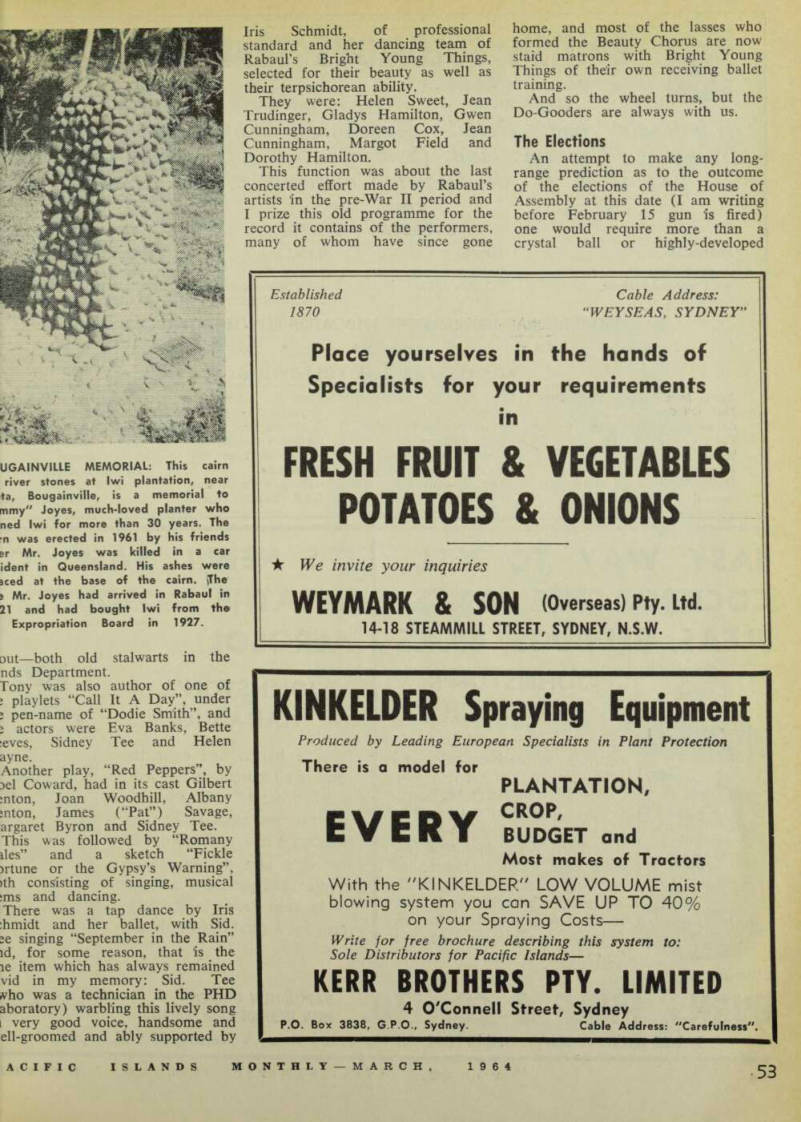
[?]Ugainville Memorial: This Cairn
river stones at Iwi plantation, near [?]ta, Bougainville, is a memorial to [?]mmy" Joyes, much-loved planter who [?]ned Iwi for more than 30 years. The [?]n was erected in 1961 by his friends [?]er Mr. Joyes was killed in a car [?]ident in Queensland. His ashes were [?]ced at the base of the cairn. The [?] Mr. Joyes had arrived in Rabaul in [?]21 and had bought Iwi from the Expropriation Board in 1927.
!xtra Sensory Perception.
But, as one of the last experiments awards self-determination amongst a irimitive people, it has caused world ride interest and many varied ournalistic speculations, especially n Australia.
The elections are unique; insofar is is known there is no strongly irganised political parties, which ndicates the campaign will be a :ase of “dog eat dog”, and a variety >f planks for personal political datforms have been announced by candidates in their policy speeches: idvocacy for hanging, revised dnnk ng laws, self-government, a self iupporting territory and turning riack skins into white resulting in 3henomenal economic changes!
Fantastic? Maybe so; but are :hey so vastly different to some of the gobbledegook we swallow (or are expected to swallow) during Australian hustings?
Those "Forgotten Isles"
It must be a great relief for the native people of Maty, or Wuvulu Island, who have been clamoring for years for an adequate fresh water supply, medical and educational facilities and some sort of com munication with the outside world, at long last for an Assistant Patrol Officer to teach them how to: Build
roads and a footpath around the island; build a copra drier and make copra and how to play “soccer”.
This is according to a NG news paper report.
They have been making copra for half a century and a European owned plantation has been estab lished there for the same period.
How naive can some of these reports be!
Old New Guinea hands talked of old times at Ballina, NSW, recently when Mr. Ted Taylor, former District Officer, had a visit from Mr. and Mrs. Steve Lonergan and Mrs. Alice Dodd.