Cyclone Brings
p. 49 · Read in the full issue
End To Long Drought
Cyclone Berthe brought good
ains to New Caledonia early in February, bringing an end to a
iix-months-long drought. But in
nid-February much more rain vas still needed to restore the sland’s lakes to their normal evels.
UNTIL the rains came, fires had ravaged pasture land in the :ountry districts for weeks and many nountain top forests were on fire.
The island’s west coast, which is generally the driest, was particularly lard hit. More than 3,000 cattle vere estimated to have died on the :attle stations there.
In Noumea, water was restricted svery evening to enable the reservoirs supplying the town to refill, and the brigade was frequently called out to combat grass fires around the town.
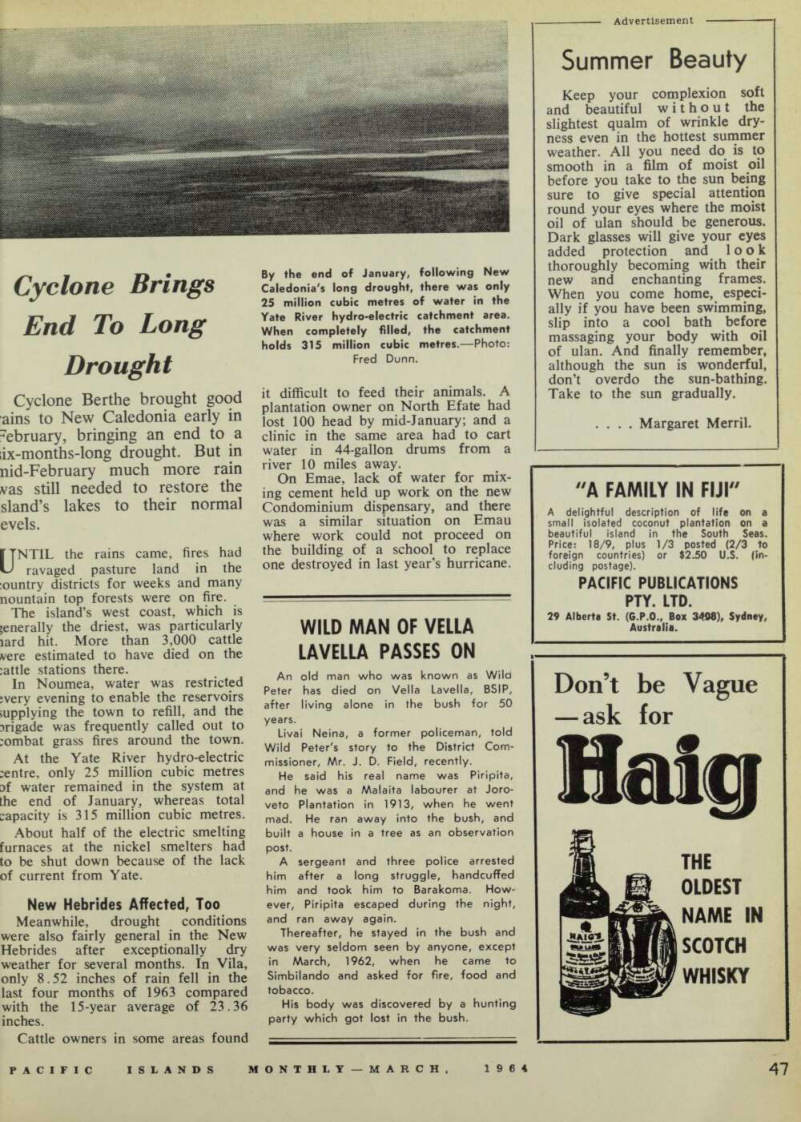
At the Yate River hydro-electric centre, only 25 million cubic metres of water remained in the system at the end of January, whereas total capacity is 315 million cubic metres.
About half of the electric smelting furnaces at the nickel smelters had to be shut down because of the lack of current from Yate.
New Hebrides Affected, Too Meanwhile, drought conditions were also fairly general in the New Hebrides after exceptionally dry weather for several months. In Vila, only 8.52 inches of rain fell in the last four months of 1963 compared with the 15-year average of 23.36 inches.
Cattle owners in some areas found
it difficult to feed their animals. A plantation owner on North Efate had lost 100 head by mid-January; and a clinic in the same area had to cart water in 44-gallon drums from a river 10 miles away.
On Emae, lack of water for mix ing cement held up work on the new Condominium dispensary, and there was a similar situation on Emau where work could not proceed on the building of a school to replace one destroyed in last year’s hurricane.
By the end of January, following New Caledonia's long drought, there was only 25 million cubic metres of water In the Yate River hydro-electric catchment area.
When completely filled, the catchment holds 315 million cubic metres. —Photo: Fred Dunn.