[?]eople: Avoid
p. 45 · Read in the full issue
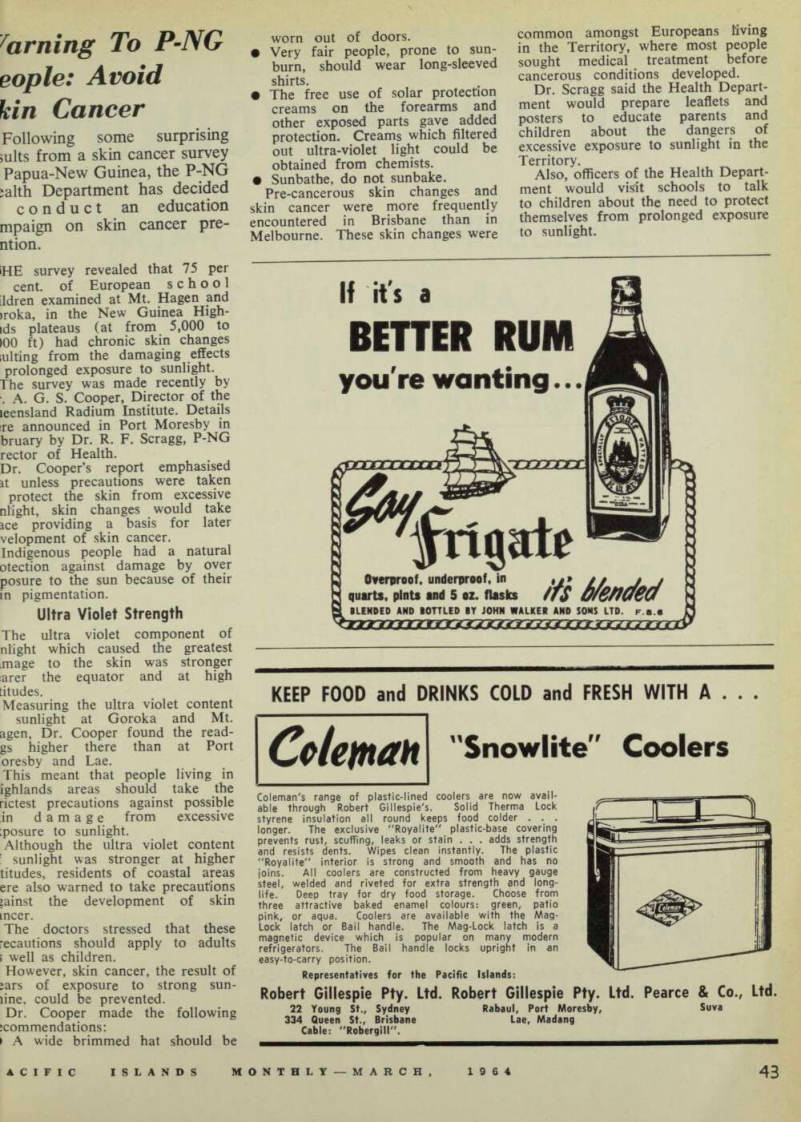
Aanting To P-NG [?]eople: Avoid kin Cancer
Following some surprising
mils from a skin cancer survey Papua-New Guinea, the P-NG
jalth Department has decided
conduct an education mpaign on skin cancer pre ntion.
HE survey revealed that 75 per cent, of European school ildren examined at Mt. Hagen and >roka, in the New Guinea High ids plateaus (at from 5,000 to 100 ft) had chronic skin changes lulting from the damaging effects prolonged exposure to sunlight.
The survey was made recently by . A. G. S. Cooper, Director of the leensland Radium Institute. Details ;re announced in Port Moresby in bruary by Dr. R. F. Scragg, P-NG rector of Health.
Dr. Cooper’s report emphasised it unless precautions were taken protect the skin from excessive nlight, skin changes would take ace providing a basis for later velopment of skin cancer.
Indigenous people had a natural otection against damage by over posure to the sun because of their in pigmentation.
Ultra Violet Strength The ultra violet component of nlight which caused the greatest mage to the skin was stronger arer the equator and at high titudes.
Measuring the ultra violet content sunlight at Goroka and Mt. agen, Dr. Cooper found the read gs higher there than at Port oresby and Lae.
This meant that people living in ighlands areas should take the rictest precautions against possible in damage from excessive :posure to sunlight.
Although the ultra violet content ; sunlight was stronger at higher titudes, residents of coastal areas ere also warned to take precautions jainst the development of skin mcer.
The doctors stressed that these recautions should apply to adults i well as children.
However, skin cancer, the result of ;ars of exposure to strong sun line, could be prevented.
Dr. Cooper made the following ;commendations: ► A wide brimmed hat should be
worn out of doors. • Very fair people, prone to sunburn, should wear long-sleeved s ki r t s • The free use of solar protection creams on the forearms and other exposed parts gave added protection. Creams which filtered out ultra-violet light could be obtained from chemists. • Sunbathe, do not sunbake.
Pre-cancerous skin changes and skin cancer were more frequently encountered in Brisbane than in Melbourne. These skin changes were
common amongst Europeans living in the Territory where most people sought medical treatment before cancerous conditions developed.
Dr. Scragg said the Health Depart ment would prepare leaflets and posters to educate parents and children about the dangers of excessive exposure to sunlight in the Territory „ n .
Also, officers of the Health Depart ment would visit schools to talk to children about the need to protect themselves from prolonged exposure to sunlight.