Picturesque
pp. 39-40 · Read in the full issue
Rotuma To Get Aid
More than 400 miles NNW
of Suva, and rising abruptly out
of the sea which surrounds it for more than 200 miles on all sides, is a tiny group of islands called Rotuma.
Rotuma was in the news in
February when a team of Fiji
Government experts, including an agricultural officer and an engineer, sailed from Suva to formulate an economic develop ment plan for the next five years.
The survey team will work in co-operation with the Rotuma Council. people know that Rotuma, isolated like Pitcairn Island, owes its first recorded European dis covery to events arising from the mutiny of the Bounty. In 1791, Cap tain Edwards in the frigate HMS Pandora, while searching for mutineers of the Bounty, visited the group and named it Grenville Island.
It was subsequently visited by Captain Wilson in the missionary ship Duff and by other British and French navigators.
Polynesian Stock
Basically the Rotumans are of Polynesian stock, but their make-up includes many other strains ranging from Mongoloid to European, the latter derived from escaped convicts from New South Wales, deserting sailors from whalers which called for water and fresh vegetables, and others who frequented the group in the early 1800’s. More than 70 Europeans were reportedly living on the island at this stage, most of them violent men who were killed in fights among themselves or with the Rotumans.
The language is unlike any other speech in that part of the world, but it includes words found in the dialects of other Pacific Islands, and modified vowels characteristic of some European and Asian languages.
Christianity was introduced in 1842 by Tongan Wesleyan teachers and these were followed by Roman
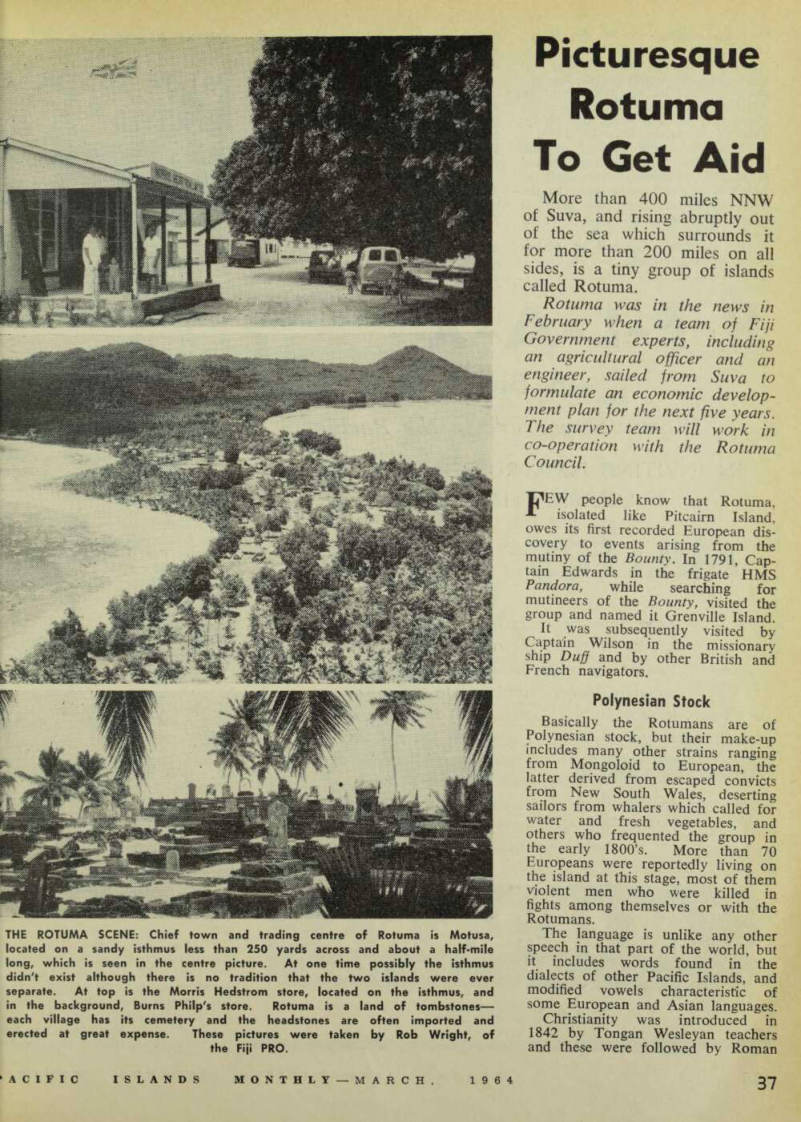
THE ROTUMA SCENE: Chief town and trading centre of Rotuma is Motusa, located on a sandy isthmus less than 250 yards across and about a half-mile long, which is seen in the centre picture. At one time possibly the isthmus didn't exist although there is no tradition that the two islands were ever separate. At top is the Morris Hedstrom store, located on the isthmus, and in the background. Burns Philp's store. Rotuma is a land of tombstones— each village has its cemetery and the headstones are often imported and erected at great expense. These pictures were taken by Rob Wright, of the Fiji PRO.
Catholic missionaries of the Marist Order.
In later years, fierce enmity that grew into wars developed between the adherents of the two churches, and in 1879 the distracted chiefs asked that Britain annex the group.
This was done on May 13, 1881.
The group, with a total popula tion of about 5,200, is now divided into seven districts, over each of which is a chief responsible to the District Officer, who in turn is responsible to the Commissioner Eastern, Fiji.
The Rotuman Council of Chiefs meets once a month.
Rotuma is attractive, picturesque, and fertile, with the climate humid but pleasant.
An excellent road encircles the main island and an unusual feature to be seen on the 18-mile drive is the large number of graveyards with an array of elaborate tomb-stones— Rotumans have an almost Oriental reverence for their dead.
The chief industries are the pro duction of copra, the growing of oranges, and the making of finely plaited mats.
Inter-island vessels from Suva call monthly with passengers and stores and to lift copra.