topicalities
pp. 19-22 · Read in the full issue
An organisation called the New Guinea Biological Foundation, whose principals don’t want to make themselves known yet, has pretty well completed the purchase of Robin McKay’s 5,000-acre Aropa Estate on Bougainville, south of Kieta.
9MEBODY else tells us—and we have every reason to believe him hat the purchase price is in the inity of £180,000! fhat in itself is quite a news item. is not often that Islands plantais change hands for that kind of ney.
But there’s more to the purchase n just big figures. When the New inea Biological Foundation takes ;r around about the beginning of y, it plans to use part of the proty in a project to further the logical study of plants for the lefit of people in the tropics. rhe principals of the foundation non-profit-making show, are not pared to say anything more than ‘t just y«, but we hear from rther source that the biological iject could grow into the biggest lertakmg of its kind in the world. c . burpnse We hear also that the foundation financed by wealthy men from all jr the world, who are interested plant biology, especially research o tropical plant life.
Fhe sale of Aropa came as a sur-
prise to Robin McKay‘s many friends, but the knowledge that he has obtained a very good price for it gave them great pleasure, It means that he is reaping the reward of 17 years of hard work, good planning and looking ahead, The general verdict has been “Good for you Robin—you beaut!”
Robin has been “one of the Bougainville mob” who have become known for working together for the good of the community, and who achieved much success by their doctrine of self-help, and no beg pardons.
They k , hammering at the heads in p ort Moresby for what they con . sidered t 0 be their d and ' voiced their objection to being treated as a Cinderella district, Robin always t 0 the fore as presid ent of the Bougainville branch of the NG Planters’ Association, pre sident of the local Returned Soldiers’
League, member of the District Ad visory Council and a director of The Bougainville Company, which ran the inter-island ships from Rabaul.
In the fight to get Kieta recognised as a place needing an overseas ship
ping depot, with wharf and sheds to go with it, he was very prominent.
Now the dream is being realised and Kieta will be on the map, instead of being considered by Moresby as “an outpost somewhere in the Solomons”.
Bougainville, in fact, produces as much copra as the whole of Papua and is becoming increasingly import ant as a cocoa producer.
Company Formed
Robin went to Bougainville when he acquired Aropa Plantation in mid -1947. Plantation labourers were then hard to obtain, it was almost im possible to get building material or plantation suppli.es, and shipping was scarce.
So “the Bougainville mob” got to gether, formed a company and man aged to get a ship, the Polurrian, from England.
She did remarkable service and brought the district to life after the four devastating years of war.
Robin was a first director of the company.
During his years on Aropa, Robin added to the number of coconut palms planted, and put in many thousands of Brazilian rubber trees on the plantation.
The plantation is the only one in Bougainville now producing and shipping away copra, cocoa and rubber—and everything is handled in a modern and efficient way.
Plantation Assistant All this has been achieved by hard work and attention to the job in hand, assisted, of course, by the fertile soil and well-spread rainfall, for both of which the island is famous.
Robin first went to New Guinea
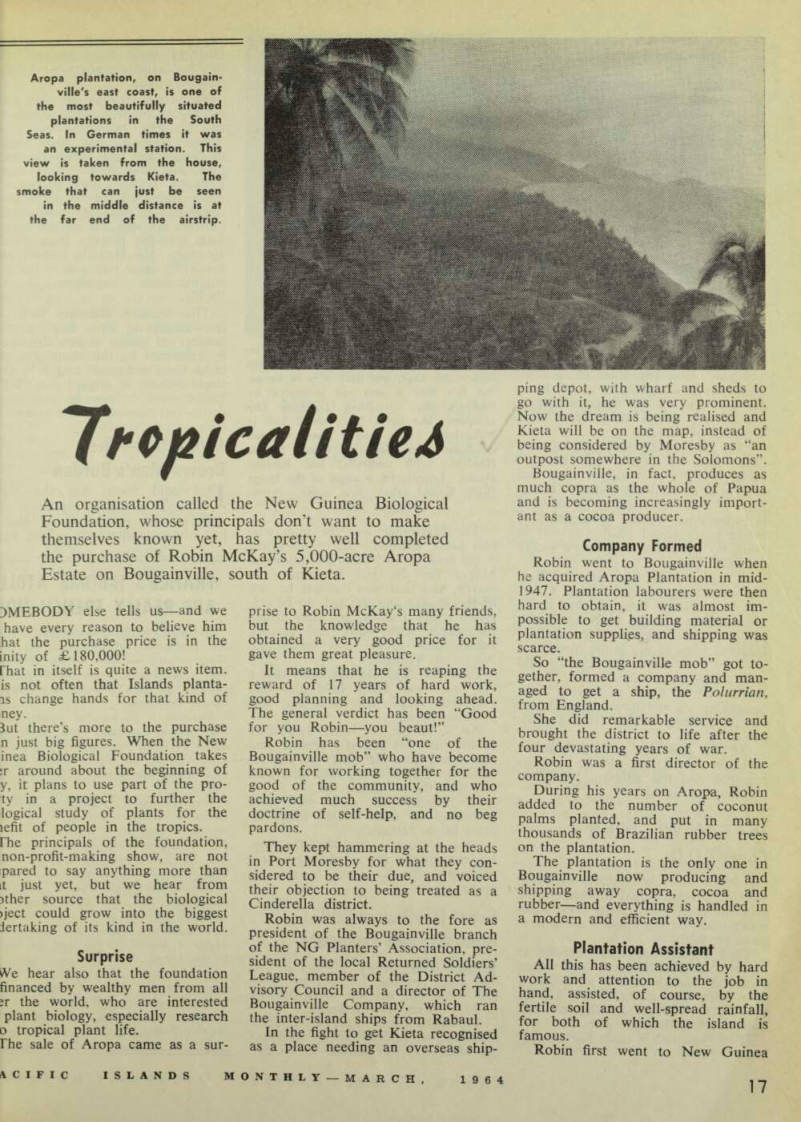
Aropa plantation, on Bougain ville's east coast, is one of the most beautifully situated plantations in the South Seas. In German times it was an experimental station. This view is taken from the house, looking towards Kieta. The smoke that can just be seen in the middle distance is at the far end of the airstrip.
29 years ago —as a plantation assist ant for a Burns Philp-owned planta tion.
He eventually graduated to man ager, and when World War II started he was an early one to enlist in the Second AIF and went overseas to serve in the Middle East. Later in the war, he served in New Guinea with the AIB.
Robin and his wife, Laurie, have always been a popular couple. They shared the trials and worries of the hard post-war rehabilitation years, and always managed to extend hospitality and take part in all social activities, besides lending a helping hand to those who might need it.
They have three growing daughters of school age.
Evolving Country
Robin says he is not leaving the Territory from any sense of financial insecurity in his lifetime, as he thinks the place is on the verge of bigger and better things than have been dreamed of hitherto.
“My reasons for leaving,” he says, “are those of family and the un certainty of my children’s lives and futures in an evolving country. There fore, if 1 am ever going to leave, it is better done while I have plenty of active years ahead [Robin is 46] to build up something in a more secure political clime.
“I have other interests in New Guinea, though, and I intend to re tain and enlarge them so that I will always have a stake in New Guinea and will have plenty of excuse for frequent trips to my home town.
“This is a wonderful country and it has been very kind to me. But I leave with a sense of having built something up and having contributed in a small way to New Guinea’s pro gress.
“It also gives me great satisfaction to know that Aropa will be used for research and the ultimate benefit of the tropical world.”
The Bride Who Didn't
Come C.O.D.
A MAN can’t be blamed for being " a bit upset when his bride-to-be gets snatched away from him, espe cially when he has made a down pay ment on her!
That is what happened recently at Marau on Guadalcanal, and when someone brought news to Honiara that there was going to be trouble over it, a police party went off and came back with eight men. . Th ey appeared in court for disturb ing the peace.
The ringleader was the man who had been “diddled” out of his bride.
He said he had paid his money at Marau for the girl he wanted to marry, and that was the last he saw of the money and the girl. So he col lected a few friends, and they armed themselves with bows and arrows, knives and sticks, and went into Numarere Village.
However, they did not know that a big feast was being held and that everyone from near and far was gathered there.
At the village, the leader rushed up to his lost girl friend’s brother and threatened him. He didn’t get far be cause his friends were soon disarmed and then the police arrived.
In Honiara, the eight men were sentenced to four weeks’ imprison ment in the “cooler”.
This, of course, may cool the ring leader’s ardour for a bride, but he’ll probably still be keen to get his money back.
Great Northwest Will
Blow Its Own Trumpets
T AUTOKA Rotary Club, Fiji, has been looking for persons with the wind up, or for those willing to blow their own trumpet. . Trumpets, and other musical instruments, arrived from overseas the other day—purchased by Rotary
as part of their Fiji Weste Districts’ brass band project, whi has had club members working 1 nearly a year.
With the arrival of the insti ments, 25 in all, retired bandmasi of the Fiji Military Forces, K Alfred Hansard, has been engag to recruit and train volunteer bano men, and now in the near-dorms Lautoka Yacht Club’s premises ( the outskirts of the town the insti ments can be heard on most evenin blowing hot and cold as Mr. Hansa sorts out the players from the h air men. Mr. Hansard helped mou the FMF band into one of the fin« combinations anywhere in t: Pacific.
The Western Districts Band w be welcome in Fiji. Each year t number of public events that wou be enhanced by the attendance of brass band increases, and it is som times difficult to engage the FMF Police bands because of distance, e pense and previous commitments.
Civilisation—The
Brown Man's Burden
IT would seem that the brov man’s domestic authority h; suffered the same fate as that ■ his white counterpart. The nath
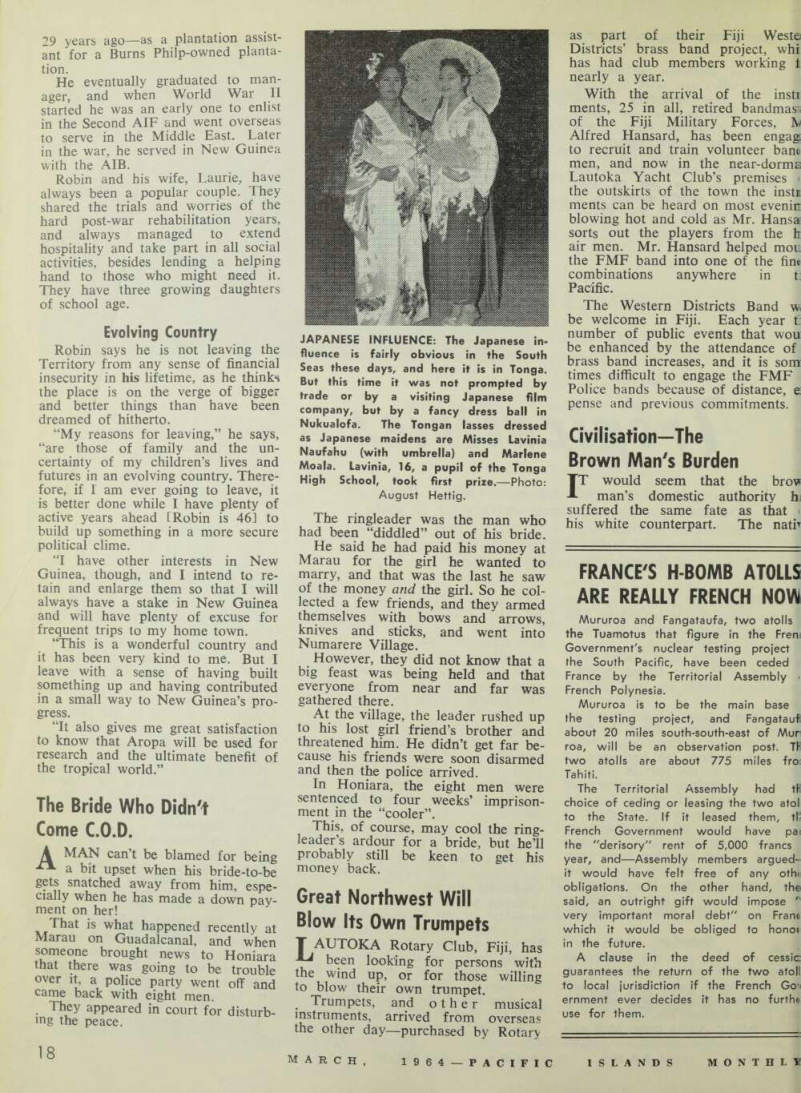
JAPANESE INFLUENCE: The Japanese in fluence is fairly obvious in the South Seas these days, and here it is in Tonga.
But this time it was not prompted by trade or by a visiting Japanese film company, but by a fancy dress ball in Nukualofa. The Tongan lasses dressed as Japanese maidens are Misses Lavinia Naufahu (with umbrella) and Marlene Moala. Lavinia, 16, a pupil of the Tonga High School, took first prize. —Photo: August Hettlg.
ig in the urban areas of Papua v Guinea has been dazzled by the ; tness with which his spouse has rped that authority, zealously fol ing the example of her white sis in claiming her place in society, rone are the days of male su nacy when a good thick ear or Tacked skull was the standard tion to any marital dispute. [e is now learning that his wife rights also, and it is these new id rights which are the basis of ly a domestic quarrel, he urban P-NG native has hed such an advanced stage of dopment as to welcome the news re marriage guidance services now red to him as an aid to reconci on with his rebellious spouse, his guidance stems from solutions forward at a series of three inars on marriage counselling 1 at Lae, Port Moresby and aul in February, in the face of growing number of marriage tkdowns in the Territory, he first of the seminars was led in Port Moresby by the P- Secretary for Law, Mr. W. W. kins, and all three seminars were ided over by the Rev. L.
Phillips, Secretary of the Aus an Marriage Guidance Council, or some time now the Territory’s Id Welfare Council has been urbed by the increasing number narital disputes and breakdowns, icularly in the Territory’s urban is.
re "Agonal" Churches
the South Pacific
IERE seems to be a movement afoot in the South Pacific at ent to build churches with more s than the usual four.
He such odd-sided church, ;agonal in design, was opened Christmas Eve at Forari, the iganese mining centre on Efate, v Hebrides; another, in the shape an octagon, is to be built at to, New Hebrides, he new Forari church, which designed by Mr. Dejouany, of French phosphate company :h exploits the manganese asits, is also unusual in being t for the use of two churches le Marist Mission and the sbyterian Church, he church has two altars, one either side of a corner spire, vel seats take the place of pews, that you can face either altar, he octagonal church for Santo be the first permanent building be erected in that town for the iglican) Melanesian Mission.
The architect is Mr. B. E. King, who studied architecture before being appointed the mission’s representative on the teaching staff of Kawenu Teachers’ College, Vila.
The church is expected to cost only about £2,000 to build. It will have a central altar, above which a four-armed cross will be suspended.
According to the mission’s news broadsheet Melanesian Mission, the need for an extension of Anglican
activities in Santo has grown con tinuously as Santo itself has grown, Melanesian Mission does not say why Mr. King decided to give Santo’s new church eight sides, but we , et . octagons to a B oose berry that it wasn t because “6 modelled If 01 l South Pacifies . Th is old church, the site of which 18 Probably little known, is at Papetoai, on the north coast of Moorea, Tahiti’s sister island. It was opened for public worship in 1829, and, as far as is known, it
has been continually in use ever since.
The church took seven years to build, mainly because of the great labour required to obtain the coral blocks needed for its construction and because its workmen had to learn how to do the necessary wood work as they went along.
The church’s designer was the Rev. George Platt, of the London Missionary Society, which estab lished its Pacific headquarters at Papetoai in 1811. The foundation stone for the church was laid on February 20, 1822.
Platt superintended the church’s construction until h e was transferred to Raiatea in 1824. The work was then carried on under the Rev. william Henry, one of the Duff £ IS i S 7Q7 ane si W u h ° arrived in Tahiti in 1797 and who was then described as a carpenter and joiner The church is 60 ft in diameter P d f S are 20 ft hi 8 h - It has four doors, over each of which is an inscription—two in Latin one ln The hl T l a a t ? and °u Q in En §h s h.
The Latin ones have almost been erased by time, but the others are still plainly legible. Translated the one in Tahitian reads ’ the
“This house was begun in the year of our Lord Jesus Christ, 1822, in the reign of Pomare 111.”
Elsewhere is an inscription in French stating that the church was “rebuilt” “renovated” would apparently have been more correct — by the Protestant parishioners of Papetoai between 1887 and 1891.
Herman Melville, the famous author of Moby Dick, who attended services in the Papetoai church dur ing his stay on Moorea in 1842 as a runaway sailor, described it in Omoo as “one of the best constructed and handsomest chapels in the South Seas”.
He added that although the coral was very nearly white when hewn from the reefs, age eventually darkened it so much that, like others in Polynesia, it had become “almost as sooty and venerable as famed St.
Paul’s”.
One of these days, no doubt, some go-getters will realise the church’s potential as a tourist attraction and will put up a notice saying: “This is the oldest church in the South Pacific”.
Until then, the growing number of tourists who pass that way are unlikely to guess that they are in the presence of a bit of genuine Islands history. (See also p. 131.)
New Guinea's First
Since Errol Flynn
TTOLLYWOOD’S newest star, -I-*- Sean Connery, is the husband of Dianne Cilento, who was born in New Guinea nearly 30 years ago, the daughter of Dr. Cilento (now Sir Ray Cilento), who was then Director of Medical Services. Dianne, a blond beauty of great determina tion, fought her way from nothing to stardom in films, in very recent years. Early in her career, she married an Italian public relations man, but the error was rectified by divorce some three of four years ago, and she too is now in Holly wood.
Connery, a dour and tough Scot, who had served in the Royal Navy, s ornehow got a place »n the chorus of South Pacific when it was put on in London; and thence he battled through to stardom. The couple are highly paid now.
A Place At Last For
Papuan Stenographers
T T ’S an odd thing, but Papuan -V Stenographers such as attractive Miss Lena Dickson, on this month’s cover, are graduates of the recently
established P-NG Administrativ College without ever having set fo* in the place. The girls did 12 month training at the Public Service Ii stitute, Port Moresby, but the ii stitute was incorporated into th Administrative College after til college was founded in November just in time for the girls to becom its first graduates.
The Administrative College cours for stenographers is the first trul integrated training course in th Territory. All races receive the sam training. It’s a new step forwari for the local girls; and in efficient the first batch certainly justified th faith placed in them by Miss Noll Gross, who is in charge.
To the present, native girls hav mostly been employed in light ofiic; duties in the Public Service, but won’t be long now before stenc graphers and secretaries are common place.