March Of The Giant Snails
p. 16 · Read in the full issue
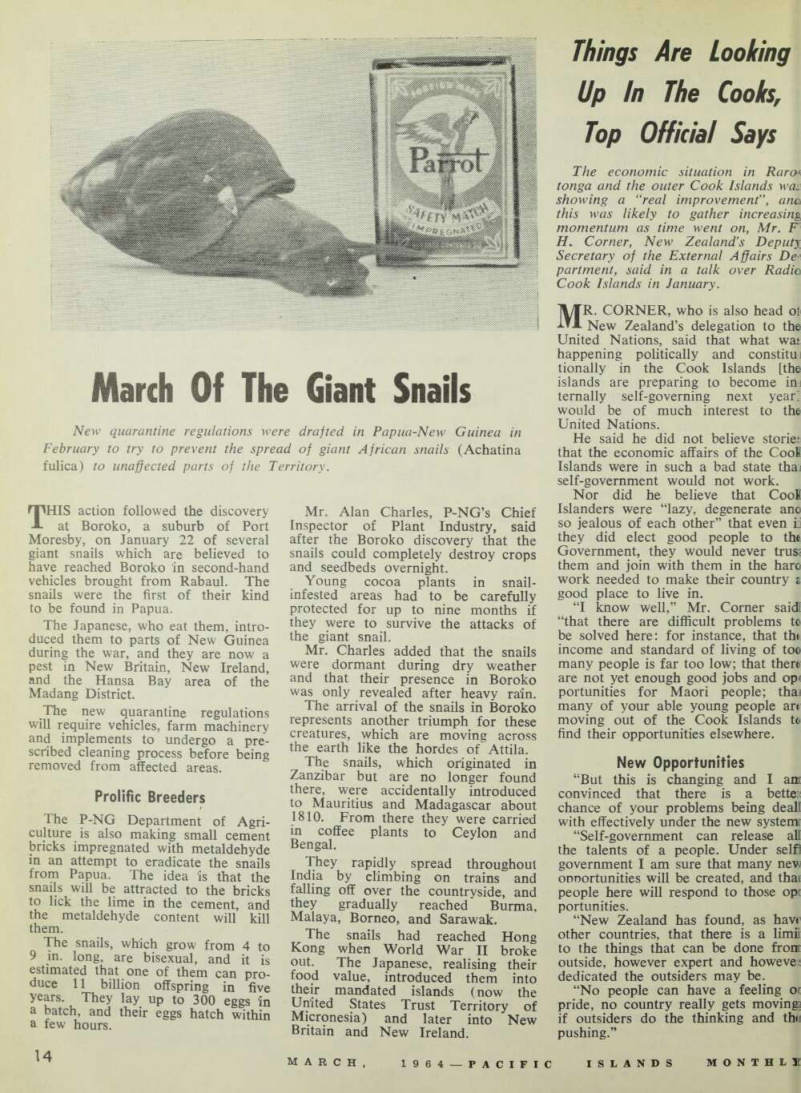
New quarantine regulations were drafted in Papua-New Guinea in February to try to prevent the spread of giant African snails (Achatina fulica) to unaffected parts of the Territory.
THIS action followed the discovery at Boroko, a suburb of Port Moresby, on January 22 of several giant snails which are believed to have reached Boroko in second-hand vehicles brought from Rabaul. The snails were the first of their kind to be found in Papua.
The Japanese, who eat them, intro duced them to parts of New Guinea during the war, and they are now a pest in New Britain, New Ireland, and the Hansa Bay area of the Madang District.
The new quarantine regulations will require vehicles, farm machinery and implements to undergo a pre scribed cleaning process before being removed from affected areas.
Prolific Breeders The P-NG Department of Agri culture is also making small cement bricks impregnated with metaldehyde in an attempt to eradicate the snails from Papua. The idea is that the snails will be attracted to the bricks to lick the lime in the cement, and the metaldehyde content will kill them.
The snails, which grow from 4 to 9 in. long, are bisexual, and it is estimated that one of them can pro duce 11 billion offspring in five years. They lay up to 300 eggs in a batch, and their eggs hatch within a few hours.
Mr. Alan Charles, P-NG’s Chief Inspector of Plant Industry, said after the Boroko discovery that the snails could completely destroy crops and seedbeds overnight.
Young cocoa plants in snail infested areas had to be carefully protected for up to nine months if they were to survive the attacks of the giant snail.
Mr. Charles added that the snails were dormant during dry weather and that their presence in Boroko was only revealed after heavy rain.
The arrival of the snails in Boroko represents another triumph for these creatures, which are moving across the earth like the hordes of Attila.
The snails, which originated in Zanzibar but are no longer found there, were accidentally introduced to Mauritius and Madagascar about 1810. From there they were carried in coffee plants to Ceylon and Bengal.
They rapidly spread throughout India by climbing on trains and falling off over the countryside, and they gradually reached Burma, Malaya, Borneo, and Sarawak.
The snails had reached Hong Kong when World War II broke out. The Japanese, realising their food value, introduced them into their mandated islands (now the United States Trust Territory of Micronesia) and later into New Britain and New Ireland.