Indonesia To Co-Operate
pp. 14-15 · Read in the full issue
Many Problems Ahead Yet, But. . .
On Ng Border Survey
By a Staff Writer
Australia and Indonesia are “no longer in conflict” over the definition of the border between Papua-New Guinea and West New Guinea, according to Australia’s Ambassador to Indonesia, Mr. Keith Shann.
MR. SHANN said this in Djakarta late in February just before leaving for Canberra for three weeks of consultations with the Government.
He said that Indonesia would send a survey team to the border area in the “near future”, and that this team would be accompanied by a liaison officer from Australia’s Embassy in Djakarta.
Meanwhile, Australia would re sume its placing of temporary markers along the Australian side of the border, Mr. Shann added.
The erection of the temporary markers was suspended late last year following two incidents with the Indonesians. In the first one, the Indonesians removed some markers; and in the second, an Indonesian patrol resisted an Australian attempt to restore them.
Australia’s Minister for External Territories, Mr. C. E. Barnes, later announced that an Australian survey of the border would not be resumed until it was known whether Indo nesia would co-operate.
Now that this co-operation is forthcoming, it is assumed that the Austrahan-Indonesian survey of the border will be followed by a treaty between the two countries defining the border’s position.
Two Agreements
At present, there is no single agreement covering this, and the two agreements that do exist leave much to be desired.
The definition of the northern section of the border—from the north coast to the junction of the trust territory and Papuan eXn ari^~K S S6t out in notes ®* c *}f° ged , between the Common in 193 Netherlands Governments a tT^ e tv S °“ the^ SeCtion is defined and tb b f WCen Great Britan 1895 th Netherla nds on May 16, The notes on the northern sec
tion of the border have never been published. (A paper containing the notes was ordered to lie on the tables of both the Australian Senate and House of Representatives on November 12, 1936, but it was not printed).
The notes stated that the 141st meridian was to continue to be the boundary between the two territories.
According to PIM of November, 1936, “the 141st meridian was to be deemed a line running true north and south from the middle of a monument placed as a result of observations made by Dutch and Australian surveyors in September, 1933”.
The Anglo-Dutch treaty of May
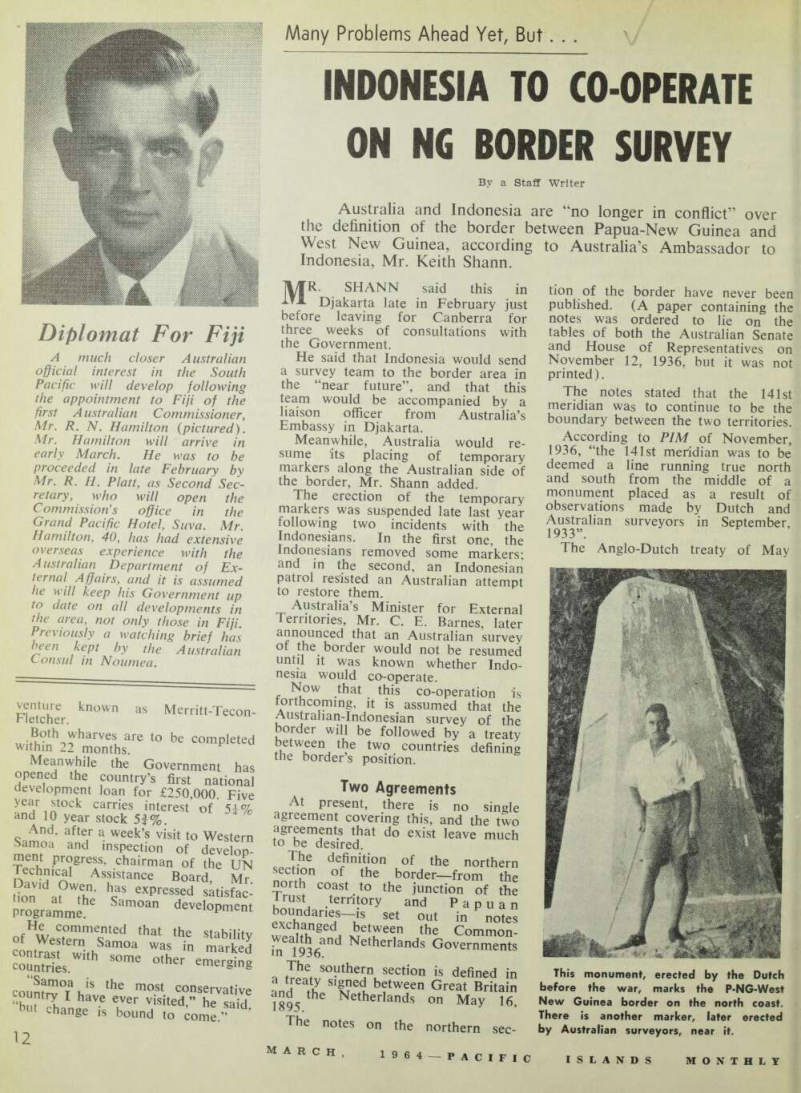
This monument, erected by the Dutch before the war, marks the P-NG-West New Guinea border on the north coast.
There is another marker, later erected by Australian surveyors, near it.
6, 1895, fixing the southern section if the border, consisted of five rticles, two of which, the third and he fifth, were open to varying iterpretations.
The first two articles said that the order began in the south at the fiddle of the Bensbach River, situated at about 141 deg. 1 min. 7.9 sec. of east longitude”, and lat it proceeded north on that leridian until the Fly River was ncountered.
Article 111 said: “From that point, le waterway ( thalweg ) of the Fly iver forms the boundary up to the 41st degree of east longitude”.
Article IV said that from then on le 141st meridian was the border > the intersection of the boundaries f “the British, Netherlands and German positions”.
And Article V said: “Navigation f the Fly River is free for the ibjects of both contracting powers, ccepting as regards the carriage of arlike stores, and no duty shall be nposed on other goods conveyed y that river”.
It will be seen from Article 111 lat the British and Dutch negotia te did not state whether the )ulge” of the Fly was in Dutch or ritish territory, or whether the irder ran down the middle of it.
And Article V was potentially oublesome in that it gave the Dutch eedom to sail through hundreds of lies of British territory, both south id north of the Fly’s bulge, resumably the Indonesians may aim they now have the same right -that they can if they desire ivigate the Fly to the mouth of that ver!
Until they came to look into the jestion of the border recently, lost Australian officials probably Sieved that the whole of the Fly iver was in their territory.
Infiltrators A report from The Hague in ebruary quoted Marcus Kaisiepo, le of the soundest and most telligent of the Papuan “elite” of utch times, who is now in exile Holland, as saying that the Indo jsians were now spreading •opaganda in West New Guinea med at getting the Papuans to ema n d “unity” with P-NG. ifiltrators were to spread the word i the P-NG side.
In Port Moresby, the Administra ir, Sir Donald Cleland, said he lew nothing of infiltrators. Dr. erbert Feith, a lecturer at Monash hiversity, Melbourne, who had just 'sited West New Guinea, said he ould “be surprised” if there was any uth in Kaisiepo’s claim.