Election Extravaganza
pp. 11-131 · Read in the full issue
A Month Of Variety In New Guinea's Big Election Extravaganza
From Judy Tudor, in New Guinea Although some areas of Papua-New Guinea have lived up to the fondest hopes of those who designed the House of As sembly election extravaganza now being played to packed houses here, there are also some areas where the whole performance has turned out to be pure farce.
THE elections are the first on a common roll in Papua-New Guinea (population two million) and hey will result in 54 elected mem bers in a new legislature of 64 mem bers.
I have just stood for some fas-
cinated hours in a polling booth about 45 miles from Madang and watched hundreds of natives go through the usual voting procedure and then poke completely blank ballot-papers into the red plastic ballot-boxes.
For a whole day the futile pro cession went on, broken only occa sionally when some patrol officer, acting as returning officer, and irri tated to desperation by the wasted effort, broke off to upbraid the as sembled voters for their mulishness.
The reason for the extraordinary business was a one-time Administra tion pet, turned prophet, by the name of Yali—or sometimes “King” Yali.
As Yali Singina he is now standing for the new House of Assembly in the Rai Coast open electorate, but Yali’s writ runs strongly all along the Madang coast and also an un comfortable way inland.
Yali is a former policeman and wartime Coastwatcher who for a time after the war was supported by the Administration as one of the country’s earliest “elite”. He had visited Australia and was impressed with the need for his people to work.
He did good work but eventually be came involved in a career as cargo cult prophet. This cult had all the usual overtones of sex and exclusive ness from the Administration, although who was responsible for the excesses—the prophet or his disciples —can be argued.
The Administration cracked down eventually and Yali served a long gaol sentence at Lae. He served it quietly and little has been heard of
him publicly in the decade since his release, but the present Yali mania in the Madang is proof that his in fluence is strong.
On this afternoon, as I watched, it was running strong indeed in this particular pocket of the Madang open electorate. All day the followers of the prophet, like zombies in a waking dream, filed in one door of the shed that was serving as a booth, whispered the name of their village and their own name to a long-suffer ing returning officer, and retired with him to the small polling booth.
The booth was decorated with the pictures of the three candidates for Madang open electorate—two natives and one European woman —and the pictures of the three European candi dates standing for the Madang-Sepik special electorate (reserved for Euro peans).
With the voter induced to sit, the officer would then go into his usual patter (none of these people was capable of marking the paper him self and no absentee voter that I saw was capable of signing his own name).
The officer would point out the
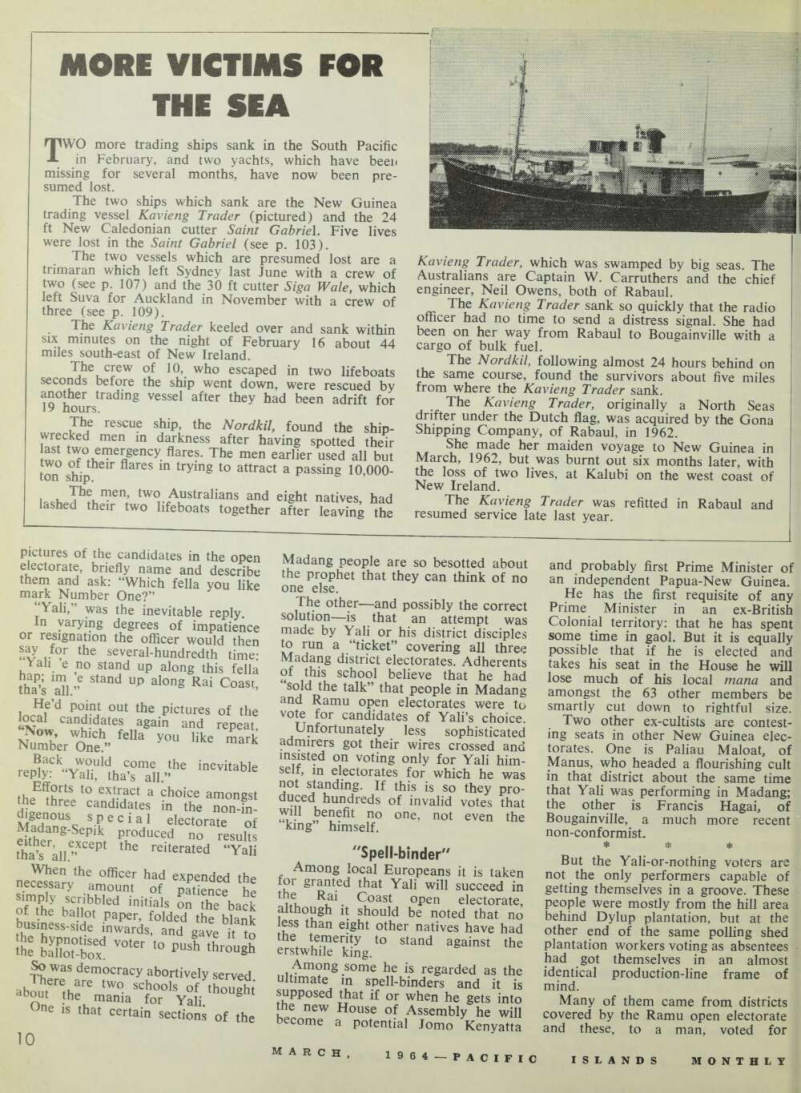
BIGGER AND BETTER; When 64 members crowd into P-NG's new House of As sembly when the House is opened on June 8, space will be at a premium.
The chamber itself will not be enlarged, but space previously taken by the public and by native observers will be used by the members. In February, when this photograph was taken, work was well advanced on three-storey additions to the House to provide office accommodation.
Cost is about £50,000. The main build ing, which was once Port Moresby General Hospital, is in the background.
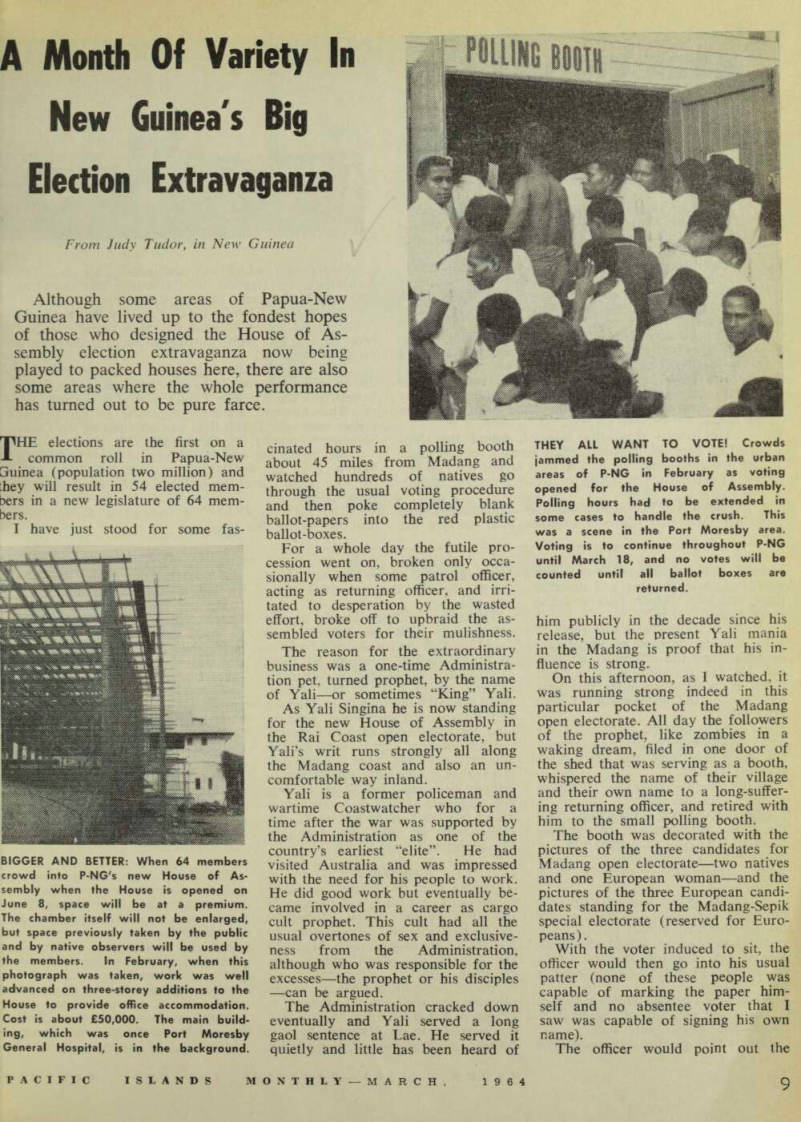
They All Want To Vote! Crowds
jammed the polling booths in the urban areas of P-NG in February as voting
opened for the House of Assembly.
Polling hours had to be extended in some cases to handle the crush. This was a scene in the Port Moresby area.
Voting is to continue throughout P-NG until March 18, and no votes will be counted until all ballot boxes are returned.
electorate, briefly name and describe them and ask: “Which fella you like mark Number One?”
“Yali,” was the inevitable reply In varying degrees of impatience or resignation the officer would then say for the several-hundredth time- "Yali -e no stand up along Tis Sla hap im e stand up along Rai Coasr tha’s all.” g oast ’
He’d point out the pictures of the locul candidates again and repeat N°w, which fella you like mark Number One.”
Back wou |d come the inevitable reply: “Yali, tha’s all.”
Efforts to extract a choice amongst the three candidates in the non-fn genous special electorate of Madang-Sepik produced no results either, except the reiterated ‘‘Va t tba^ a 1 the officer had expended the rimnlv y iTf of Patience he of thJ S b , bled lnitials on the back hnsillL ba -i 0t - paper ’ folded the blank r wards ’ and gave it to the baltot box d V ° ter l ° PUSh throu 8 h „ , ox - So was democracy abortively served there are two schools of thmS is hC tb ? ania for Yalk h One is that certain sections of the
the nronhet fbat tb S ° beso ,“ e ? about nm* P Ju? het that tbey can thmk of no , solntioi?_f<f tw poSSlbly the correct made bv -T S to run* h d • dlsciples lu^ 11 CoVenn S all three f? o *,!' Ad *“ “ so ]d tu- taiv”^ tl believe /hat A e bad sold the talk that people m Madang vote for candMa,« e «f° v‘m W 7 e - *° Unfortiinat^to^ 6 ! ° f Yab /- choice admirers Jfi- es . s sop histicated ! ? w res t cr °ssed anu Sil? '! 8 ° f n y fo J- X 3 ’ 1 hlm ' not sSndlnJ ° r ?‘ es t J or . »b«:h he was duced bnnrWi 5 11 - 8 18 , s ? tbey pro ‘ will benefit no < l mVal,d ( votes “l at “kine” himself 0 ° ne ’ DOt eVen tbe 8 himself * // . „ Amons JP e "- bmder - - , for eranmd 11 18 tak^ n the Raf d W 1 sacceed m although it Sfnfn i? P£n „ electorate, less than piato°otT? be f 1 that no the temerifv to t “f 68 baVe b ? d erstwhile king d agamSt tbe
Amnno u ■ ,
ultinSte 8 inln w egarded a ? the ultimate in spell-binders and it is the P new Home °f m B l tS into becomT , As T sembl y, he will me 3 potential Jomo Kenyatta
and probably first Prime Minister of an independent Papua-New Guinea.
He has the first requisite of any Prime Minister in an ex-British Colonial territory: that he has spent some time in gaol. But it is equally possible that if he is elected and takes his seat in the House he will lose much of his local mana and amongst the 63 other members be smartly cut down to rightful size.
Two other ex-cultists are contest ing seats in other New Guinea elec torates. One is Paliau Maloat, of Manus, who headed a flourishing cult in that district about the same time that Yali was performing in Madang; the other is Francis Hagai, of Bougainville, a much more recent non-conformist. * * * But the Yali-or-nothing voters are not the only performers capable of getting themselves in a groove. These people were mostly from the hill area behind Dylup plantation, but at the other end of the same polling shed plantation workers voting as absentees had got themselves in an almost identical production-line frame of mind.
Many of them came from districts covered by the Ramu open electorate and these, to a man, voted for
Master Ben,” and refused to give •references to the other three candi ates or to take part in the election if a candidate from the Madang lepik special electorate.
“Master Ben“ is Watson Griffith fall, a European planter near Bogia. dthough he is standing against three lative opponents he is given a good hance of making the grade. (His ibsentee supporters at Dylup who oted “Master Ben tha’s all”, cast icrfectly formal votes and will assist n the good work.) The mob-voters, the hypnotised ,nd the stubborn are only part of he story. At Nagada, nearer Madang own, on Saturday, February 22, oting went with a swing.
This is a Lutheran Mission area »ut local natives made up most ot he voters and here mum and dad >rought the kids along and turned it nto something like a picnic.
The majority of these people were :apable of marking their own ballot >apers and those who were not went martly into the booths and told the eturning officer the candidates of heir choice, in order of preference, or both open and special electorates.
And this happy state of affairs was epeated in dozens of places, all over he Territory, although anyone who magines that more than a fraction )f these people understand the im ilications of what they are doing is icing unnecessarily naive.
"Extraordinary Gambit"
In almost every way the whole operation is one of the most extra ordinary political gambits ever at empted in a primitive country, but, it best, it can be regarded only as a Foundation and by no means a proto type. Before the month-long endur ance vote was a day old, gaps in the system were already showing up.
It is already being freely admitted that in the second election four years hence, reserved or special electorates for non-native residents will be out and that European representation will have to take its chance in open electorates.
Another change that should in all common-sense be made is in abolition of the preferential voting system.
Australians, who have this system, create world records in the number of informal votes they cast every election, but in P-NG, to suit some Australian ego, the same system was forced on to people who are about 1,500 years closer to the Stone Age.
Electorates cover vast areas and no one voter knew all candidates. Euro peans usually voted one and two for their preferences and numbered the rest of the candidates consecutively
(Continued on p. 129)
NG Elections (Continued from page 11) down the paper. Native voters generally didn’t bother; they voted for their first and second preference and let the rest go hang.
In the Australian system all candi dates must be given an order or preference; in P-NG the figure 1 in any square makes the vote valid.
Voting is not compulsory.
Some thought might also be given to a bit more real secrecy in the actual voting. Because it was the first attempt, facilities were given to observers and Press which will never be tolerated again, and probably in publicity value for the Territory it has paid handsome dividends.
It was not necessary to be clairvoyant, however, to see that although local voters could vote in privacy, those who could not mark their papers themselves and had to vote absentee could do so only by calling out the name of their prefer ence to the returning officer.
As there were always at least two dozen other voters within hearing, it is a ready-made oportunity for mob voting and for pressure tactics.