Pacific Commerce and Produce
pp. 123-125 · Read in the full issue
New Scheme May Underwrite Some P-NG Investment
Legislation now being framed in Canberra may go part way towards underwriting some Australian investment in Papua-New Guinea.
CHE proposals were outlined in the policy speech of Mr. John IcEwen, Deputy Prime Minister, linister for Trade and leader of the mstralian Country Party before the ist Australian general elections on fovember 30. Mr. McEwen has nee amplified the proposals.
It is proposed that manufacturing nd commercial activities established verseas, including Papua-New ruinea, by Australian companies will e insurable by the Government gainst non-commercial risks —that war risks, riots, nationalisation, onfiscation and similar perils that, all )o often, have overtaken private nterprise in newly independent Asian nd African countries since World II.
The scheme will be similar to those Iready operated by the Governments f the United States, Germany and apan in respect of their own ationals. It is proposed (although 11 proposals will have to get Cabinet pproval before being presented to ’arliament), that cover for about 80 er cent, of new capital investment dll be available at a premium of bout i of 1 per cent.; and that loss f remission of earnings up to 10 er cent, of capital invested will Iso be insurable at a further i of per cent.
Who Benefits Primarily, the insurance scheme dll be for new Australian invest nent overseas and it will be based m the premise that manufacturers dll amortise their investment over ipproximately 20 years.
Manufacturers already established n overseas countries may come into he insurance plan also but each ;ase will be considered individually, f, for example, a manufacturer has >een established overseas for a dozen rears and has been earning good jrofits, it might be considered that he manufacturer’s own amortisation
arrangements give him sufficient pro tection.
The main idea behind the scheme is to provide outlets for Australian exports—e.g., an Australian woollen mill in Pakistan would consume Australian wool; or an Australian flour mill in Fiji would consume Australian wheat. To this extent the insurance plan is an extension of various incentives given by the Australian Department of Trade (now to be called the Australian Department of Trade and Industry), to Australian exporters in the last two or three years.
What is new about the proposals is the inclusion of Papua-New Guinea. Before an Australian manu facturer can set up a manufacturing plant abroad he has to have the approval of the Australian exchange control section of the Treasury and this gives the Commonwealth Gov ernment final discretionary powers over what manufacturing industries are set up overseas.
Papua-New Guinea, however, comes within the Australian currency bloc and the Commonwealth Govern ment has no control over the in dividual who wants to set up any sort of business whether it be a milk bar or a cement factory.
Some Points Not Known Whether something will be written into the proposed legislation giving the Commonwealth Government power to choose which new investors in P-NG it will insure and which it will not is not known at this stage.
Old-established private enterprise in the Territory will be on the same footing as old-established Australian enterprise anywhere else overseas: each case will be considered on its merits.
Because of the possibility of self government in P-NG, and all that can mean these days, the Territory has been in the economic doldrums for the last four or five years. The
new insurance scheme, when it comes into operation, will at least remove most of the risks and most of the excuses Australian manufacturers have had for not setting up branches in P-NG.
The new insurance scheme will be administered by the Overseas Export Insurance Corporation, of the Aus tralian Dept, of Trade and Industry.
In late January Departmental officers were working on the new scheme prior to submitting proposals to Commonwealth legal draughtsmen who are already working at top pressure on new legislation promised during the last election campaign.
As the new insurance scheme was part of Mr. McEwen’s policy speech, and as such is provided for in the next Budget, it is expected that the new legislation will come before Parliament in the next session and be in operation by the second half of this year.
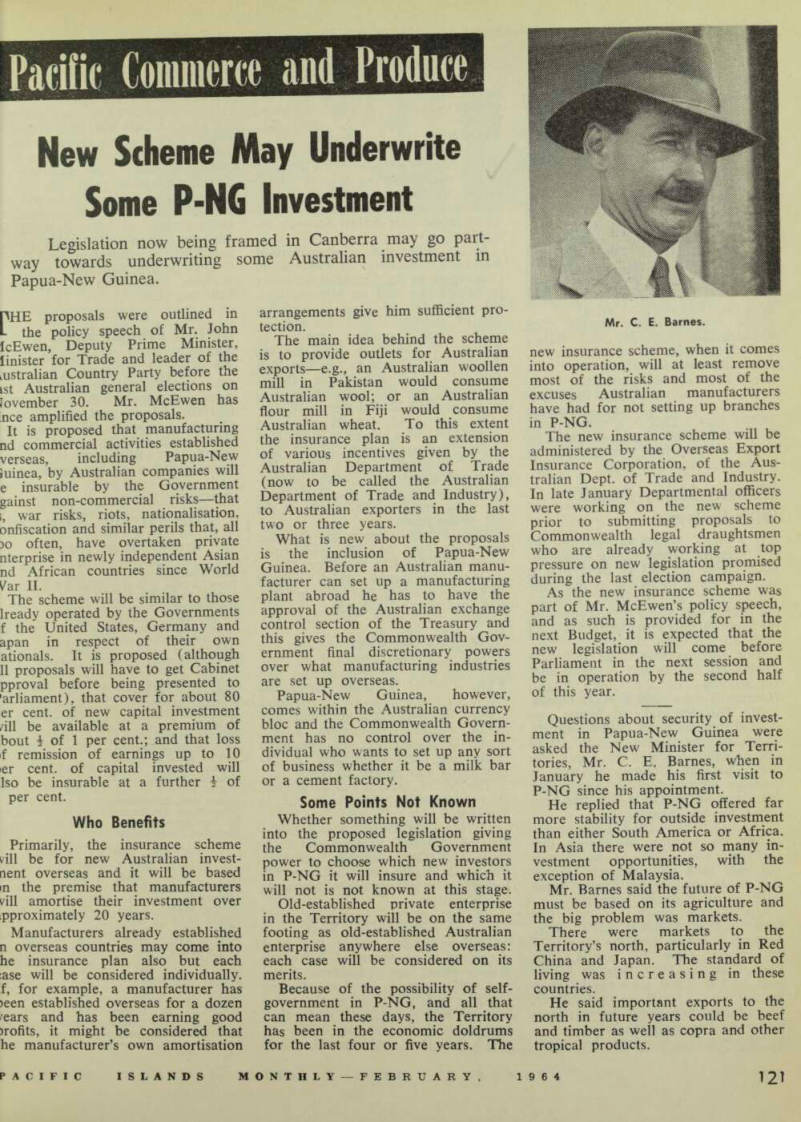
Questions about security of invest ment in Papua-New Guinea were asked the New Minister for Terri tories, Mr. C. E. Barnes, when in January he made his first visit to P-NG since his appointment.
He replied that P-NG offered far more stability for outside investment than either South America or Africa.
In Asia there were not so many in vestment opportunities, with the exception of Malaysia.
Mr. Barnes said the future of P-NG must be based on its agriculture and the big problem was markets.
There were markets to the Territory’s north, particularly in Red China and Japan. The standard of living was increasing in these countries.
He said important exports to the north in future years could be beef and timber as well as copra and other tropical products.
Mr. C. E. Barnes.
BSIP To Sell More
Copra to Japan
THE 1963 contract between the BSIP Copra Board and the Mitsui Company for the sale of 3,000 tons of Protectorate copra was completed in January when the MV Herbjorn loaded the last 350 tons for Japan.
The manager of the Copra Board, Mr. D. S. Corner, said that the contract with Mitsui for 1964 had not yet been signed, but it had been verbally agreed with the company that the Board will sell 5,000 tons of copra FOB in the Solomons to Mitsui this year. The price agreed for 1964 is 2/6 sterling per ton higher than the 1963 contract price.
The overseas copra market price had remained firm at 198.5 dollars from December 20 until January 3, the latest date for which the Copra Board had received quotations.
Copra production in the Pro- C c Ct ,°™ te * n 1963 amounted to tons. This is a record year, 1,500 tons over last year’s produc tion and 1,300 tons over the former production record in 1962.
Western Samoa Breaks
With Unilever
TN a major marketing decision, the A Western Samoa Copra Board an nounced at the end of 1963 that it was not going to renew its five-year o d contract with Unilever, London, but that it was going to sell the bulk ?o^ amoa i copra Production during 1964 on the open market.
The decision was taken following discuss.ons in London in Septembe? by Secretary of the Copra Board H M? a TtT homSen ’ with UK buyers c.vi om l en said that Samoa con wh?ch i hat the tCrms of the contract, which was negotiated in 1957 were « date - He said the break was made because Unilever refused to consider improved prices and highe? asked‘ U for by faS.*' been dudnir Sa hf, 1 i at n e got the im P r ession UnileL warctose dl t S n CUSsions ,hat the effect*? ‘ hr °“^lea?of
been buying Samian Sunder
Philippines P cop S ra ba on d ° f “• 8K rin 3 8 2^ 6 L Weste ™ h s -°"
-rtcet amf Hgg S ?o"
Western Samoa’s copra has estab
lished its reputation as good copra in the United Kingdom and on the Continent, and it is much in demand.
I do not anticipate any trouble dis posing of all our copra on the open market —in the United Kingdom, Europe or elsewhere,” said Mr.
Thomsen.
He said that in the light of the Silsoe report on the copra industry in Fiji recommending a more unified voice in South Pacific produce marketing, it was possible other terri tories might later follow Samoa’s ex ample.
Mr. Thomsen recommended marketing unification in 1961 when, in a report to the Financial Secretary in Samoa, he said he felt the Uni lever attitude was close to exploita tion of underdeveloped countries.
The only contract made by Samoa for 1964 has been for the supply of 3,500 tons to Abels in New Zealand. The Bank line freight agreement has also been renewed at an increase of 22/6 a ton to 187/6.
Samoa’s 1963 exports of copra were 14,997 tons valued at £850,000.
This compares with 12,805 tons worth £645,907 for 1962. Mr.
Thomsen attributed improved produc tion figures to the higher local buy ing price based on £62 a ton at the end of the year.
Total banana exports for the year were just over 685,000 cases com pared with 760,835 cases for 1962.
Cocoa production, which reached 5,258 tons worth £1,165,802 in 1962, was expected to be down.
New Plan to Beat
Rhinoceros Beetle
I) R - Charles Peterson Hoyt has TZ . been made manager of the joint United Nations Special Fund and South Pacific Commission project aimed at controlling and eventually eradicating the coconut pest Oryctes rhinoceros and related insects. w/ Th T? SPCs Secretary-General, Mr.
W. D. Forsyth, announced this in January.
Dr. Hoyt, an American, is a gradu ate of Stanford University, Cali toma, and since 1955 has been with tne South Pacific Commission as En tomologist in charge of its rhinoceros beetle project.
He has worked in Malaya and Africa as well as in the Pacific.
The new joint project has been conceived as an expanded and accel erated attack on rhinoceros beetle and smifiar pests in the South Pacific. these seriously threaten the copra industry both in territories where they are established and in others to which they they could spread.
The new project, which will g ( under way almost immediately, n suited from an approach by the SP< to the Special Fund of the Unite Nations three years ago.
The Special Fund has allocate $558,000, which will be matched b: the five participatng Governments c the South Pacific Commission (Auj tralia, France, New Zealand, th United Kingdom and the Unite; States), which between them will cor tribute $344,000 in cash, while th Governments of New Zealand an.
Western Samoa will provide service and facilities equivalent to $75,000 The project will be based oi Western Samoa and will be sprea< over five years.
Norfolk Freight Rates
I>URNS PHILP’S shipping depart " ment was a bit upset in Januar over a statement in PIM for tha month that the freight rate between Norfolk Island and Australia i; £l7/10/- a ton. The figure was given to a PIM writer on Norfolk Island, but BP’s say the correct figure is £l2 a ton for general cargo,
ecord Fiji Sugar Season:
rospects Bright for 1964
HHE Fiji cane crushing season L which ended on January 9 estab shed a record. The four mills, at autoka, Rarawai (Ba), Labasa and mang (Rakiraki), crushed 2,336,894 ►ns of cane. The previous record as 2,313,102 tons in 1959.
The output of raw sugar was about 30,000 tons, about 20,000 tons lore than the previous record set i 1959. At a conservative estimate le 1963 crop will be worth £l5 lillion, for the British Common ealth Sugar Agreement price, under r hich Fiji sells about 130,000 tons f raw sugar, is more than £FSO.
And the world price is much
higher than the Commonwealth price, and has been for more than 12 months.
The world sugar market is a seller’s market now, and looks like staying that way, at least until the end of this year. Another record crop, barring a hurricane or some other natural disaster, is in sight for Fiji this year, and with a world de mand for sugar for several reasons, no sharp drop in prices appears likely.
Cuba cannot recover from the 1963 hurricane for another two years at least, if ever. Brazil has had a bad drought, and Australia lost a lot of sugar in a bad fire at a terminal at Townsville last year. Those are just some of the factors which will help to keep prices in sellers’ favour for 1964 at least.
South Pacific Sugar Mills Ltd., a subsidiary of the CSR Co. Ltd., which operates the four mills in Fiji, said that the 1963 crop had been well cultivated and more fertiliser than ever before had been used.
Farmers and harvester gangs had kept up a steady supply of cane to the mills, except for one brief spell of wet weather.
The four mills crushed con tinuously since May 9, and all are now preparing for the 1964 season.
SPSM is now engaged on an expan sion programme which will enable even bigger tonnages of cane to be crushed in future.
The tonnages of cane crushed at each mill in 1963-64 was: Lautoka, 1,084,927, finished January 9; Rarawai, 735,512, finished January 7; Labasa, 364,515, finished January 5; Penang, 151,940, finished November 24.
Bureau Closes
THE Bureau de Recherche Geo logique et Miniere (Bureau of Geological and Mining Research), a French Government organisation which has been working in New Caledonia since 1952, is ceasing activities in New Caledonia and also in Tahiti. Reasons given are “economic”.
Some 87 employees (engineers and labourers) will be affected. Engineers in New Caledonia and Tahiti will return to France.
The organisation has done a tremendous amount of work in New Caledonia. Prospecting has been done in nearly every corner of the territory.
BSIP Rice Plan
Gets Under Way
THE Commonwealth Development Company in Honiara, BSIP, has leased 115 acres of land near Ilu, and intends to use 45 acres for dry rice, 45 acres for wet rice, and the rest for planting oil palms.
The manager, Mr. R. Johnson, said recently that about 30 acres of land had already been ploughed for dry rice planting; a tractor is expected from Fiji within the next few weeks to pull up stumps.
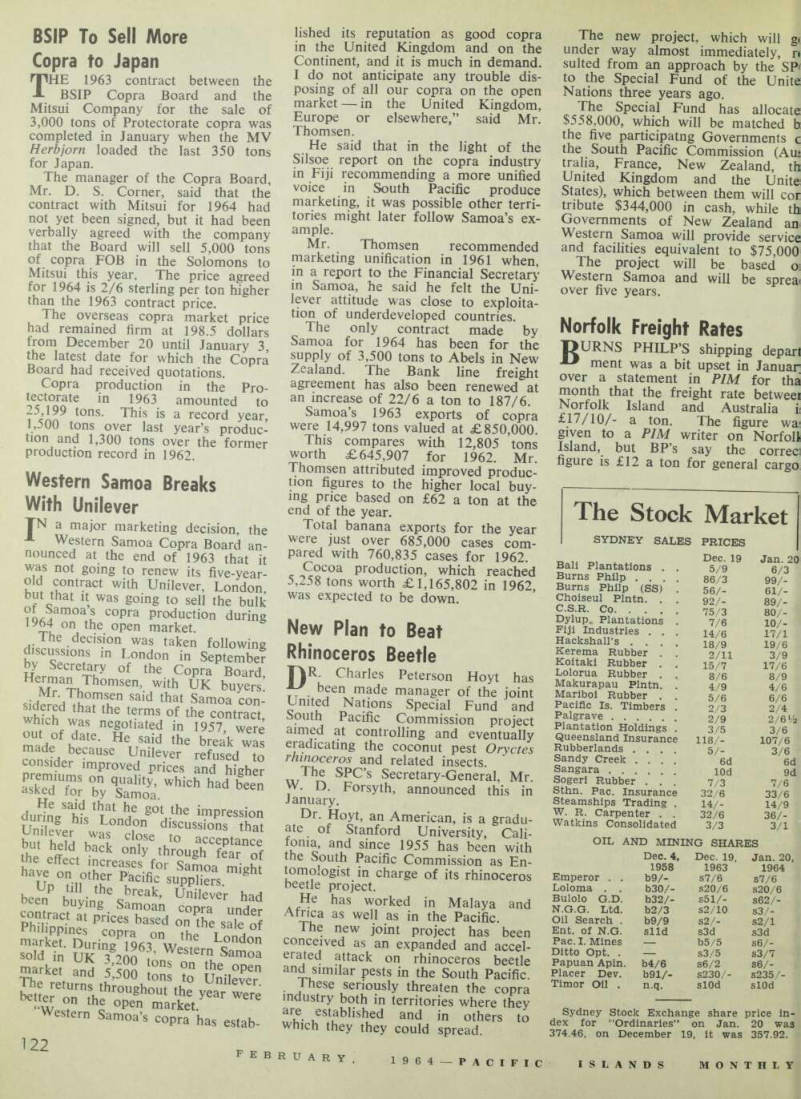
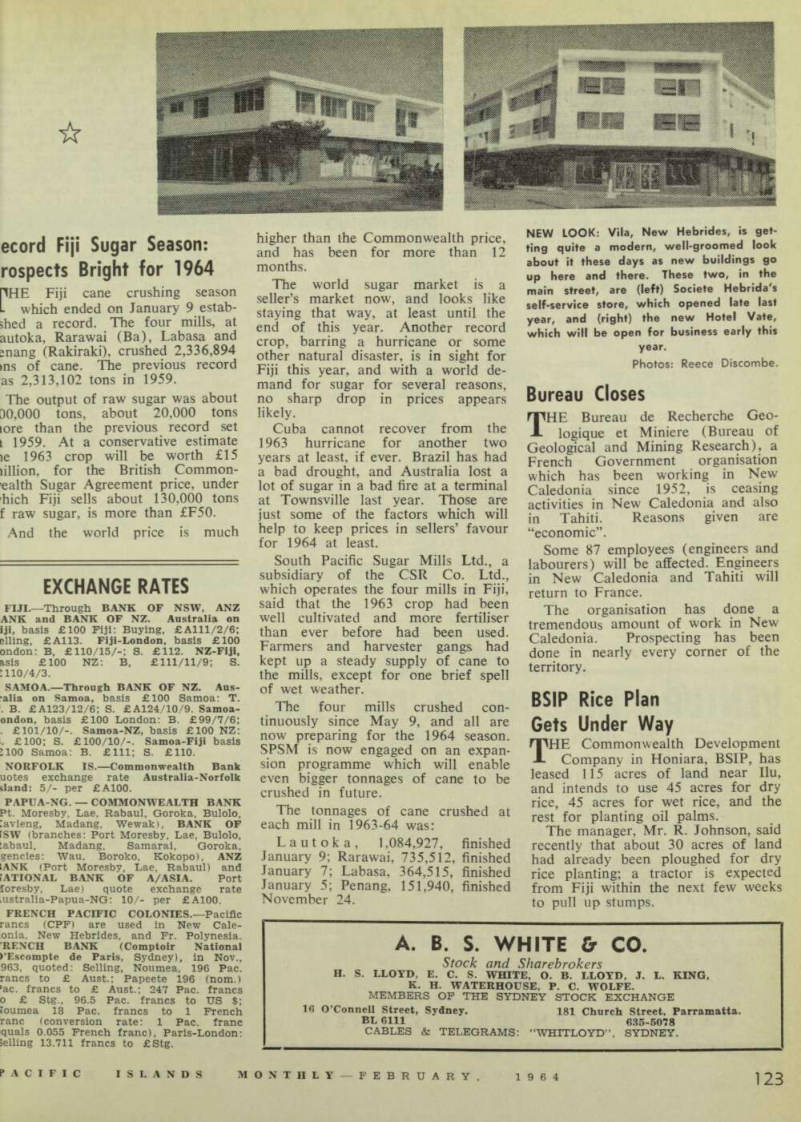
NEW LOOK; Vila, New Hebrides, is get ting quite a modern, well-groomed look about it these days as new buildings go up here and there. These two, in the main street, are (left) Societe Hebrida's self-service store, which opened late last year, and (right) the new Hotel Vate, which will be open for business early this year.
Photos: Reece Discombe.