Nutshell
pp. 115-118 · Read in the full issue


In A Nutshell
• The dangerous dependence of •4ew Caledonia’s economy on the nining industry has again been de nonstrated by export figures released ecently for the first 11 months of 963. They show that New Caledonia’s mineral exports for the >eriod were worth more than £l5 nillion compared with only £340,000 or agricultural products (mainly offee and copra). The mineral ex torts included nickel ore, chrome ore, ron ore and smelted nickel in vari es forms. Australia bought iron »re to the value of more than e 275,000. • The British Trust for Ornithology las written to thank a New Hebridean tolice constable for reporting the inding of a dead Cape pigeon, with . ring on its leg, at Tanna last Sep ember, The bird, a kind of petrel, vas ringed as a nestling last Feb uary by the British Antarctic Survey t Signy Island in the Antarctic. The British Trust heard about the bird iter the constable took it to the British District Agent, Mr. John .eaney. The Trust said the report vas the most important it had ever tad from the Pacific.
I • Shipments of bananas from Fiji o New Zealand in 1963 totalled .96,299 cases, valued at about
£230,000. In the previous year, the number of cases was 149,934. • The first helicopter survey of timber stands in Papua-New Guinea has been completed in the Gogol River area, near Madang.
Carried out by normal methods, the survey would have taken at least six months. Using a helicopter, the Department of Forests completed it within 10 days.
About 130,000 acres were sur veyed.
Forestry officers estimate that the area contains about 150 million super feet of Kwila, a very durable hard wood. Tenders for the area will be called by the Department this year. 9 New Caledonia was in the throes of a severe drought in Jan uary. As a result fires were raging in many country districts; water re strictions were in force in Noumea; part of the generating equipment at the Yate River hydro-electric station was shut down for lack of water; and meat was expected to become scarce. • UN official Harry Spence hopes to have the new Regional UN Office for the South-West Pacific established in Apia in late March.
Two UN people will be on his staff; the rest of his staff will be recruited locally. In addition to the 10 UN technical experts already at work in Western Samoa in agriculture, education, health, public works and statistics, another eight UN employees will be at work in the territory in 1964.
These will include a senior develop ment economist, a fiscal economist to make a 3-4 months study of taxation
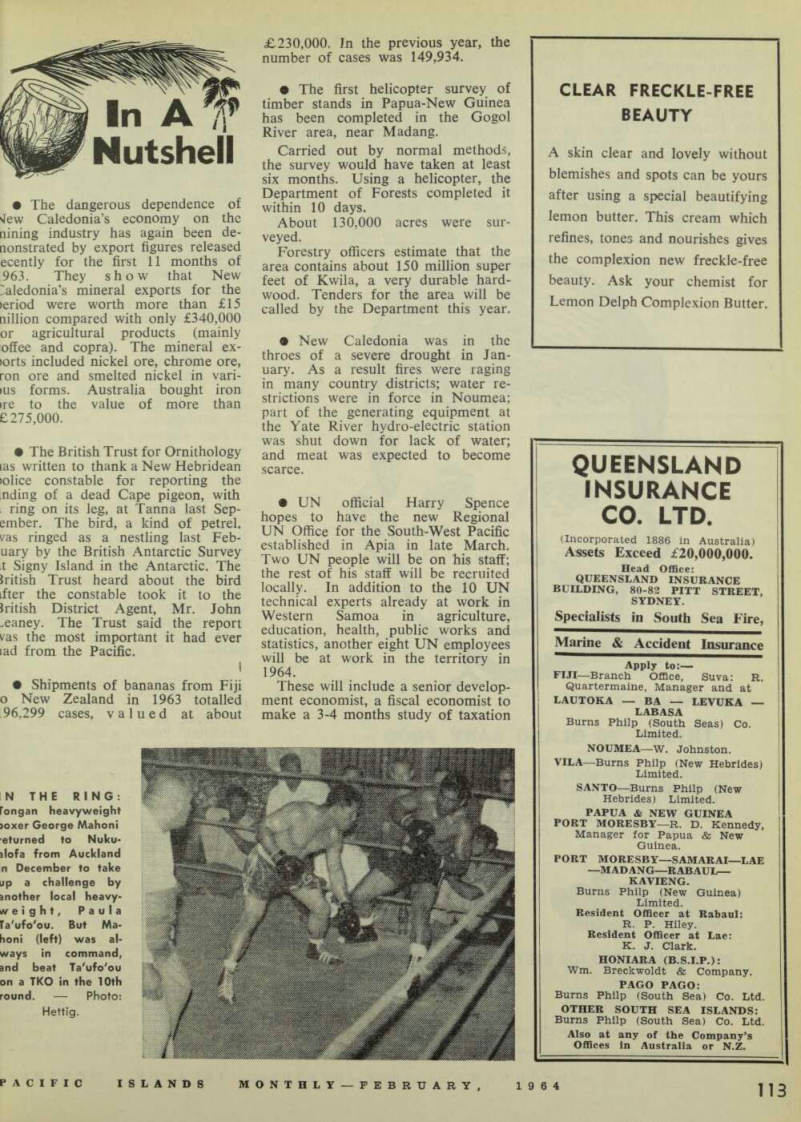
[?]N The Ring:
[?]ongan heavyweight [?]oxer George Mahoni [?]eturned to Nuku alofa from Auckland [?]n December to take [?]p a challenge by another local heavy weight, Paula [?]Ta'ufo'ou. But Ma honi (left) was al ways in command, and beat Ta'ufo'ou on a TKO in the 10th round. Photo: Hettig.
and government revenues, a teacher training expert, and two tropical agricultural instructors. • More than 400 travel men from 27 countries will converge on Aus tralia in February and March for the 13th Annual Pacific Area Travel Association Conference and Work shop.
They will join 200 Australian delegates to discuss all aspects of travel in the Pacific in what will be
one of the world’s biggest tourist forums ever held.
The conference runs from March 2 to 6 at the Menzies Hotel, Sydney.
A PATA Workshop will precede the conference at the Southern Cross Hotel, Melbourne, from February 27 to 28. (PATA is an organisation to develop, promote and facilitate travel to, from and within the areas of the Pacific. Its members represent 23 governments, 27 airlines, 10 shipping
companies, 299 travel agencies, 90 hotels, 23 publishing houses and 40 other firms and organisations with travel interests in the Pacific.) • Reporting statistics on the regular air services in Papua-New Guinea for the year ended June 30, 1963, the Chief Statistician, Mr.
C. L. Walters said recently that regular air routes in the Territory now totalled 12,615 miles.
During 1962-63, aircraft had flown nearly two million miles, he said.
Planes were in operation for almost 15.000 hours and carried more than 103.000 passengers.
The aggregate distance flown by these passengers on Territory routes last year was over 24 million miles. • During the 1962-63 financial year, 600 miles of vehicular roads were built in Papua-New Guinea.
This increased the total trafficable roads to 7,092 miles in all parts of the territory.
The districts with the highest mileages are Eastern Highlands, 1,027 miles; Sepik, 834; Morobe, 823; and Central District, 814 miles. • The French Navy in the Pacific was due to receive a DC4 aircraft in January. The plane will be based at Tontouta (the international airport that serves Noumea). An announce ment said the plane would be used “for transporting troops and for carrying the High Commissioner and other important officials on missions.”
A second DC4 for the Navy is ex pected later in the year. • A move which may lead to the establishment of a Pacific Province of the Anglican Church was made at a recent meeting of the South Pacific Anglican Council held at Honiara, BSIP. The council comprises representatives from the Dioceses of Polynesia, Melanesia, New Guinea and the Torres Strait Mission of the Diocese of Carpentaria.
The formation of a Pacific Province, which has been mooted for many years, would co-ordinate the work of the dioceses and would be more realistic for them in deal ing with the development of the South Pacific Anglican Church. • The Registrar of Co-operatives in the Gilbert and Ellice Islands Colony, who has accumulated a large stock of handcrafts, including model canoes, new types of fan and mats from the Southern Gilberts, has hopes that the Colony will develop a profit able export trade in these articles.
• Airlines of NSW will put a new flying-boat into service between Syd ney and Lord Howe Island next Easter. The new aircraft, a Sunder land, was secured on lease from the Royal New Zealand Air Force in De cember and will replace the Pacific Chieftain, which was wrecked in a storm at Lord Howe last July. A party of Ansett engineers visited Lord Howe Island in early December to salvage portions of the wrecked fly ing-boat for use in the conversion.
After salvage operations were com plete the remains of the aircraft were towed out to sea for disposal. • Three small New Hebridean girls, all aged about five, were drowned at Santo just before Christmas when they went in for a bathe in the Segond Channel. They were apparently swept away by a current. One child was the daughter of Mr. Timothy Bila, senior clerk in the British District Agency, Santo. • A boy, who was swimming with his girl friend in the lagoon at Tarawa, GEIC, was involved in an unusual accident recently. The two lovers were supporting themselves on floats from Japanese fishing nets when the girl dived under the boy and released the float she was hold ing. The float shot up through the water and smashed the float support ing the boy. The result? The boy’s abdomen badly gashed by broken glass and a stitching job for the Colony Hospital.
• The discussions between the two factions disagreeing over the conferment of the Tupua Tamasese title in Western Samoa resulted in a stalemate, and the case has been filed with the Lands and Titles Court for settlement. It is expected to be reached soon. • New Caledonia’s internal air line, Transpac, which recently cele brated its eighth year of service and carried its 100,000 th passenger, has begun an air taxi service with light planes.
The service is available to a number of centres in the country that have no air strips capable of using the regular de Havilland Herons and Dragons, which compose the Trans pac fleet.
The planes Transpac is using in the taxi service are a Morane Rallye and a Piper Cherokee. A two motor plane capable of carrying five passengers is to be added to the fleet during the year. • The first major revision of the Code of the United States Trust Territory of the Pacific Islands is being made in Saipan, Mariana Islands. The High Commissioner, Mr. M. Coding, has called for a major revision and reorganisation of the laws of the Trust Territory to meet the social, economic, and political development of the people of Micronesia. • The people of Papua-New Guinea speak one-quarter of the
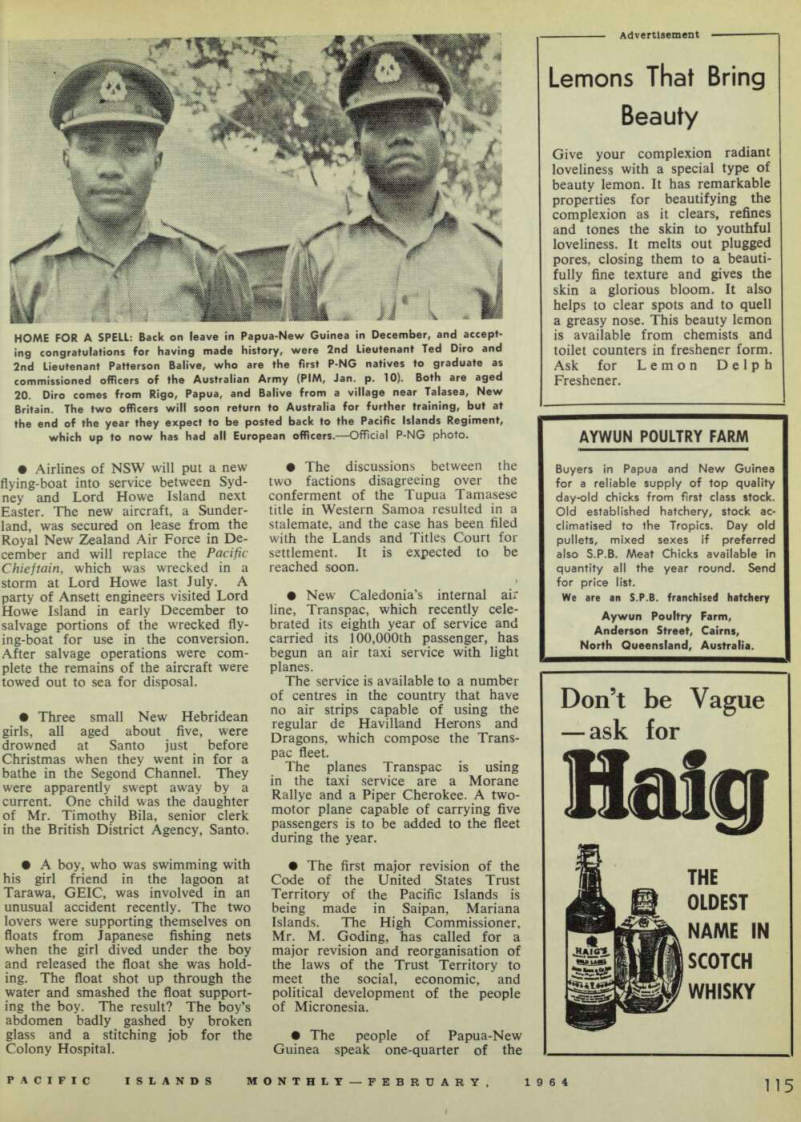
HOME FOR A SPELL: Back on leave in Papua-New Guinea in December, and accept ing congratulations for having made history, were 2nd Lieutenant Ted Diro and 2nd Lieutenant Patterson Balive, who are the first P-NG natives to graduate as commissioned officers of the Australian Army (PIM, Jan. p. 10). Both are aged 20. Diro comes from Rigo, Papua, and Balive from a village near Talasea, New Britain. The two officers will soon return to Australia for further training, but at the end of the year they expect to be posted back to the Pacific Islands Regiment, which up to now has had alt European officers. — Official P-NG photo.
world’s known languages, according to the Rev. Leo Buckman.
Mr. Buckman, who is secretary of the British and Foreign Bible Society for Papua Guinea, said this in an address at the Port Moresby Rotary Club recently.
He said there were more than 700 known languages in the Territory, not including dialects or place talk.
Of these, only 36 had been translated. • Following an explosion of a 4i oz pressure can of “Perfect Net” hair spray in Brisbane in January, causing burns to a young woman, the spray was withdrawn from sale in Aus tralia and in Papua-New Guinea stores. Apparently some of this size can were faulty. A chemical reaction resulted in the production of hydro chloric acid. • At the end of December, serious labour disputes among the phosphate workers at Ocean Island were re ported officially to be threatening the economy of the GEIC. The Phosphate Commission and GEIC labourers had reached a deadlock over conditions, O So bad is the telephone service between Kokopo and Rabaul, NG (a distance of 23 miles) that the Kokopo Town Council in January unani mously agreed to request that last year’s fees be refunded to sub scribers. One councillor said he had found it quicker to drive to Rabaul and back than get a phone call through. • A dispute over the succession of High Chieftainship at Butaritari, in the GEIC, has been resolved by the GEIC Resident Commissioner, Mr. V. J. Andersen, after a visit.
The islanders have agreed to aban don the hereditary system, and lands formerly owned by the High Chief will be distributed. • Workmen erecting an aircraft beacon at Betio, Tarawa, were shocked to find a 450 lb unexploded bomb near Police Headquarters. An appeal was made to the RNZAF to send up a bomb disposal expert to deal with it, • Elections for Western Samoa’s Legislative Assembly will be held on April 4. Electoral rolls will close on February 7, Parliament will be dis solved on February 8, and nomina tions for the elections will close on February 28. • Increased air services brought a record number of 371 passengers to Norfolk Island in December. Of these, 201 came from Australia and 170 from New Zealand.