Pacific Shipping And Yachts
pp. 97-111 · Read in the full issue
Yachts
Samoa Gets Cracking On New Harbours
With the departure from Apia on Christmas day of UN technical expert, Director of Works B. Claussen, for New York, the long dreams of deepwater harbours for Apia and Asau, Western Samoa, entered the first stage of reality. In New York he signed a letter of intent with the firm of Merrit, Chapman Scott for construction to start early in the New Year.
final decision was taken two L weeks earlier as a result of an Ter by the New Zealand Govern ed to guarantee a £1,000,000 loan ir Samoan harbour development lised on the New Zealand money arket.
As a result of this offer Western imoa will be able to borrow the oney at a substantially lower rate of terest and easier repayment terms ian offering from the United States here Works Minister, Mr. F, C, F. elson, tried to negotiate finance last jptember.
It is generally felt in official circles i Apia that it was the negotiations >r finance in the U.S. that prompted ew Zealand to come forward with
its offer, largely as a matter of self respect.
“After all,” said one politician, “it doesn’t look too good for a country only two years independent to be starting a £1,000,000 harbour pro ject, when nothing was done for the previous 42 years under NZ admin istration.”
The harbour project will be a joint venture of two U.S. firms, and Fletcher Construction Co. from New Zealand. Total cost is estimated at £1,200,000 and the wharves are ex pected to be finished within 22 months after the signing of the contract. Of the total cost, Samoa will pay only £200,000 until the wharves are actu ally in use. ‘This is unquestionably a major step forward in our development and will have a tremendous impact on the success of our first five-year develop ment programme,” said the Minister of Finance, G. F. D. Betham.
It is now expected that the full five-year development programme will be implemented in 1965.
O “Cook’S Tour” Plan:
Captain Alan Villiers, who hopes to retrace the first Pacific voyage of Captain James Cook, will outline his plans at the Pacific Area Travel Association conference in Sydney in March.
Captain Villiers, a veteran of the last big sailing ships, plans to build a replica of Cook’s Endeavour, to be sailed from England to Australia in time for the 200th anniversary of Cook’s discovery of the east coast of Australia.
Captain Villiers has written several
books on ships and the sea.
Recently, he prepared a compre hensive feature on Australia for the National Geographic Magazine.
He has assisted in an advisory capacity in the production of several films, and he commanded the whaling ship Pequod for the filming of “Moby Dick”.
Several years ago, he sailed a replica of the Mayflower from England to the United States.
• French Ship At
NORFOLK: The French naval vessel Dunkerquoise called at Norfolk Island in December in the course of an oceanographic survey. Her skipper, Commander Brossett, declared open ship for two hours and invited residents aboard for an inspection. The same evening, he entertained a large party of residents on board.
• First Visit To Suva: The
sleek Italian luxury liner Guglielmo Marconi made a big impression on Suva on December 27 when she arrived from Tonga on her maiden voyage. The vessel is of 28,000 tons.
Aboard her as navigational adviser
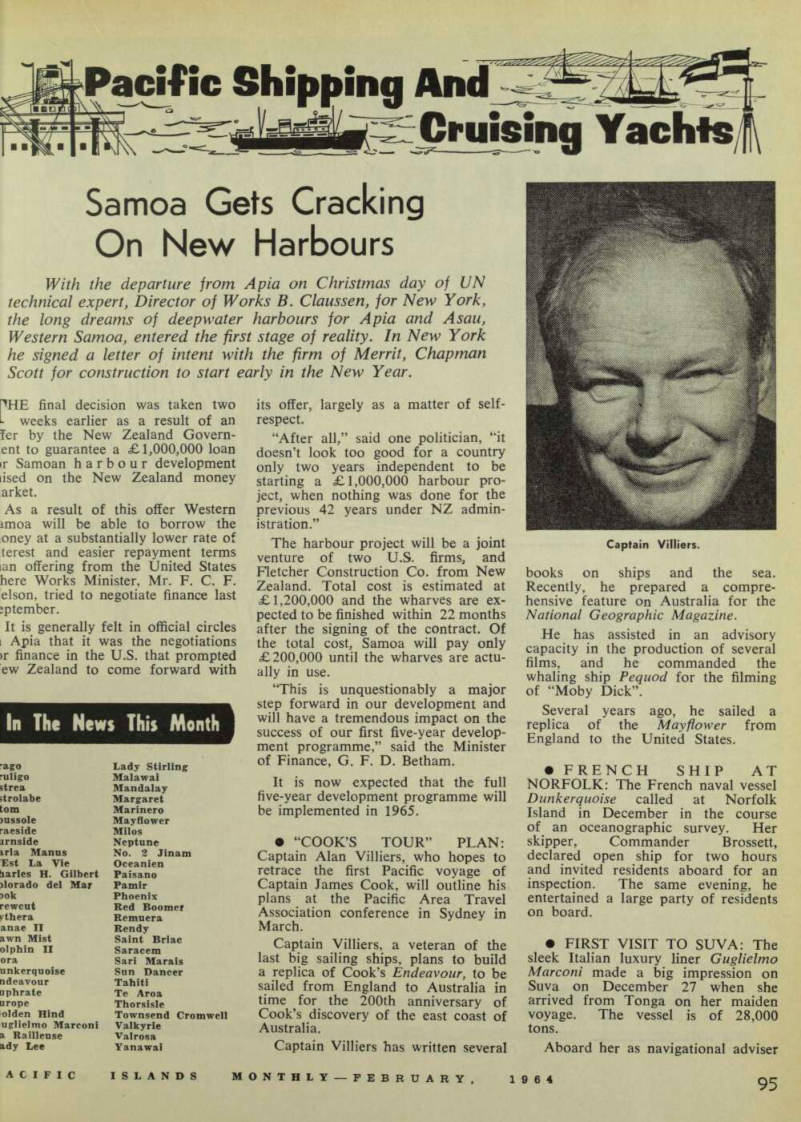
Captain Villiers.
yas the Suva Harbour Master, Captain E. James, who had flown to fonga the previous day.
The Marconi carried 1,700 pas engers, mostly Australians, and also darconi’s widow, Marchioness Cristina Marconi, and daughter ilettra.
It was the first call by a Lloyd- Tiestino Line vessel to Suva.
Captain Francesco La Rosa said he short Pacific cruise was such i success that if more time could ie found between the express Italyrun, other cruises to the slands were possible.
• Safety With New Life
ACKET: A new life-jacket made to specification set by the British Itandards Institution after 18 months’ esearch, turns an unconscious man in to his back in five seconds.
It supports his head, keeping the nouth well clear of the water, and nclines the body backwards. The urvivor is presented face on to he approaching waves, and rides vith them. In this way his body notion never gets out of phase with he waves and his head is not ingulfed.
All this is achieved by the cientific distribution of the buoyancy vhich must total a minimum of 30 b. The life-jackets take no more han 30 seconds to put on and ecure.
Two British firms are to produce he jackets. They are RFD Company, Lane, Godaiming, Surrey, ind the Vacuum Reflex Ltd., 2C Jandbury Road, London, N. 17.
• Mission Ship Lost: The
10 ft Methodist Mission ship Handalay was wrecked on January i on a reef at Pigeon Point, Bougain ville.
The Mandalay was sailing between \ropa Plantation and Kieta, on Bougainville, when she ran aground ust before daylight.
First reports said nine Solomon Island native crew members and four nassengers, all believed to be natives, ‘ought their way ashore through leavy seas when the ship stuck fast >n the reef. No one was hurt.
A later report said there were 18 people on board.
The ship took a heavy pounding irom seas before help arrived from nearby plantations and an attempt was made to beach her.
However, she could not be pulled right up on to the beach so it was decided to strip her.
Her engine and many fittings were
removed before the waves finally broke her up.
The Mandalay was a famous New Zealand racing ketch about 30 years ago.
The Methodist Mission operated her between Bougainville and the
Bsip.
• Loan For Mangaia
Harbour Plan: The Cook
Islands Executive Committee has approved an interest-free loan of £3,300 to the Mangaia Island Council to improve the harbour of that island.
The sum of £2,100 will be avail able for the deepening of the harbour, while £1,200 will be allocated for a concrete road alongside the harbour.
The Island Council will raise the harbour levy from 2/6 to 5/- a ton, and will place a charge of 3d on each case of produce leaving the island. This will enable the loan to be paid off at an annual rate of not less than £5OO.
As primary production on the island, particularly pineapples, is increasing, a better harbour will be of much benefit.
Mangaia, the southernmost island in the Cook Group, is 110 miles south-east of Rarotonga.
• Search For More La
PEROUSE RELICS: Vila engineer and marine salvage expert Reece Discombe left Vila by ship for Vanikoro, BSIP, early in January to
make yet another search for relics of the French navigator La Perouse, whose ships Astralope and Boussole were wrecked at Vanikoro in 1788.
Discombe has made four previous trips to Vanikoro for La Perouse relics, the last two being in 1962.
On his first trip in 1962—in June— he discovered what he believed to be the wreck of the Boussole while div ing in 40 ft. of water on the outer edge of Vanikoro’s reef.
In the following December, he re trieved a lead ingot from this site which positively confirmed his belief, as the ingot bore the same arsenal markings as ingots recovered from the Astrolabe. Discombe thus solved a 174-year-old maritime mystery, as no one had previously been com pletely sure that Boussole had been wrecked at Vanikoro.
Among the objects from the Boussole that Discombe has seen and photographed on the sea bed are brass wheels, lead ingots, iron rods and six anchors ranging in length from eight to 15 ft. Discombe hopes to raise some of these objects during his current trip.
With the aid of two metal de tectors, he also plans to make a search on land for relics of La Perouse’s expedition. Quite a num ber of such relics, including coins and musket balls, have been found at Vanikoro over the years, particu larly at Peu, the headquarters of the Kauri Timber Company.
The relics at Peu were apparently
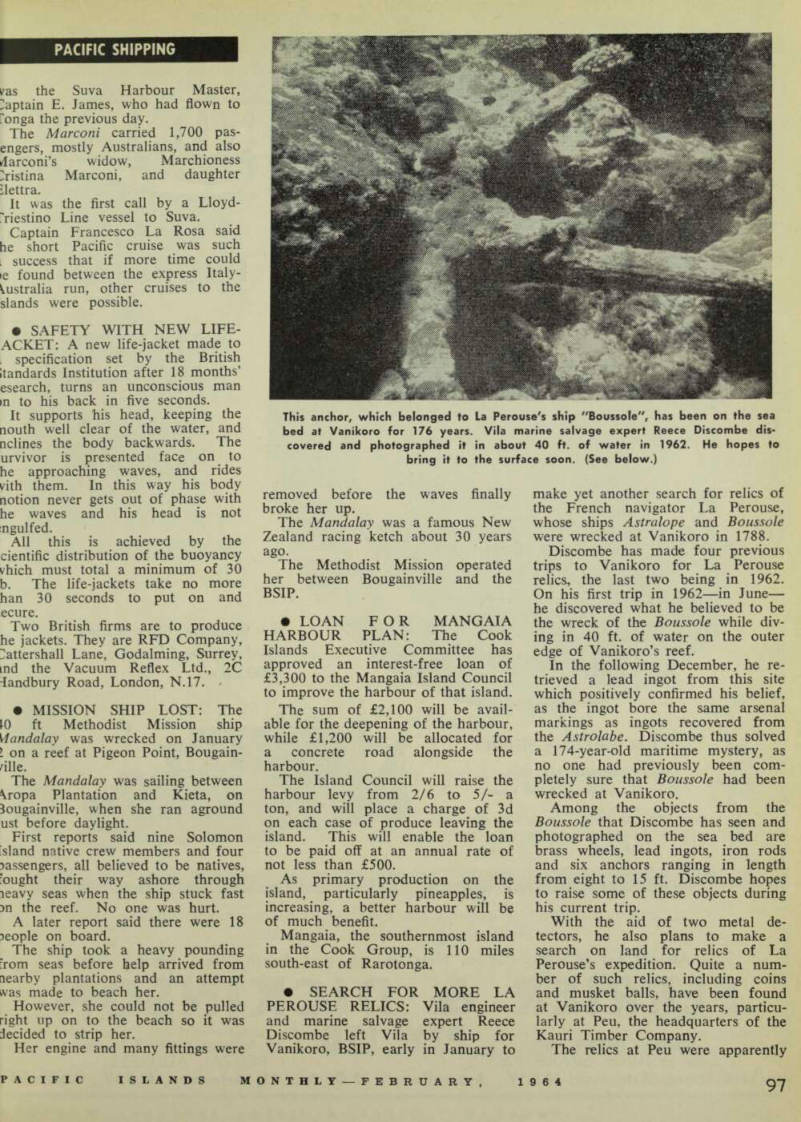
This anchor, which belonged to La Perouse's ship "Boussole", has been on the sea bed at Vanikoro for 176 years. Vila marine salvage expert Reece Discombe dis covered and photographed it in about 40 ft. of water in 1962. He hopes to bring it to the surface soon. (See below.)
eft there by survivors of the Astro abe and Boussole, who lived on the dand for several months after their hips were wrecked. These men cut [own a number of trees in the icinity to build a boat and eventu lly sailed away in it. They were lever heard of again.
Although the search for La ’erouse relics will be the most in sisting part of Discombe’s visit to 7anikoro, his main object is to alvage a cargo of brass that was sttisoned from the ship Milos several 'ears ago. On this mission, he will ic partnered by Mr. Geoffrey Seagoe, >f Vila, whose son Laurence, a lydney University student, will also ;o along.
Messrs. Discombe and Seagoe have bartered the inter-island vessel Neptune for their salvage job. The Neptune, a steel vessel which can arry up to 30 tons of cargo, norm illy freights cargo between Vila, imae, Tongoa, Ambrym and Male :ula.
• Floating Gasworks: The
dV Arago, a 500-ton ship which was pecially built in France two or three 'ears ago for carrying butane and »ropane gas, and ammonia in bulk, las gone into service between Aus ralian and Pacific Islands ports. She vill call at Sydney, Brisbane, North Queensland ports, Papua-New Guinea, 'Jew Caledonia and the New iebrides. The ship’s Sydney agents ire F. H. Stephens Pty. Ltd.
• Chain Of Accidents: The
veil-known inter-island trading vessel Zarla Manus, which was looked on >y some people as the pride of New Britain, was wrecked five miles from labaul on December 27 while trying o help another vessel, the Margaret, hat had gone aground.
The Margaret, in turn, had gone iground 100 yards from the shore vhile trying to rescue the 70-ton anding barge Dolphin 11, belonging o Nonga Sawmills, which had mapped her deep water moorings md had drifted on to the reef op josite the sawmills.
The Margaret, which is owned by he Catholic Mission at Kavieng, :ame to grief when a tow rope con lected to the Dolphin II fouled her propeller as she tried to drag the jarge free on December 26.
When the Carla Manus went to the aid of the Margaret, her propeller ivas also fouled by a tow rope that had been connected to the Margaret.
At this point, the similarity in the dories of the two vessels ends, for 3n December 27, the Margaret managed to get off the reef with the
help of about 50 natives and her own power, but the Carla Manus did not.
Mechanics later began dismantling the engine with the idea of beaching the Carla Manus. Although badly damaged, it was hoped that she might sail again.
The Carla Manus, of 78 tons gross, is owned by Mr. Jack Thurston. The ship is uninsured. Mr. Thurston valued her at £25,000. See picture of stranding on p. 109.
• “Frog” Evans Retires:
Captain J. H. Evans who has been a fixture around Madang, New Guinea, for the last nine years retired as Harbour Master and Pilot on January 11. Before Madang he was stationed at Rabaul and at one time had the job of liquidating the Administra tion’s inter-island fleet of trading vessels a post-war nationalistic brainstorm of the late Eddie Ward, then Territories Minister.
Captain and Mrs. Evans were to leave for Hong Kong in mid-January on MV Milos, and will then spend about a year in Europe before settling in Western Australia.
• Too Many Ships For
PAPEETE: Ten or 12 years ago, the arrival of a ship in Papeete was such a novelty that half the popula tion used to go down to the water front to stand and stare whenever one tied up. In those days, Papeete averaged about one ship a week as Tahiti then had no tourist traffic worth mentioning, and the world’s shipping fleets were still under strength following the war.
Nowadays, with the development of Tahiti as a tourist centre and as a forward base for technicans for the Mururoa nuclear testing site, Papeete gets so many ships that they now attract little attention—except when there are so many of them that there is no room for them to tie up.
This was the situation several times over Christmas and the New Year.
On Saturday, December 21, for
Captain "Frog" Evans.
sample, there were five ships in le harbour together Thorsisle, aracem, Euphrate, Oceanian and l emuera and only room for three f them at the wharf.
Later in the month, the port was till so crowded that the Shaw, Savill nd Albion liner Southern Cross, diich was due to put into Papeete dth 1,170 passengers, was forced to ive Tahiti a miss. She went straight n to her next port, Suva, where she pent two days instead of her usual ne.
News that the Southern Cross was 3 stay two days in Suva caused some did rumours in Suva before she actu lly got there. It was said that, in nture, the liner would not call at 'apeete, that she would stay longer i Suva, and that the change in :hedule had something to do with olitics, etc.
However, the master of the outhern Cross, Captain A. H. Baber, oon killed the rumours on his rrival in Suva.
“We didn’t call at Papeete for the imple reason that there was no erth available,” he said.
Captain Baber said his ship left tie United Kingdom a day behind chedule and, after leaving Panama,
the port authorities at Papeete radioed to ask if the Southern Cross could arrive a day earlier than planned.
“When I said this was impossible, I was told that there would be no berth available for us at Papeete,” the captain went on.
“When we arrived off Papeete, a Matson liner and a cargo vessel were already at the main berth and an other ship was berthed at the old wharf.
“I was asked if I could anchor out in the stream and let the passen gers come ashore, but, as there was not sufficient swinging room if I had anchored, I had to decline.
“We took two passengers and mail on board and then sailed for Suva.”
The captain added that when he made an announcement to the passen gers that they would not be putting in at Papeete, many of them ex pressed disappointment, and said they
IN HONOLULU: "Townsend Cromwell" (left) a new 158 ft., all-steel ship built for the Honolulu area, Bureau of Commercial Fisheries, US Fish and Wild Life Service arrived at her home port of Honolulu on Christmas Day. She was built in Morgan City, Louisiana, at a cost of $1.2 million. Tied up behind the "Townsend Crom well" is the "Charles H. Gilbert", another vessel of the Bureau of Commercial Fisheries which returned to Honolulu on December 13 after a 10-week South Pacific cruise to study tuna in the waters around the New Hebrides, New Caledonia, Fiji and Samoa. — Photo: Warren Roll.
iad been looking forward for a long ime to a visit to Tahiti.
Such disappointment will probably ie expressed by quite a few more ruise passengers before the next ouple of years are out. But by the nd of that time, everyone should et a look in again.
The end of 1966 is the scheduled ompletion date for a £2i million lan to develop Papeete’s port facili ies ( PIM, Dec., p. 95). The plan nvisages the construction of 2,000 dditional feet of wharf space.
• Suva Reef Mishap: Mr.
'im Hurley’s motor ship Malawai scaped almost undamaged after pending nearly 12 hours on the main uva reef early in January.
The ship, commanded by Captain ,uke, was entering the main Suva 'assage when she went aground with full load of timber. Her cargo was nloaded at low water, and she got ff the reef when the tide came in gain.
E Burns Philp Ship Sold:
Tie Burnside, BP’s 24 - year - old assenger-freighter, which has been perating a service between Sydney nd Singapore, was sold recently. It i understood that the sale price was i the vicinity of £120,000 and that ie buyers are Asian interests.
The Burnside was seen in New ruinea once in a while—when BP trips on the regular New Guinea Lin were in dock. She operated the ydney-Singapore service with the :P motorship Braeside, which will ontinue the service alone.
Waterside gossip in January was sking just how long the Braeside rould continue alone because one rip is not a service. Originally, iree BP vessels operated this service, nd two were not enough to keep it oing strictly to schedule.
• In Inter-Island Service:
'he MV Rendy, owned by James P.
'urry, of Apia, Western Samoa, has egun a weekly service between Apia nd Pago Pago, American Samoa, Captained by Chief Toleafoa, the [endy arrives in Pago each Monday lorning and leaves for Apia the ame afternoon. She is licensed to arry 62 passengers plus general argo. • MUSEUM PIECES: Honolulu 5 currently in the grip of “museum iece” fever—two famous ships of he sailing era being given a new ife there. One ship is the Falls f Clyde, the other is the Essex.
The Falls of Clyde, which is to be restored and re-rigged as she was when she was launched in Glasgow in 1878, was saved from beiLg used as a breakwater in Canada last year after shiplovers in Hawaii and the mainland United States subscribed $18,950 to buy her ( PIM, August, p. 99). On being restored, she will become part of the Bishop Museum, The Falls of Clyde arrived in Honolulu, November 17, towed by the Navy tug Moctobi. Her rusty hull, peeling paint and rotting super structure were all that many of the several hundred persons who greeted her could see, but many on the restoration committee could already see her as the sleek sailing vessel of the Indian trade and a fledgling of the Matson Line. When restored, she will be the only four-masted, full-rigged ship afloat.
The other museum piece, the Essex, is being built at Kapalama ship repair yard in Honolulu. She is being modelled on the lines of a New Bedford whaler of a century or so ago, and will be 70 ft long with a beam of 17 ft.
Designed by Naval architect Ernie Simmerer, the Essex will lack only a bottom. She will be permanently berthed on concrete at the new Oceanarium of Sea Life Park, Makapuu Point, now under con struction.
The completed hull will make its one and only voyage through Hono lulu streets on a house-moving rig.
Visitors boarding the Essex will go below to concrete “holds” where portholes will enable them to view marine life.
FOOTNOTE: The original whaler
Essex was stove in and sunk by a whale while fishing near the Equator, north of the Marquesas Islands, in 1820. The ship’s crew, fearful of putting into the cannibal Marquesas, made for the coast of South America, some 3,000 miles away, in three boats. On reaching Henderson Island, near Pitcairn, some of the crew refused to go on.
Those who did were eventually re duced to drawing lots to decide who should be killed for food. The crew of one boat, which reached Valparaiso, gave news of the men who had stayed on Henderson Island, and a British ship, the Surry, picked them up en route to Sydney. The story of the Essex was later the basis for Herman Melville’s novel Moby Dick.
• For New Guinea Trade:
The 340-ton motor vessel Darega, which was formerly engaged in the
On the Rocks
Many people in Fiji affection ately remember the Burns Philp motor vessel "Yanawai" which, for a long time, ran very efficiently on the Suva-Vanua Levu-Taveuni ser vice. She was later transferred from Fiji to the New Hebrides and, shortly afterwards —in March, 1962 —she was caught in a sudden storm off the inhospitable coast of Aoba. Unable to get her engines started, the vessel dragged her anchors until thrown against the rocks where she was holed. This photo shows how she looks now. —Photo; Rob Wright.
iss Strait trade, has begun trading tween P-NG ports.
She arrived in Port Moresby from elbourne on January 11 with a ;w Zealand author, Barry John ump, who had been rescued, half irving, from an island off the North leensland coast.
Darega sailed for Rabaul with a rgo ex-Melbourne on January 14. e is skippered by her owner ptain R. H. Houfe, of Frankston, ctoria.
• Fishing Boat Drama; An
ensive air-sea search in January the waters around Rakahanga, 10k Islands, failed to locate the ;w of a Korean fishing boat which s wrecked 25 miles off Rakahanga December 28.
The search began after two sea :n from the fishing boat got ashore Rakahanga after swimming from raft. The wrecked boat was the san-based No. 2 Jinam, which was der charter to a Japanese fishing tnpany operating out of Pago go.
The two survivors are Moon In e, an apprentice engineer, and ung Miung-Jin, the ship’s engineer, io reached Rakahanga on New ar’s Day.
Because of language difficulties, :y were unable to give a coherent :ount of what had happened until interpreter was obtained about week later.
Meanwhile, on January 3 (Fiji le), the RNZAF sent a flying-boat im Laucala Bay to search for other ■vivors. No trace of any ship ecked men was seen.
Early in the following week, two nderlands from Laucala Bay and ps in the area made a further, successful search after the two •vivors had given a clearer account what had befallen them through interpreter.
The survivors said that their ship d sunk early in the morning of :cember 30 and that the crew of had escaped on a bamboo raft, lis was 1 ft under water when i 23 men were on it, so glass ats were attached to it to give it oyancy.
The raft drifted to the NNW side Rakahanga and early next 3rning the men on the raft saw ikahanga and Manihiki.
They rigged a sail of raincoats and file some of them paddled, others am alongside towards Rakahanga.
About 11 a.m. on December 31, ? two survivors and two others r t the raft wearing life jackets and irted to swim towards Rakahanga. le two survivors arrived about 8 tl, but the other two apparently
drowned on the way. The sur vivors said that the only equipment on the raft consisted of two or three rubber capes. There was no food or water, and no fish hooks. All the crew were wearing singlets and shorts.
The RNZAF was somewhat handicapped in its searches for survivors because there are no
refuelling facilities at Manihiki (about 20 miles from Rakahanga), where the flying-boats stayed over night each time they went out. After leaving Laucala Bay they had to stop at Satapuala, Western Samoa, to refuel.
• Dismissed From Survey
SHIP: Commander Frank William Hunt, captain of the naval survey ship HMS Cook, was found guilty of two offences under the Naval Disciplinary Acts and was dismissed from his ship by a Royal Naval court martial in Singapore in January.
The court also severely repri manded the captain, a member of the Order of the British Empire with 22 years of surveying experience.
Commander Hunt was found guilty of negligently hazarding HMS Cook and causing her to be stranded on a coral reef off Fiji on October 1.
He was acquitted of two other charges of failing to take prompt action to trim or lighten the ship after she was stranded, and of failing to order the maximum boiler power available in his first attempt to get the ship clear after she had stranded.
• Mail Launch For Bsip:
The BSIP Marine Department’s new fast mail and passenger launch, Aruligo, which arrived from the United Kingdom in December, is quite a speedster. During her trials she did up to 15 knots. She will be used between Gizo Government station and the airfields at Munda and Barakoma.
The loss of the Korean tuna boat "No. 2 Jinam" about 25 miles from Rakahanga in the Northern Cook Islands in December recalls the epic voyage earlier last year of the "Te Aroa", a 17 ft. boat, which was blown off course while making the 20-mile crossing from Rakahanga to Mani hiki. More than two months later, the "Te Aroa" reached Erromanga, New Hebrides, about 2,200 miles away. Three of the seven men who were in the boat at the beginning of the voyage survived.
This picture shows the "Te Aroa" just before she left Manihiki for Rakahanga last August on a food-gathering mission.
It was on the return voyage that the vessel was blown away.—Photo: J. Murray Henderson.
• SUN DANCER, 36 foot yacht, s at Thursday Island early in iuary with a crew of four young rmans on their way to New Guinea a crocodile shooting expedition.
Skipper and navigator is Arthur :nkhoff, lone sailor, wanderer and venturer, who lost his 30 ft cutter \ty after hitting Wharton Reef, ne 250 miles north of Cairns, last le. ( PIM, August, p. 107.) Menkhoff, on that occasion, was 0 on his way to do some crocodile >oting. With him were two mtrymen whom he had met in irns a short time before. They 1 pooled their resources for the codile-shooting expedition.
Menkhoff left his home port of vious expedition are with him on 5 one. They are Siegfried tschaulat, 31, and Horst Kasber, fhe fourth member of the party ped them raise the money to buy 7 Dancer.
Vlenkhoff, left his home port of mburg in April, 1961. He was ompanied by a friend to Panama, ; from there he sailed alone to irns via the Galapagos, Pacific mds and New Zealand.
Vhen Salty struck Wharton Reef, nkhoff and his companions had ucky escape as they were 15 miles m shore, and when they loaded tie gear in the dinghy and set for it, they were almost immedi ly swamped by a wave and the ghy went to the bottom.
Remembering the numerous sharks y had seen about the reef, the men im hurriedly back to Salty, ich had remained with a foot or ) of freeboard above the water, day, the Port Leeuwin, which ises that way once every four nths to tend an unmanned light the reef, picked them up. • LADY STIRLING, a large w Zealand yacht, was at Lord we Island early in January and s due to return home about the idle of the month. Also at Lord we over the holiday period was a Iney yacht, Dawn Mist, or some 'h name, whose crew of three— :ording to Signal, the island’s leoed news sheet—“became quite popular as a result of their general laviour”.
• TAHITI, 30 ft Tahiti ketch, with owner Lorrin A. Smith and crew member Nick Mikami, arrived in Honolulu 32 days out of Papeete on November 5, 1963.
Smith bought the Tahiti in 1951 and has made a total of 10 round trips to the South Pacific. He was in Auckland in 1956. Of the 13 boats he has owned, he built all but the last three.
Nick Mikami, his crew, is the only Japanese yachtsman to have circled the globe under sail. He did this aboard Dr, Earle Reynolds’ Phoenix in the 1940’5. The voyage took three years. Nick was also aboard the Phoenix when Dr. Reynolds sailed her into the H-bomb testing zone in 1958. • CEST LA VIE, Lyall Price’s 23 ft sloop, reached Brisbane from Tahiti in December. Crewing was Nobett Torea, of Tahiti.
• St. Yves D’Armour, 70 Ft
French fishing yawl, arrived in Sydney on January 15 on a voyage round the world that began at Etel, Brittany, in 1960. On board were Robert le Serrec, 36, his wife Raymonde, 34, their daughters Annaich, 7, and Gwenole, 3, and a son, Yves, 2; and two American crew members, Marcus Rinderman, 36, and Douglas Fraser, 23.
The two youngest children of Mr. and Mrs. le Serrec were born in ports during the voyage— Gwenole at Casablanca, and Yves at Nassau. Both were taken to sea when only a few weeks old.
The St. Yves d’Armour was in Suva last November. She then went on to New Caledonia before sailing to Sydney.
Mr. le Serrec planned to stay in Sydney a fortnight and then go on to Brisbane. From there, he will return to France via Indonesia, South Africa and the Azores.
• Red Boomer, 42 Ft
Fremantle ketch, arrived in Port Moresby in December and will stay until some time in July. Aboard are skipper Bob McNeil, his wife Yvonne, and daughter Yvette. They are accompanied by John Drew, also of Fremantle, and Miss Colleen Dewhurst, of Colac, Victoria.
Mr. McNeil says Red Boomer will remain in Port Moresby until after his wife’s second baby is born in June. Meanwhile, all aboard except Mrs. McNeil have taken temporary employment with the Administration. • SARI MARAIS, 45 ft ketch, single-handed by Royce Hubert, of Portland, Oregon, arrived in Port Moresby in December. Mr. Hubert is on a cruise round the world. The cruise started in the Virgin Islands in May, 1960, and, in the Pacific, has taken in most island groups south of the Equator. • EUROPE, 75 ft French yacht with a crew of four, arrived in Tahiti early in January in the course of a cruise round the world. The yacht, which is registered in St. Malo, began the cruise in Monaco and has visited the Balearic Islands, Gibraltar, the Canary Islands, Barbados, the Antilles, Trinidad and Curacao. The crew will pay their way (they hope) by making television and movie films, and writing articles and a book. • CYTHERA, Mr. Peter Fenton’s 50 ft steel yacht, which was stolen from Lord Howe Island last April and which was damaged at Norfolk Island when the Colorado del Mar collided with her in arresting the thieves, has been repaired in Sydney.
Mr. Fenton, his wife, and daughter Penny are living on the yacht at Rushcutters Bay. Mr. Fenton is trying to raise funds to fight a writ of £lO,OOO issued by the owners of the Colorado del Mar. • VALKYRIE, John Goetzche’s 32 ft ketch, which we last reported in Suva in August, reached Whangarei, New Zealand, via Kadavu, on September 21. A month later, a correspondent reports, she looked like being there for some time.
Lorrin Smith and Nick Mikami aboard the Tahiti ketch "Tahiti" in Honolulu in De cember.—Photo: Warren Roll.
• LA RAILLEUSE, a French Letch, which was dismasted in November gales near Cocos Island )ff the Gulf of Panama, completed epairs at Pedregal, North Panama, ind left for Easter Island the day ifter Christmas.
The yacht, skippered by Eric Des Champs, is under charter to Dr. brands Mazier, a French anthro jologist, author and adventurer, vhose books have been published n English as well as French. After esearches and film taking at Easter sland, La Railleuse will go on to [Tahiti for July’s Bastille Day cele >rations.
Others on board are Dr. Mazier’s ovely Tahitian wife Tela, who is a Yench movie star and correspondent or a Paris magazine; the yacht’s ngineer, Bob Terry; Georges, a Yench crew member; and Puck, a log. • DORA : A Christmas card, landed to an Ecuadorean warship in he Galapagos Islands, and mailed rom Guayaquil, Ecuador, has irought us news of the 47 ft French r awl Dora, sailed by Josef, Madeleine and little Brigitte Merlot.
Dora, which crossed from the Mediterranean, through the West ndies and the Canal, “gunkholed” ilong the Gulf of Panama and the Ycific coast of Colombia and Ecuador before heading out with the lumboldt current to the Galapagos. >he plans to leave there shortly for Yench Oceania, then on around the vorld. • PAISANO, 61 ft ketch, from Yinceton, New Jersey, passed hrough the Panama Canal recently ;n route to Tahiti.
Other yachts which have cleared Jalboa for South Pacific ports in ecent months include the Danae 11, >f France, with the Goche family »ound round the world from Dakar; md the 46 ft ketch Saint Briac, of Cannes, France, with Didier and lernadotte Depret on a circum lavigating honeymoon. • GOLDEN HIND, 36 ft ketch vith Lyle and Norma Graham, and heir teenage sons Michael and Lee, vere reported in Balboa, US Canal 'one in December, after spending just >ver a year cruising in the South md North Pacific. During their :ruise, the Grahams visited the Marquesas, Tuamotus, Society and Hook Islands, Samoa and Hawaii.
Lyle and his sons are keen to go m another cruise as soon as they can
salt a few dollars away, but Norma says she has had enough. • CREWCUT, 23 ft cutter, with Dennis Lobb, 21, and Yvonne Dahl, 20, reached Rabaul in January on a cruise through the Islands that began in New Zealand last March.
Mr. Lobb, a shipping clerk of New Plymouth, NZ, built Crewcut himself in his own backyard. With Miss Dahl, he has sailed the cutter to Lord Howe Island, Sydney, up the Aus tralian coast to Cairns, then on to Samarai, Lae and Rabaul.
The pair are planning to visit the Solomons next, and possibly the New Hebrides and New Caledonia before returning to New Zealand. • LADY LEE, 42 ft ketch of Long Beach, California, is reported to be heading for the South Pacific soon with Fred and Doris Murphy.
• Better Sailing
Weather Hoped For: The
High Commissioner for the Western Pacific, Sir David Trench, laid the foundation stone of Honiara’s Point Cruz Yacht Club in January, and the Rev. Canon C. E. B. Wood blessed the stone after it had been laid.
The commodore of the club, Mr.
C. D. Wright, said at the ceremony that the club had been formed as a meeting place for people with common interests in yachting and marine matters. The members, them selves, had carried out most of the work on the club site, except for the concrete foundations and floor.
The club now had enough money from donations and interest-free loans from members to complete the building.
Heavy rain fell throughout the stone-laying ceremony, and Sir David Trench, declaring the foundation stone well and truly laid, said that although he knew nobody would mind getting wet, he wished the club better sailing weather in future.
THE RABAUL SCENE: The barge, "Dolphin II", ashore near Nonga, Rabaul, with the "Carla Manus" seen at the rear, stuck on the reef. "Carla Manus" has since been abandoned. See p. 99. Centre picture shows the MV "Roybank", latest of the long line of Bank vessels, seen on her maiden voyage to Rabaul. She is air conditioned and was built in Belfast.
Below, new master of BP's 6,600 ton "Bulolo", Captain Brett Hilder, on his first visit to Rabaul in regular command of her. During Christmas Day at sea later it was noted that Father Christmas' beard looked very much like the one normally
worn by Captain Hilder.