Lively Account Of Battle
pp. 91-93 · Read in the full issue
For Power In Tahiti
No European Powers have ever gone to war against each other over the possession of any of the islands in the South Pacific. But back in the 1840’s, England and France came very near to it.
THE trouble started when two French Roman Catholic priests landed on Tahiti in 1836 with the idea of establishing a mission.
Tahiti at that time had not been claimed by any foreign Power, but English Protestant missionaries from the London Missionary Society had been established on the island, except for a short break, since 1797.
In those 40 years, they had become the island’s lawgivers and advisers to Tahiti’s Royal Pomare family; and one of them, George Pritchard, who occupied the mission station at Papeete, the chief port, was a man of considerable influence.
Not surprisingly, the missionaries were jealous of the important positions they held and of the sway they held over the natives. So when the French Catholic priests arrived,
they did not take kindly to what they regarded as an invasion of their preserve.
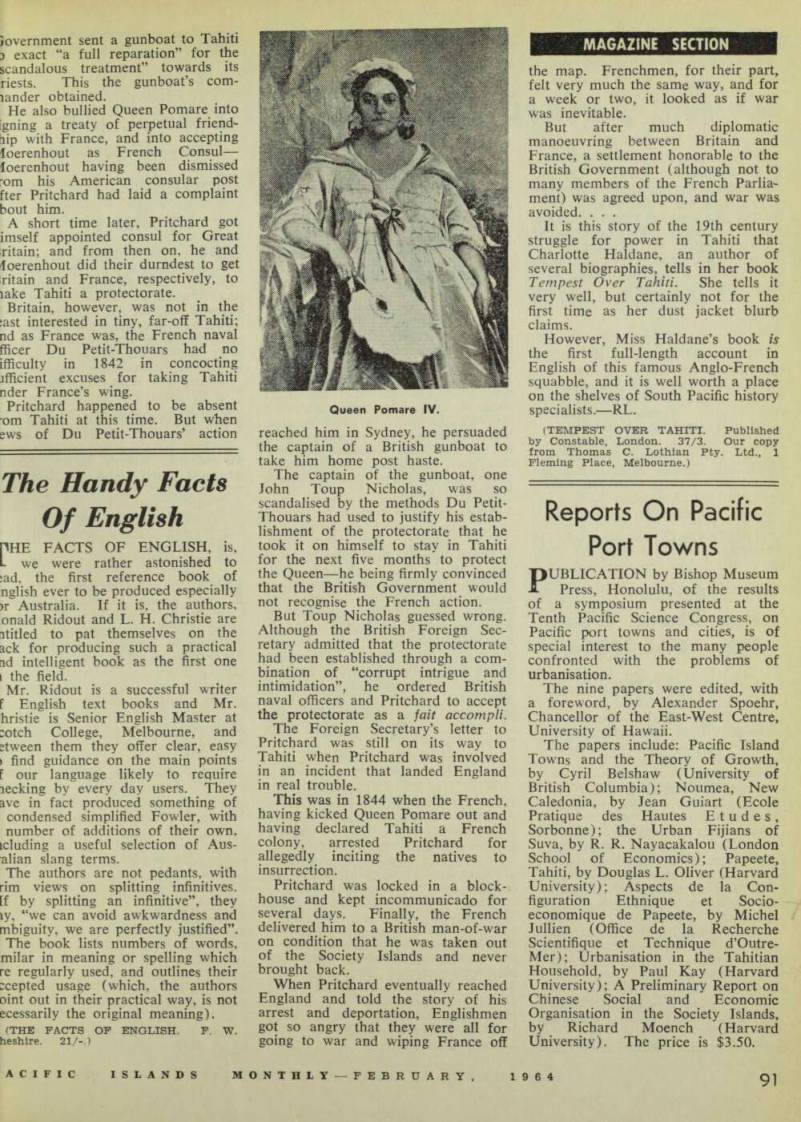
More than that, they got the Tahitian sovereign, Queen Pomare IV, to order the priests to be expelled; and when the priests refused to go, they saw to it that they were thrown out.
It happened, however, that the priests had been staying in the house of a Belgian merchant called Moerenhout, who, besides being a Roman Catholic, was Consul for the United States.
Moerenhout, in his official capacity, wrote a highly-coloured account of the priests’ expulsion to the French Consul-General in Chile, and, he, in turn, passed on the story to the French Government, The result was that the French
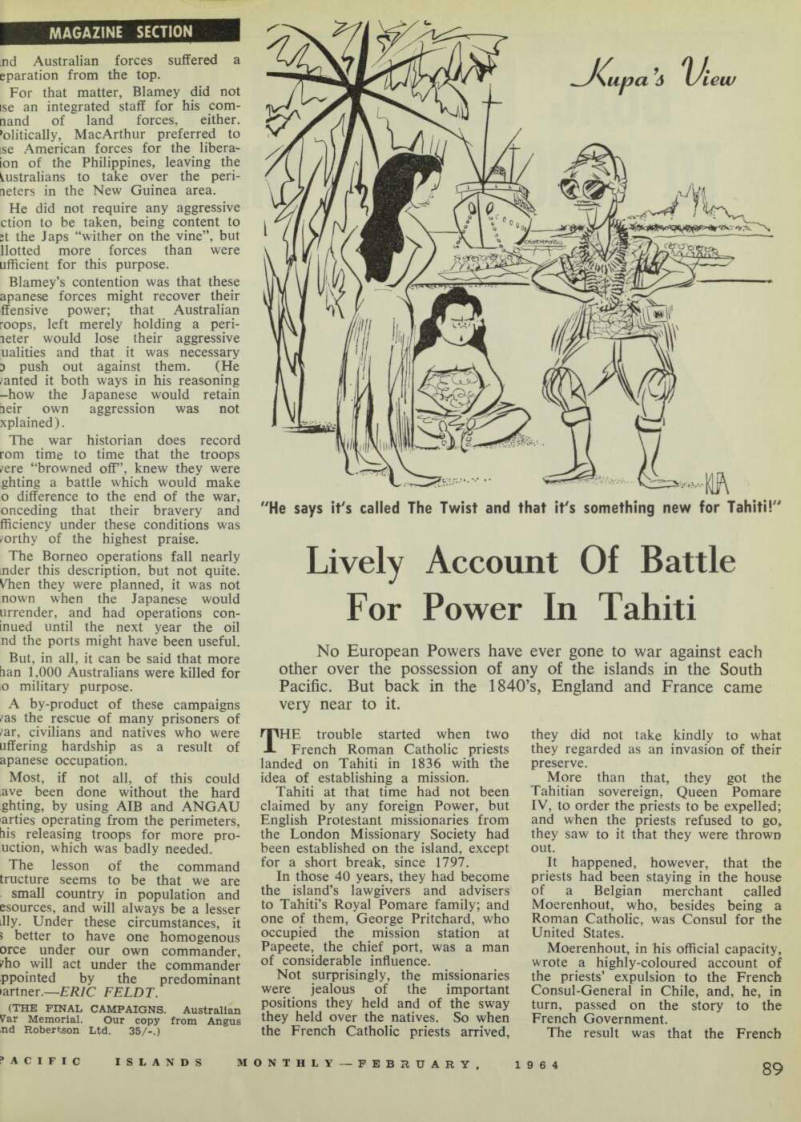
“He says it's called The Twist and that it's something new for Tahiti! 7 '
Jovernment sent a gunboat to Tahiti i exact “a full reparation” for the scandalous treatment” towards its riests. This the gunboat’s com lander obtained.
He also bullied Queen Pomare into igning a treaty of perpetual friend tup with France, and into accepting loerenhout as French Consul— loerenhout having been dismissed :om his American consular post fter Pritchard had laid a complaint bout him.
A short time later, Pritchard got imself appointed consul for Great ritain; and from then on, he and loerenhout did their durndest to get ritain and France, respectively, to lake Tahiti a protectorate.
Britain, however, was not in the :ast interested in tiny, far-off Tahiti; nd as France was, the French naval fficer Du Petit-Thouars had no ifficulty in 1842 in concocting ifficient excuses for taking Tahiti nder France’s wing.
Pritchard happened to be absent om Tahiti at this time. But when ews of Du Petit-Thouars’ action
reached him in Sydney, he persuaded the captain of a British gunboat to take him home post haste.
The captain of the gunboat, one John Toup Nicholas, was so scandalised by the methods Du Petit- Thouars had used to justify his estab lishment of the protectorate that he took it on himself to stay in Tahiti for the next five months to protect the Queen —he being firmly convinced that the British Government would not recognise the French action.
But Toup Nicholas guessed wrong.
Although the British Foreign Sec retary admitted that the protectorate had been established through a com bination of “corrupt intrigue and intimidation”, he ordered British naval officers and Pritchard to accept the protectorate as a fait accompli.
The Foreign Secretary’s letter to Pritchard was still on its way to Tahiti when Pritchard was involved in an incident that landed England in real trouble.
This was in 1844 when the French, having kicked Queen Pomare out and having declared Tahiti a French colony, arrested Pritchard for allegedly inciting the natives to insurrection.
Pritchard was locked in a block house and kept incommunicado for several days. Finally, the French delivered him to a British man-of-war on condition that he was taken out of the Society Islands and never brought back.
When Pritchard eventually reached England and told the story of his arrest and deportation, Englishmen got so angry that they were all for going to war and wiping France off
the map. Frenchmen, for their part, felt very much the same way, and for a week or two, it looked as if war was inevitable.
But after much diplomatic manoeuvring between Britain and France, a settlement honorable to the British Government (although not to many members of the French Parlia ment) was agreed upon, and war was avoided. . . .
It is this story of the 19th century struggle for power in Tahiti that Charlotte Haldane, an author of several biographies, tells in her book Tempest Over Tahiti. She tells it very well, but certainly not for the first time as her dust jacket blurb claims.
However, Miss Haldane’s book is the first full-length account in English of this famous Anglo-French squabble, and it is well worth a place on the shelves of South Pacific history
specialists.-
RL.
(TEMPEST OVER TAHITI. Published by Constable, London. 37/3. Our copy from Thomas C. Lothian Pty. Ltd., 1 Fleming Place, Melbourne.)
Queen Pomare IV.