New Guinea Drinkers Don’T
pp. 53-55 · Read in the full issue

Have It So Good
From a Port Moresby Correspondent, and AAP-Reuter Twelve months after the introduction of liquor to P-NG natives there are growing complaints in several areas about drinking conditions.
People in both Rabaul and Port Moresby say that the towns have too many native drinkers and not enough bars to hold them.
3ABAUL has two hotels and the LV Rabaul Town Advisory Council ays it ought to have a third, toether with licensed restaurants to ater for natives. The council has Iso suggested that storekeepers hould be able to sell single bottles, Dr many native drinkers, who have 3 buy a carton, use all their wages nd often drink the lot in one sitting nyhow. Wives and children go ungry.
Tolai women have recently marched irough Rabaul in protest against the rinking conditions. They said their icn folk should be taught how to rink intelligently or else they should e r> b u 111 drinking.
Rabaul police have had to crack own recently on methylated spirit rmkers and some suppliers have sugested that the spirit should be dulterated by the addition of quinine cfore U is sold.
In Port Moresby, which has three ;°tels for a population of 35,000 here has also been a request (to he Liquor Licensing Commission) or another hotel.
Sittings of the commission have ecently helped to bring many native brmking problems into focus, and howii many Europeans throughout he Territory that the drink problem s not as simple as it might first lave looked when prohibition was ifted in November, 1962.
The commission has heard applica tions for extra liquor outlets in large urban centres, aimed mainly at giving the native population greater access to alcohol.
During these sittings groups of native women have demonstrated against greater availability, and have demanded the reintroduction of native prohibition, Police have told of increased “tribal brawling”, increases in petty thievery, and attacks on police, Missions have warned of the de moralising effects of alcohol on their converts,
Far Ranging
Police Commissioner Normoyle says, although serious incidents dur ing the past year or so have been rare, the social effects have been far ranging.
The basic wage rate in the Terri tory’s urban centres is about £3 a week. A native base rate labourer or houseboy faced with the upkeep of a wife and two children plus a liking for alcohol has found the problem in many cases almost too much for him to bear, In some cases wives and children have been neglected, essential items of clothing for families are just no longer available, and sometimes the wives and children have been forced to return to the villages so they can get enough to eat.
On the credit side there has been a growing awareness among the natives themselves of the effects of alcohol and a growing social consciousness brought about by its problems.
Native welfare associations have shown greater maturity in looking after the rights and interests of the people in their areas.
Moves have been made in some areas to get the base rate wage in creased to cope with the growing cost of living, or the growing cost of “luxury” living.
Missionaries, and to a lesser extent police and welfare workers, believe the change has been too sudden for a relatively unsophisticated people to absorb without harm.
And they feel that as further licence concessions are granted in outlying areas the problem will grow.
But they readily admit that not to allow drinking rights would smack of “racialism”.
Anti-Liquor, Anti-Smoking
IN New Guinea, as elsewhere in the South Seas, temperance societies are growing.
The most active temperance move ment in P-NG, the Society for the Encouragement of Voluntary Abstinence, is soon to get a full-time secretary from Sydney, Pastor L.
A. Dyason.
Already SEVA has two full-time employees, Mr. G. Maskelyne who
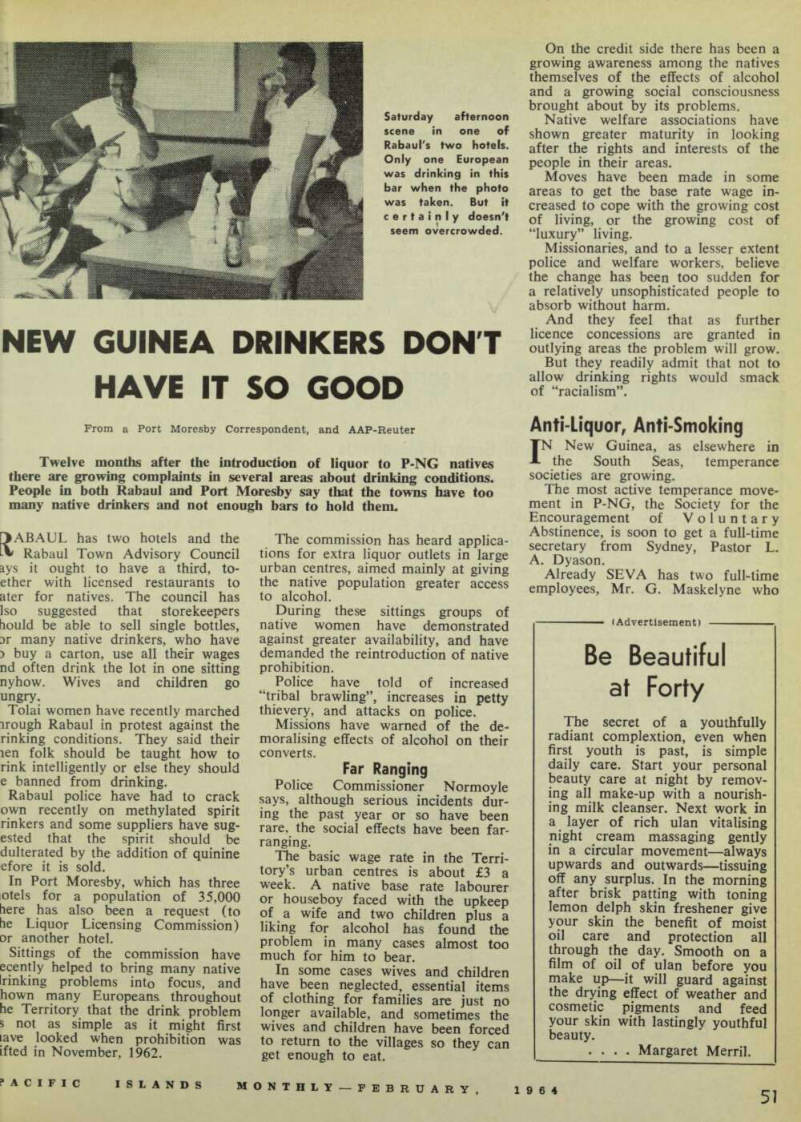
Saturday afternoon scene in one of Rabaul's two hotels.
Only one European was drinking in this bar when the photo was taken. But it certainly doesn't seem overcrowded.
works from Port Moresby, and Mr.
R. Skerman based at Rabaul.
Both officers move among the people carrying out “liquor education campaigns”, and encouraging abstinence.
Finance for the movement comes mainly from the Queensland Temperance Union, but the Admimsu p pleme nts this income with Discussion on the first day of the Papua Ekalesia Assembly (formerly the LMS) was devoted almost entirely to the drink question. Most Assembly members said they did not favour prohibition for church members, but were in favour of the continued encouragement of voluntary abstinence.
The Assembly referred to “dread ful” things that were happening in villages because of drink and decided that Administration should be kept fully aware of the hardship it was causing in many cases.
Assembly members supported the work of temperance societies. n , ortJvp in Tahiti (he Cooks both SamoaSj Tonga an d KjL Generally they are affiliated with th « Australian Temperance Society, whose secretary is Pastor E H Steed ? f the Seventh-day Adventist Church u Syd " ey V Pa . stor t S ' eed V w- the Church s Director of Public Relations, The temperance societies are currently making a big drive for membership, The Cook Islands Society recently
organised a Temperance Week, another is promised for Western Samoa this year and there are plans to have one in New Guinea. In the Temperance Week in the Cooks a crowd of 3,000 to 4,000 people saw parades and demonstrations. One banner read, “Go Steedy on the Bust Beer”.
Pastor Steed, who was present ai the Temperance Week, and who latei went on to Western Samoa, saic Samoa’s Prime Minister, Fiame Mataafa, as honorary president ol the Samoa Temperance Society, hac
agreed not to serve any alcohol at any official or social function for which he was responsible.
The various temperance societies are also making a drive against smok ing in the Islands, particularly in Fiji and New Guinea, where there are rigarette factories.
Pastor Steed said in January: The tobacco firms are attempting to quickly expand their South Seas markets, for they know the axe will fall on cigarette smoking in the metro politan countries because of the wide publicity about links with cancer.
They are introducing cigarettes to thousands of new victims who haven’t got enough education to understand scientific and medical aspects of smoking”.
Samoan Home Brew During the pre-Christmas period, Apia police made an all-out drive against home brewers and boot leggers.
The Commissioner of Police, Alphonse Philipp, said that raids were being made on an average of 50 premises each week and that illegal liquor was being found in half the raids.
“About 25 per cent, of the home brewers manage to destroy the evid ence before the police can confiscate it,” he said. The use of radio-tele phones installed in police vehicles has proved a big help in these raids.
The Commissioner said he did not think that there was even one village
in Samoa where some person was not brewing beer. He said brewing was on the increase and that recently many trading stations had started sell ing small amounts of Customs beer on the sly. ‘The police are doing their best to see the law is carried out,” he said.
Under Samoan law a Liquor Board issues “medicinal permits” for liquor on a basis of race, and finance and social position. Nobody can drink without a permit. It is generally acknowledged that the police are fighting a losing battle.
An official American Government
report linking smoking with lung cancer, released in January, gave the anti-smoking drive in the Islands a helping hand. Prohibitionists made good use of it as a weapon.
In Fiji, Health Department officers said the best advice they could give was “don’t smoke”. They said they accepted that cigarette smoking caused lung cancer and other illnesses, as mentioned in the American report, but they also accepted the report of the Royal College of Physicians, pub lished two or three years ago.
Officers said that in 1962 nine cases of cancer of the throat and lungs were admitted to Fiji hospitals.
Pastor E. H. Steed.