On Early
pp. 51-52 · Read in the full issue
New Light On Early Fiji
The discovery of pieces of >ottery and other ancient craft vork in the sands at the mouth
)f the Sigatoka River, Fiji, leads
At. J. B. Palmer, curator of the 7 iji Museum, to advance a heory that at least that part of
7 iji was populated by Poly
lesians about 500 BC. 9E is supported by Mr. R. C.
Green, Senior Lecturer in Pre listory, University of Auckland, nd Mr. Jack Golson, who is in harge of archaeology at the Aus ralian National University, Can ierra.
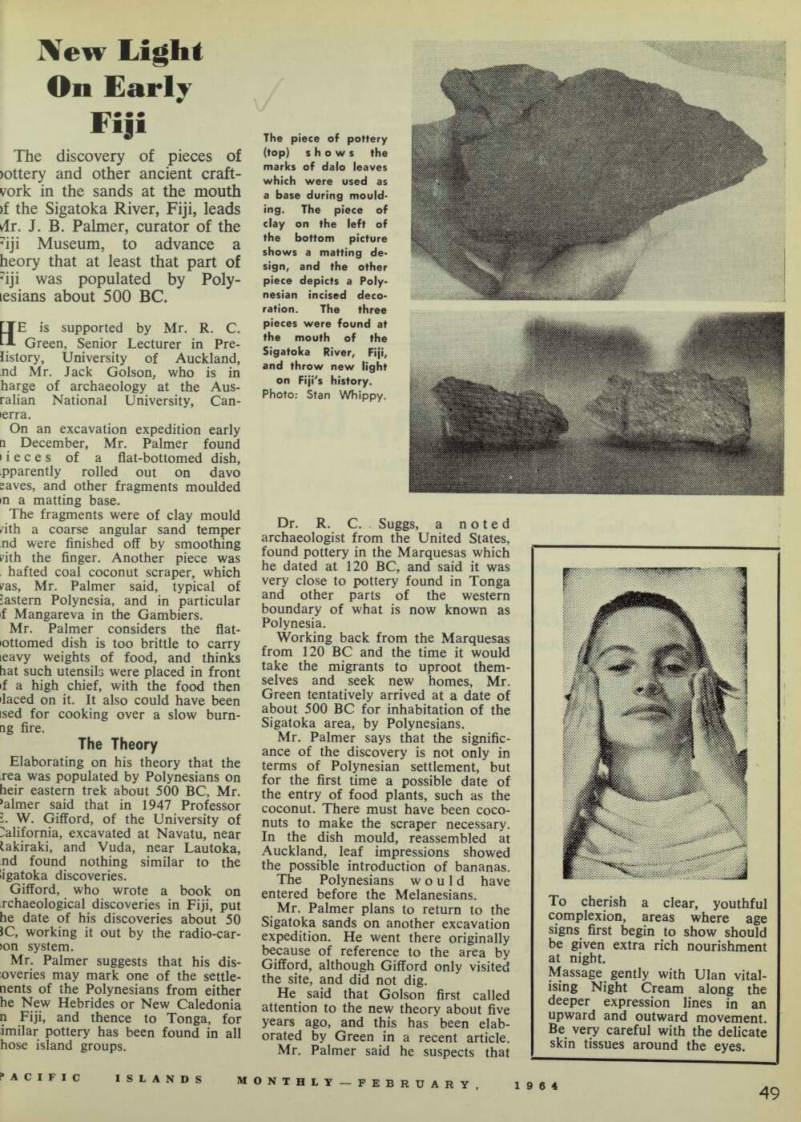
On an excavation expedition early n December, Mr. Palmer found iie c e s of a flat-bottomed dish, pparently rolled out on davo saves, and other fragments moulded m a matting base.
The fragments were of clay mould dth a coarse angular sand temper nd were finished off by smoothing /ith the finger. Another piece was hafted coal coconut scraper, which /as, Mr. Palmer said, typical of iastera Polynesia, and in particular f Mangareva in the Gambiers.
Mr. Palmer considers the flat •ottomed dish is too brittle to carry teavy weights of food, and thinks hat such utensils were placed in front if a high chief, with the food then ilaced on it. It also could have been ised for cooking over a slow burn ng fire.
The Theory
Elaborating on his theory that the rea was populated by Polynesians on heir eastern trek about 500 BC, Mr. ’aimer said that in 1947 Professor i. W. Gifford, of the University of California, excavated at Navatu, near lakiraki, and Vuda, near Lautoka, nd found nothing similar to the ►igatoka discoveries.
Gifford, who wrote a book on rchaeological discoveries in Fiji, put he date of his discoveries about 50 IC, working it out by the radio-car >on system.
Mr. Palmer suggests that his dis overies may mark one of the settle nents of the Polynesians from either he New Hebrides or New Caledonia n Fiji, and thence to Tonga, for imilar pottery has been found in all hose island groups.
Dr. R. C. Suggs, a noted archaeologist from the United States, found pottery in the Marquesas which he dated at 120 BC, and said it was very close to pottery found in Tonga and other parts of the western boundary of what is now known as Polynesia.
Working back from the Marquesas from 120 BC and the time it would take the migrants to uproot them selves and seek new homes, Mr.
Green tentatively arrived at a date of about 500 BC for inhabitation of the Sigatoka area, by Polynesians.
Mr. Palmer says that the signific ance of the discovery is not only in terms of Polynesian settlement, but for the first time a possible date of the entry of food plants, such as the coconut. There must have been coco nuts to make the scraper necessary.
In the dish mould, reassembled at Auckland, leaf impressions showed the possible introduction of bananas.
The Polynesians would have entered before the Melanesians.
Mr. Palmer plans to return to the Sigatoka sands on another excavation expedition. He went there originally because of reference to the area by Gifford, although Gifford only visited the site, and did not dig.
He said that Golson first called attention to the new theory about five years ago, and this has been elab orated by Green in a recent article.
Mr. Palmer said he suspects that
The piece of pottery (top) shows the marks of dalo leaves which were used as a base during mould ing. The piece of clay on the left of the bottom picture shows a matting de sign, and the other piece depicts a Poly nesian incised deco ration. The three pieces were found at the mouth of the Sigatoka River, Fiji, and throw new light on Fiji's history.
Photo: Stan Whippy.
the Polynesians touched the Yasawas or Lautoka before moving on to Sigatoka, although there is no evidence. He also thinks that when they left Fiji they touched somewhere in the Lau Group before going on to Tonga.
Big Population
Mr. Palmer also suspects there was quite a big population in the Sigatoka area, not only near the mouth of the river where he found his pottery, but also well up the Sigatoka Valley. He flew over the area recently as the guest of Fiji Airways.
One of the pilots, Captain Joe Rudenko, a Dutchman who was an
amateur archaeologist in Indonesia before joining Fiji Airways, noticed on his regular flights over Fiji ancient agricultural terraces on hillsides in the valley.
When Mr. Palmer flew over, Cap tain Rudenko pointed out the terraces, and Mr. Palmer noted that they were to terraces in the New Hebrides and New Caledonia, Mr. Palmer described the terrace finds as unique and very important, They indicated the presence of skilled agriculturists at an early date. They could be linked with the discovery of the pottery, and could also date back to about 500 BC.
The terraces were apparently fo earth conservation and to make th best use of rainfall. They were i: steep spurs and in remote am apparently inaccessible spots.
Mr. Palmer said he would expec to find such terraces near the set but not miles inland. An explans tion could be that the makers wer harried and pursued by other people They could also reflect a perio when Fiji’s climate was different. 1 they were agricultural terraces the could have been abandoned becaus of the climatic change.
Mr. Palmer plans to visit the are later this year to make an on-thc spot investigation.
FOOTNOTE: Pieces of crocken adzes and ashes of fires of 1,90 years ago were dug up at Vailelc Western Samoa, in December by Mi R. C. Green and an anthropologies team sponsored by the Aucklan University and Hawaii’s Bisho Museum. Other finds include mound ranging from 20 to several hundre feet across on which Mr .Gree believes the ancient Samoans bur their houses, Mr. Green expect to be at Vailele for six month*.