First All-In Election
pp. 11-12 · Read in the full issue
300 Candidates For First All-In Election
There were jew surprises contained in the list of nominees for Papua-New Guinea’s new House of Assembly when nomina tions closed on January 6. As expected, most of the old legis lature’s elected members have nominated for re-election, but few of the nominated members will seek to retain their seats.
CiNLY two of the Legislative Council’s elected members are lot offering themselves as candidates, tfr. J. L. Chipper, of Rabaul, and Jougainville’s Mr. Paul Mason.
Mr. B. E. Fairfax-Ross, Mrs, R. I. lates, Fr. J. G. McGhee, Dr.
Reuben Taureka, Mr. Ephraim übilee, Miss Alice Wedega and Mr. tfaneto Kuradal are the seven lominated members from the old louse who are not contesting their ilaces.
Of these Dr. Taureka was the only urprise absentee from the list of lominations.
He is not standing because he /ishes to pursue his career in nedicine and nomination and lection to the House of Assembly /ould have meant his resignation rom the Public Service.
Surprise Absentee
Influential Kerema, Albert Maori Liki, is another who has surprised y failing to nominate. It had been ddely expected he would resign his osition as an Administration welfare officer to contest the akekamu open electorate which ikes in his home village of Kikori.
Most of the interest in the ominations has centred about those ew to central politics, or those ;eking to return to them after an bsence.
For instance, there is Major Don arrett, who is contesting the West lazelle special electorate in an Sort to return to the legislature fter an absence of many years.
Then there’s Wewak’s elder olitician Simogun Peta who is try ig to return to the legislature after similar respite from central politics.
Among those taking their first tilt t the House are the New Guinea arty’s Mr. Charles Kilduff, a Port loresby Barrister; Mr. Dennis Junior) Buchanan, a light aircraft perator from Goroka who will ppose Mr. lan Downs, and Koitaki lanter Mr. Colin Sefton, who will ave 11 opponents for the Moresby pen electorate.
Three of the most intriguing ominations are those of former cult
leaders Yali, of Madang, and Paliau, of Manus, and present leader of a cult on Buka, Francis Hagai. All are contesting open seats.
Paliau, formerly the leader of a troublesome magico-religious cargo cult on Manus in the immediate post-war years, is now the president of a Local Government Council.
Yali, from the Saidor area of Madang, is a former police sergeant and wartime Coastwatcher, who won a very big following after the war.
He disappeared from the scene when sentenced to six years jail.
Already people in electorates surrounding the one that Yali will stand for have expressed disatisfac tion because they will not be allowed to vote for their old leader!
Close observers say both Yali and Paliau are almost certain of election.
Francis Hagai is one of the leaders of the Hahalis Welfare Society on Buka Island, whose 3,500 native adherents refuse to conform to social tenets and want to run their lives independently of everyone else. They have created many problems for the Administration and for the missions.
Hagai, too, has served a gaol sentence.
Cult Activities Hagai is being opposed in the election by the leader of the Buka Local Government Council, Anton Kearei, who at one time was being openly accused on Bougain ville of having himself been mixed up with cult activities. He at one time studied for the priesthood.
Perhaps the most closely con tested electorates will be the Moresby open, the Central special, the Milne Bay open and the West Papua special.
In the Moresby open, Papua and New Guinea Workers’ Association president Oala Oala-Rarua will contest the seat with three Europeans —Colin Sefton, Bill Stansfield and Tapini businessman John Martin— as well as four fellow Motuans and four Goilalas.
Before nominations were an nounced Oala-Rarua was considered
a good thing. He had been endorsed by the Fairfax Local Government Council and a number of his likely opponents had assurred him they would not stand in opposition.
But the nomination list showed Hanuabadan Willie Gavera and three others had not kept their promises.
Mrs, Ana Frank Gaudi from Oala-Rarua’s home village of Pari had nominated and so had Bill Dihm, a Seventh-day Adventist adherent from Kila Kila, and ex Sgt.-Major Daera Ganiga, of Hanuabada.
It now seems certain the Motuan vote will be split sufficiently to give either a Goilala or European candidate victory.
The Goilala area provides the Moresby open electorate with its biggest individual block of voters, 17,000. Already there has been criticism from both natives and Europeans on the definition of the electorate.
Anthropologist Dr. Murray Groves, who is visiting P-NG, says, “It will be tragic if the sophisticated urban people of Port Moresby in this election fail to get a voice in the House.
“For years they have tried to find a political outlet but each attempt has been frustrated. If they fail this time they will certainly blame the electoral system. They will
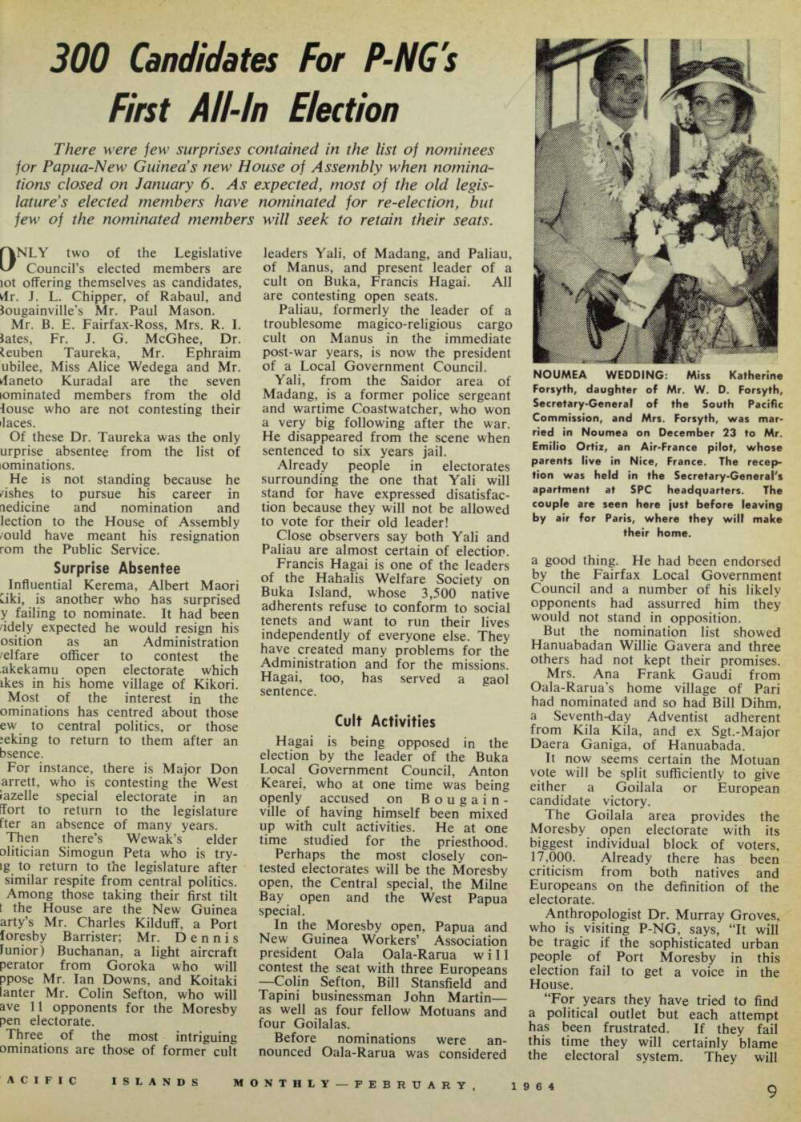
NOUMEA WEDDING: Miss Katherine Forsyth, daughter of Mr. W. D. Forsyth, Secretary-General of the South Pacific Commission, and Mrs. Forsyth, was mar ried in Noumea on December 23 to Mr.
Emilio Ortiz, an Air-France pilot, whose parents live in Nice, France. The recep tion was held in the Secretary-General's apartment at SPC headquarters. The couple are seen here just before leaving by air for Paris, where they will make their home.
believe deliberate efforts have been made to keep their representative out of government.”
In the Central special LMS missionary Rev. Percy Chatterton, who came to the Territory in 1923, seems to hold the best chance.
He is opposed by Baraina trade store owner and Catholic lay preacher Mr. Ron Brennan; Port Moresby barrister Mr. Charles Kilduff, the member of the New Guinea Party who recently contested (unsuccessfully) the West Sydney seat in the Federal elections; Mrs.
Kay Ashcroft-Smith the wife of a Port Moresby public servant, Tapini planter Mr. “Andy” Ander son who was formerly an ADO, and Mr. Bert Pikett, a Sogeri business man.
Before nominations were declared Mr. Brennan was thought to have the best chance because he looked likely to take the Goilala vote. But now, with Mr. Anderson sure to split the Goilala vote, Mr. Chatterton’s position seems secure.
Senior Papuan politician Mr.
John Guise will contest the Milne Bay open electorate with long-time Milne Bay businessman Mr, Bob
Bunting, Mr. Asineru Dickson and Mr. Albert Munt.
Mr. Dickson, a Kwato Mission adherent who has worked with Administration for many years, is tipped to take a good slice of the votes John Guise may otherwise have expected. This could well put Mr. Bunting in a favourable position.
Mr. Guise himself recognises it’s going to be a closely fought seat.
He said in Port Moresby recently he would not be surprised if Mr.
Bunting won.
Ex-Legislative Councillor Mr. Ron Slaughter, a Yule Island business man, chose to stand for West Papua special in preference to the Central special electorate in which he would have opposed Mr. Chatterton.
He is opposed by Mr. Ronald Thomas Dalton Neville, who re signed his position as ADO at Tan to contest the seat. The concentra tion of voters in this electorate is around the area in which Mr. Neville has been well-known to the native people for a number of years.
Mr. Slaughter is scarcely known to the people of his electorate other than those who live on the coast.
Among those who were expected to nominate but didn’t was Mr.
Mick Leahy, pioneer planter. His electorate is the South Markham special, but it is understood he decided not to nominate against Lloyd Hurrell, the sitting member, who Mr. Leahy considers has done an excellent job.
Mr. Hurrell has two oponents— Markham planter Mick Casey and Kainantu hotel owner Graham Gilmore.
Will Europeans Succeed?
The big question at present is whether any Europeans will succeed against natives in Open electorates.
Opinion on this question is divided.
Many Native Affairs officers say that where there are native can didates representing a number of tribal groups within one electorate the voting will be split enough to give a European candidate victory on the preferences.
But there are grave doubts that more than a fraction of native voters will use the preference system.
Already John Guise’s constituents have said they find the preference system too difficult to understand and that they will mark only one name.
The fact there are 299 candidates for the 54 seats means the electoral education campaign will be extended
even further, believes Chief Elector; Officer Mr. R. R. Bryant.
“This number of candidates wi have an important effect on tl people’s understanding of tl election,” he says.
Mr. Bryant says the number ( candidates indicates the success ( the electoral education campaig carried out in the field for the pa five months.
So far the election machinei seems to be working as planne< although printing of the Commo Roll and electoral map is still ui finished.
Electoral education patrols ai now engaged following the route to be taken by mobile polling tearr to check the timetables drawn u in Mr. Bryant’s office.
Before the first polling day, Eel ruary 15, mock elections will ha\ been carried out in more than 8,00 villages and hamlets.