Fiji Starts New Year
pp. 9-10 · Read in the full issue
With New Governor And New Political Plan
From a Suva Correspondent Fiji has taken the first step towards in ternal self-government. On January 17 the unofficial members of the Legislative Council unanimously passed a resolution calling on the Government to introduce the “Member system” of government as soon as practic able. The official members, as is usual when constitutional matters are discussed, refrained from taking part in the debate, and also from voting.
Ratu K. K. T. Mara, a leading Fijian chief, who moved the motion, said “It will not be far-fetched to put it alongside the great Deed of Cession
IN Indian member, Mr. A. I. N.
Deoki, who seconded the lotion, said the occasion was one of 16 most momentous in the history Fiji* Under the Member system the overnor will invite unofficial embers of the Executive Council ► undertake supervisory functions 'er groups of Government departents There might be a Member ir Natural Resources, a Member T Social Services, and so on.
The Members will have no tecutive authority, but all policy afters relating to their departments ill be referred to them. They will ive a big say in policy-making, and ill be expected to take an active terest in all asnects of the work
: the deoartmentsTn thdr oortfoUrT
P Hnuu If Wnrlrc p . . .
Policy questions coming in from apartments, which are at present ft with m the Secretariat, will be
t 0 tbe . Members.
hey can take policy matters to f ST Council and they will ' expected to pilot through the egislative Council bills dealing with On IfnnnSmint vr u un appointment, Members will be quired to give an undertaking to 'CePt collective responsibility. In ie Executive Council they will be a 6 tf!°f^ PreSS • T WS xecutive ro,mr?l' e m C a e t b °? ce - !he xecutive Council makes a decision 16 Members Wlll b e bound by it.
If they do not wish to be bound they will have to resign.
The Government would thus be able to reduce the official side of th® Legislative Council. The official majority would always be available, but a number of official members would not be required to take their seats.
The Government, recognising that the work will take up a considerable portion of the time of Members, considers that a suitable salary will have to be paid to compensate them for loss of earnings. One unofficial member, privately, puts a suitable salary at £4,000 a year.
Ministers Eventually t-u e b cvenruaiiy f The Government hopes that in time, the Member system will develop into a full Ministerial system with executive responsibility.
The Government plans to retain the posts of Colonial Secretary (who may become Chief Secretary), Financial Secretary and Attorney- General, and they would rank as Ministers. Thus there would be an executive or Cabinet of ex-officio, official and unofficial ministers.
However, that is a long way off, and a Ministerial system will only be developed in the light of experience of the Member system.
Although the unofficial members unanimous in their vote at ' h ®. Januar y s . lttin s- several of them held reservations. The European members were more or less content
t 0 , wjth wh t th Fiji d ° g wun wndl ine riJians ’ whethpr the Fiiians rpallv we re undeserved in the rv ew was to ouestion Two of l ° l l ue ? tl< ? n - T *° of ' not s f. eak , ,n th . e debate, fwo rears aeo expressed very strone vTew'Taboutfnt m V ‘ 8 views about the future. *1 R^ tI L- ? enaia °J ie r stai i ed 4 h !i LeBl * la u tive Council during the Budget debate i n December, 1961, by saying: “When the time comes—and I hope the time will not come soon for some new form of Government to replace the present system—then I would like to say here that the Fijians would like the composition of the Legislative Council to be reviewed, and I would also like to have it recorded here that the running of this Colonv must be handed § over to the Fijians. By that I mean administratively and politically”
Ratu George Cakobau the second silent Fijian, had at’ that fime echoed Ratu Penaia’s words He said in 1961: “I have‘nothing against independence; let indepen® dence come. But when that independence comes—l should like
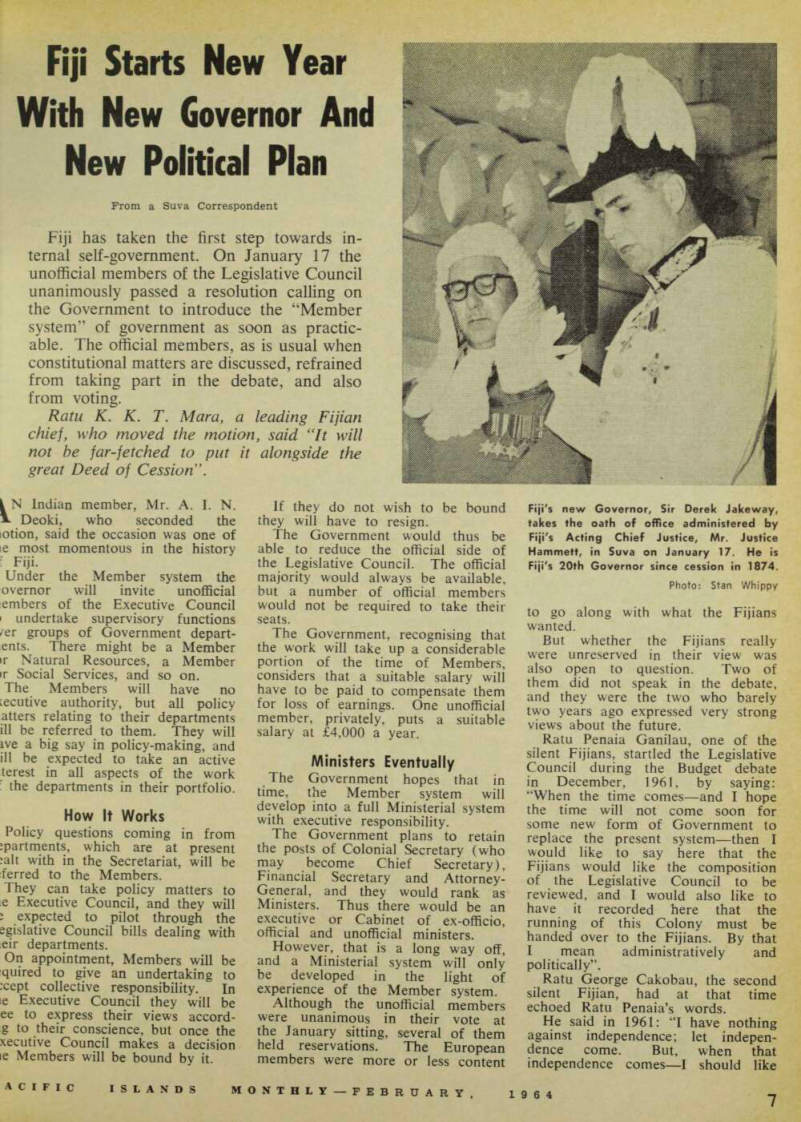
Fiji's new Governor, Sir Derek Jakeway, takes the oath of office administered by Fiji's Acting Chief Justice, Mr. Justice Hammett, in Suva on January 17. He is Fiji's 20th Governor since cession in 1874.
Photo: Stan Whippy
this recorded in this House—let the British Government return Fiji to the Fijians in the state and in the same spirit with which the Fijians gave Fiji to Great Britain”.
Many Views
Acknowledgement that there were indeed many views beneath the surface was made by a European member at the January sitting, Mr.
J. N. Falvey. He said, in effect, that the different viewpoints would become more obvious when the details of the system came to be worked out.
Fijian Ravuama Vunivalu said he had irrevocable proof that a foreign influence was at work in Fiji trying to create a wedge between the various races.
He said that people all over the world were asking why the Fijians did not want independence.
My answer to that, my personal answer, is that with our growing population, the comparative lack of development of the land, and with more than 10,000 school-leavers every year, there is bound to be a blow up, however you like to term - »is bound to come , Ravuama said. fn J h s e WiH rtainly be problems for the new Governor, Sir Derek Jakeway, in choosing his Members.
By what yardstick will they be chosen*? Presumably all racial groups will be represented. w p G m e . neral opinion in Fiji is that the Member system will at least give
some indication of the capabilities of the people of Fiji to govern them selves.
The smaller Cook Islands adopted the system some months ago in preparation for full Cabinet govern ment, Western Samoa went through the same system a few years ago, be fore independence, and Papua-New Guinea seems to be the next big terri tory to follow suit, although P-NG people are not nearly as advanced as those in Fiji.
Governor's Arrival Fiji’s new Governor, Sir Derek Jakeway, arrived in Fiji the day after the Legislative Council meeting, and in his first public statement, immedi ately after he took the oath, promised to do all in his power to help the Colony towards internal self-government.
“I believe that it is right that the people of the Colony should play a greater part in their own Govern ment,” he said. “I can assure you that I and the officers of my Govern ment will do everything in our power to assist you towards this end, so that constitutional progress, in accordance with the wishes of the people of the Colony, may be to the benefit of all.”
Sir Derek repeated that the Sec retary of State for the Colonies, at present Mr. Duncan Sandys, intended to convene a constitutional con ference in 1964 or 1965 to discuss Wlth representatives of the people of Fiji what form further con
stitutional progress towards interr self-government might take, wh still retaining the present strong lin with the Crown of which the peoi of Fiji were so rightly proud.
Sir Derek, who has never been Fiji before, soon showed that he h done his homework. He knew great deal about the Colony and problems.
He described the 1964-68 develc ment plan as a “bold challenge”, “I am confident that the plan w bring material progress to the peop of the Colony and I assure you r Government will do all it can speed up its implementation,” said.
He warned that there might difficult times ahead, but he w confident that with goodwill ai harmony between the various rac the difficulties could be surmount to the benefit of all.
Speaker's Welcome
The Speaker, Mr. Maurice Sco welcoming Sir Derek and Lai Jakeway, said it was the ardent desi of the people to co-operate with ti new Governor for the good of tl islands. He said it was fortuna there was someone of Sir Derel calibre and experience appointed guide and help Fiji over the peril of change.
Fiji felt she had special probler which had not occurred and did n occur in other Colonies, and tho problems demanded very speci consideration.