The Fascination
pp. 89-90 · Read in the full issue
The Month's New Reading
For Smithy
Although it is now more than 28 years since Sir Charles Kings ford Smith disappeared into the void on a flight between England and Australia, Australians are still fascinated by him, both as an air pioneer and as a man. The aura of mystery and sadness that surrounded Smithy in his lifetime has continued with the years since 1935.
IWO new books help further the - legend, although neither set out do so. Isabel Carter, in her mthern Cloud, tells the story of the ss of the tri-motor Avro-Fokker air ier. Southern Cloud, in March, >3l, on a flight between Sydney and elbourne.
The aircraft, whose grave in the ustralian Alps remained unknown itil 1958, was owned by Australian ational Airways, a company unded and operated by Smithy and larles Ulm, and Miss Carter sets
out to show how the Southern Cloud disaster led, by a series of inevitable steps, to the deaths years later of both Smithy and Ulm, and how in a sense it made other men.
One of the ANA pilots of those days, and a flying comrade of Smithy’s in some of his pioneer flights, was former first war pilot P. G. Taylor, now Sir Gordon Taylor, who has produced another of his autobiographies, The Sky Beyond. This is Sir Gordon’s fifth book, and as in some of the others Smithy is writ large.
Greatest Air Mystery The loss of the Southern Cloud was Australia’s greatest aviation mystery, for the largest air search ever carried out in Australia failed to find one clue to the aircraft’s disap pearance. In the days when air trans port was new the disappearance of an aircraft large enough to carry eight people was a sensation.
Miss Carter collects every fact of the crash, even to delving into the backgrounds of the passengers, but she goes farther than that, and it is this broad view which gives the book a place in Australia’s aviation litera ture.
There is not an early flyer who does not come into the picture in some way or other as Smithy and Ulm fight to keep ANA in the air in face of the tragic and expensive loss of their glamour aircraft. But ANA went down under the weight and Smithy set out to convince an apathetic Australian Government that airlines could be run if in their first years they had the benefit of a Gov ernment subsidy. ANA had none, but it was prosperous until the Southern Cloud disaster.
Smithy crossed the Tasman six times and spent £2,000 trying to
organise an airmail service against Government indifference. He knew that his dream of running a New Zealand service, or a service to Singa pore to link up with one planned from England, would be impossible without modern fast planes. With Government support Smithy could have had a trans-Tasman service going in 1935 (the route was even tually opened by somebody else in 1940).
Which ever way he turned Smithy made no headway. He was a wonder ful bloke whenever he broke a new record, but in between times he was nobody. The contract for a Singapore service, which he desperately needed and which his pilots could have flown on their ear, was given to a small company called Qantas.
Smithy's Death
He attempted another record flight from England, in the Lady Southern Cross, in an effort to put himself in a stronger position to talk to govern ments. He did not want to make the flight; he was ill, his stamina strained to danger point by ten years of worry, exhaustion and long distance flights. And somewhere over the Bay of Bengal Smithy, Tommy Pethy bridge and their aircraft disappeared.
Smithy was then 38.
In The Sky Beyond, Sir Gordon Taylor makes the comment that although it is a popular opinion that Smithy should never have undertaken
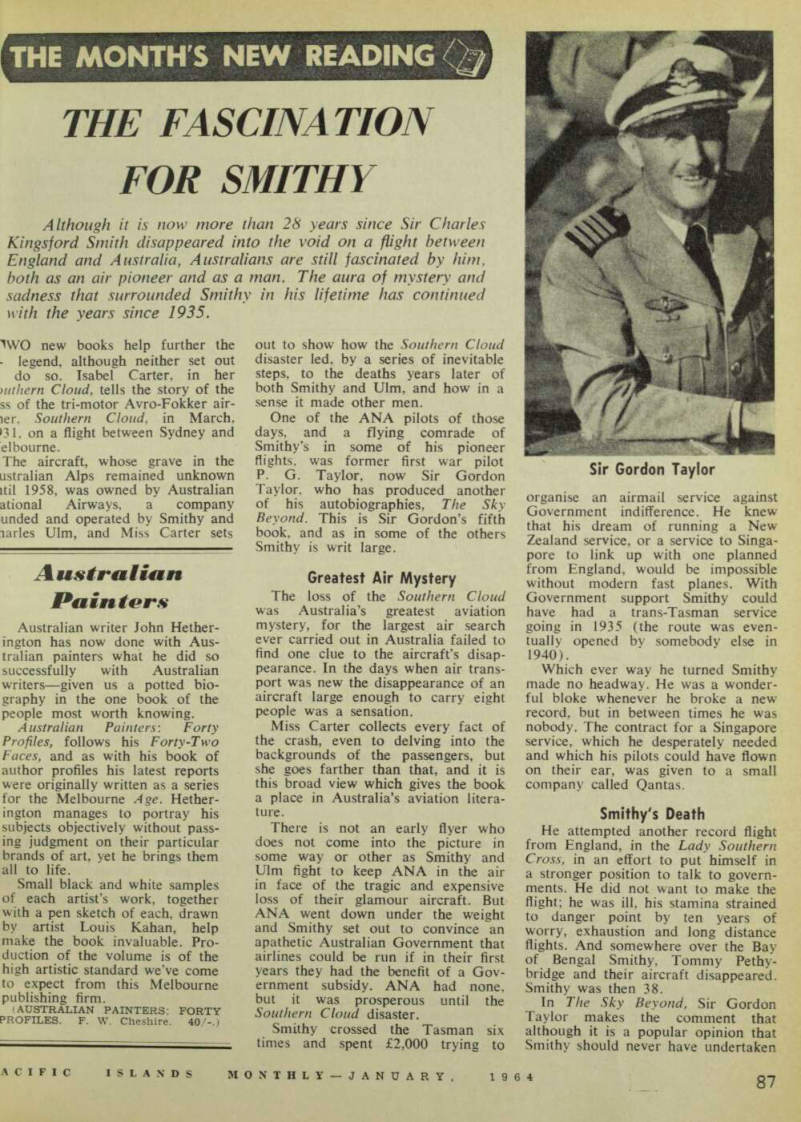
Sir Gordon Taylor
that last flight, the circumstances had forced him to it.
“There was no other way for Smithy,” writes Sir Gordon, “To have dragged out his life in some physi cally secure but drab situation would have been death for him anyway. He was completely right in setting out in this flight. It was necessary for the freedom of spirit on which he lived.”
The Sky Beyond covers most of the ground already crossed thoroughly by one or other of Sir Gordon’s earlier books, and in fact, the words are the same in many cases.
If he had not written those earlier accounts this one would have made a far greater impact, but those who have never read Taylor before will find this handsome volume more in teresting than they would have found any of the others.
Sir Gordon Taylor is a planner, a careful pilot not noted for a sense of humour. His careful prose, with, on occasions, its stilted conversations, go to emphasise his outlook.
The only time he allows himself to shine is in his account of his flying with the Royal Flying Corps as a fighter pilot on the Western front in France. This, one suspects, was the real adventure to him; in comparison, his later days were more adult, more serious.
This book brings Sir Gordon’s ad ventures up to his South Pacific cross ing between Australia and Chile in 1951, and ends with him planning his flying-boat tours in the Pacific. SI. oo < f OI^ I ?? RN CLOUD - Lansdowne Press. 28/6. THE SKY BEYOND. Cassell. 37/6.)