yesterday
p. 87 · Read in the full issue
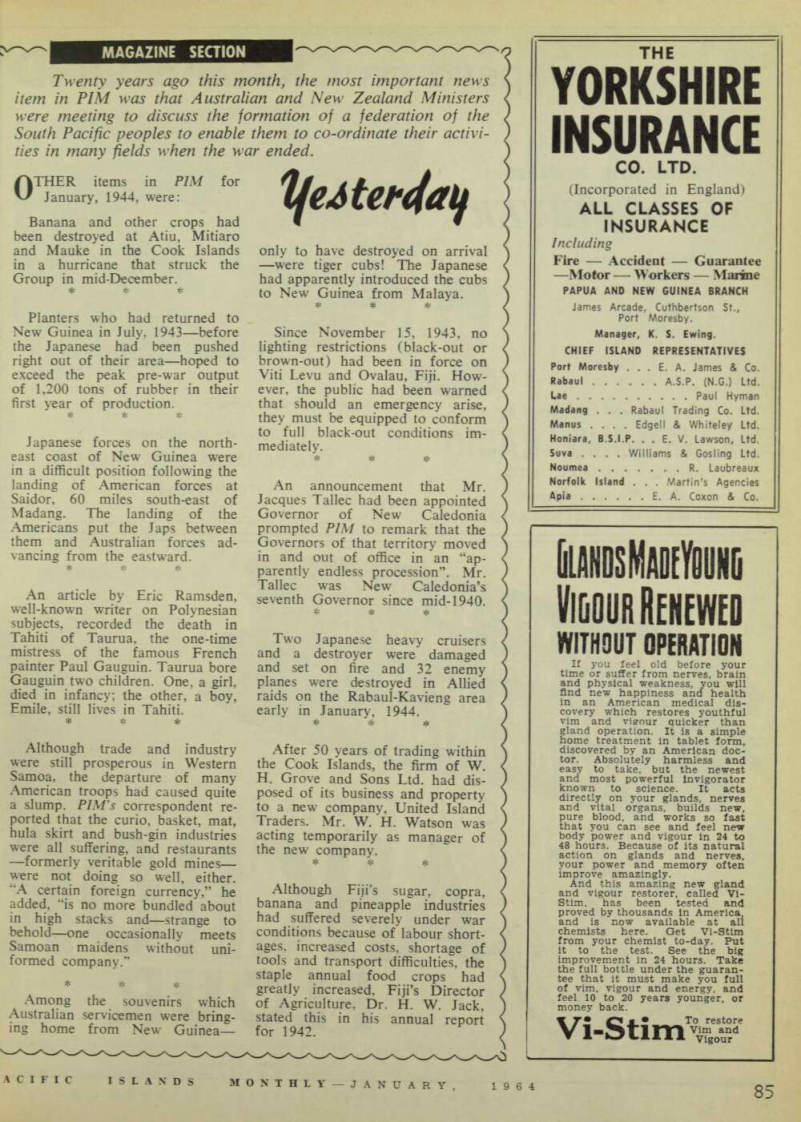
Twenty years ago this month, the most important news item in TIM was that Australian and New Zealand Ministers were meeting to discuss the formation of a federation of the South Pacific peoples to enable them to co-ordinate their activi ties in many fields when the war ended.
OTHER items in PIM for January, 1944, were: Banana and other crops had been destroyed at Atiu, Mitiaro and Mauke in the Cook Islands in a hurricane that struck the Group in mid-December. * * * Planters who had returned to New Guinea in July, 1943—before the Japanese had been pushed right out of their area—hoped to exceed the peak pre-war output of 1,200 tons of rubber in their first year of production. * * * Japanese forces on the north east coast of New Guinea were in a difficult position following the landing of American forces at Saidor, 60 miles south-east of Madang, The landing of the Americans put the Japs between them and Australian forces ad vancing from the eastward. * * * An article by Eric Ramsden, well-known writer on Polynesian subjects, recorded the death in Tahiti of Taurua, the one-time mistress of the famous French painter Paul Gauguin. Taurua bore Gauguin two children. One, a girl, died in infancy; the other, a boy, Emile, still lives in Tahiti. * * * Although trade and industry were still prosperous in Western Samoa, the departure of many American troops had caused quite a slump. PI M’s correspondent re ported that the curio, basket, mat, hula skirt and bush-gin industries were all suffering, and restaurants —formerly veritable gold mines— were not doing so well, either.
“A certain foreign currency,” he added, “is no more bundled about in high stacks and—strange to behold—one occasionally meets Samoan maidens without uni formed company.” * * * Among the souvenirs which Australian servicemen were bring ing home from New Guinea—
only to have destroyed on arrival —were tiger cubs! The Japanese had apparently introduced the cubs to New Guinea from Malaya. * * * Since November 15, 1943, no lighting restrictions (black-out or brown-out) had been in force on Viti Levu and Ovalau, Fiji. How ever, the public had been warned that should an emergency arise, they must be equipped to conform to full black-out conditions im mediately. * * * An announcement that Mr.
Jacques Tallec had been appointed Governor of New Caledonia prompted PIM to remark that the Governors of that territory moved in and out of office in an “ap parently endless procession”. Mr.
Tallec was New Caledonia’s seventh Governor since mid-1940. * * * Two Japanese heavy cruisers and a destroyer were damaged and set on fire and 32 enemy planes were destroyed in Allied raids on the Rabaul-Kavieng area early in January, 1944. * * * After 50 years of trading within the Cook Islands, the firm of W.
H. Grove and Sons Ltd. had dis posed of its business and property to a new company. United Island Traders. Mr. W. H. Watson was acting temporarily as manager of the new company. * * * Although Fiji’s sugar, copra, banana and pineapple industries had suffered severely under war conditions because of labour short ages. increased costs, shortage of tools and transport difficulties, the staple annual food crops had greatly increased, Fiji’s Director of Agriculture. Dr. H. W. Jack, stated this in his annual report for 1942.