Pacific Commerce and Produce
pp. 125-131 · Read in the full issue

P-NG Price Control And Hasty Laws Under Fire
Hasty legislation and the re mtion of price control on food i Papua - New Guinea were riticised by the chairman of
irectors of Steamships Trading
Company Ltd., Mr. H. D. Under rood, at the company’s annual leeting in Port Moresby in lovember.
LfR. UNDERWOOD said that, al ** though merchandising continued > be the greatest contributor to his Dmpany’s profits, the retention of rice control on food items in the erritory allowed unrealistic margins, specially when the much higher ssts applicable to servicing sales ere considered, compared with lose in Australia.
“Should the local Administration ;rsist with its present margins, we lay have to reassess our merchandis ig policy in this field,” Mr. Under ood said.
In criticising hurriedly-passed legis tion in P-NG, Mr. Underwood said: fhe Prime Minister’s assurances that ustralia does not propose to leave ic Territory in haste before its work is been completed and before the erritory is able to stand on its own :onomically, have been welcomed )th by the people of Papua and ew Guinea and by investors.
"Unreasonable Pressure"
“Nevertheless, due in part to the ustralian Government’s sincere but imetimes over urgent desire to bring e Territory to independence and in irt owing to unreasonable pressure •ought to bear through the United ations, legislation is being hurried rough the Legislative Council some nes without due thought being given > its effect on the economy of the ;rritory.
“For example, a bill was recently troduced into the Legislative ouncil which contained provisions npowering certain authorities to ise money by taxing all kinds of operty, “The provisions were so drafted
that taxes could be imposed in a dis criminatory manner against one section of the community to the ad vantage of another.
“Directors [of Steamships] con sidered that the powers to be granted could be exercised to the detriment of the development of the Territory by private investment and the com pany protested strongly to the Minister for Territories against these provisions.”
Mr. Underwood said he had since been informed that some amendments would be made.
However, the company would con tinue to object to any legislation which could inhibit private enterprise from developing and creating real wealth within the Territory.
Balance sheet figures for Steam ships Trading for the year to June 30, 1963, were published in PIM in November (p. 127).
Fiji Merchants Want A
Return To The FOB System
FFiji, agitation for a reversion to the FOB method of assessing Customs duty has been gaining momentum, and the Government has agreed to consider it.
Since 1948 when the Government introduced the CIF (carriage, in surance, freight) method, merchants say they have been burdened with extra paper work and with delays in clearing cargo resulting in triple bond charges.
Commerce started to speak against the current method with one voice in September and October when Senior British Trade Commissioner in New Zealand, Mr. J. L. Reading, told the Suva Chamber of Commerce, that CIF reacted against British trade with Fiji.
He even hinted that the Board of Trade might approach the Colonial Office about the matter, adding that even with the aid of preferential tariff (25 per cent.) Britain could not compete with Japan and other countries of the Far East as long as Fiji operated the CIF system.
At the October session of the Legislative Council, Mr. J. N.
Falvey, an unofficial member, moved that the FOB system be restored.
He confessed that as a member of the Fiscal Review Committee of 1954 he had been in favour of re tention of the CIF, but now he was opposed to it.
Mr. Falvey conceded, as do local merchants, that there will be a reduc tion in public revenue under the FOB system. He said this could be made up by selected increases in a number of items.
The Government refused to accept Mr. Falvey’s motion as it stood, but the Acting Financial Secretary, Mr.
R. M. Major, gave an undertaking endorsed by the Acting Colonial Secretary, Mr. H P. Ritchie, that a reversion to the FOB system would be considered early in the New Year.
But he said the Government would still require information about in surance and freight.
Mr. C. D. Aidney, president of the Suva Chamber of Commerce, and a nominated member of the Legislative Council, said Mr. Major’s suggestion appalled him.
He agreed statistical information was important, but thought it was given more importance than neces sary.
The Comptroller of Customs, Mr.
E. J. T. Mabbs, agreed that FOB would reduce the work of his staff and the importer.
NG Wire Factory Soon
Titan Manufacturing Co. Pty., Ltd., a wholly-owned subsidiary of Broken Hill Proprietary Ltd., is to build a wire products factory at Lae, New Guinea, this year, at a cost of
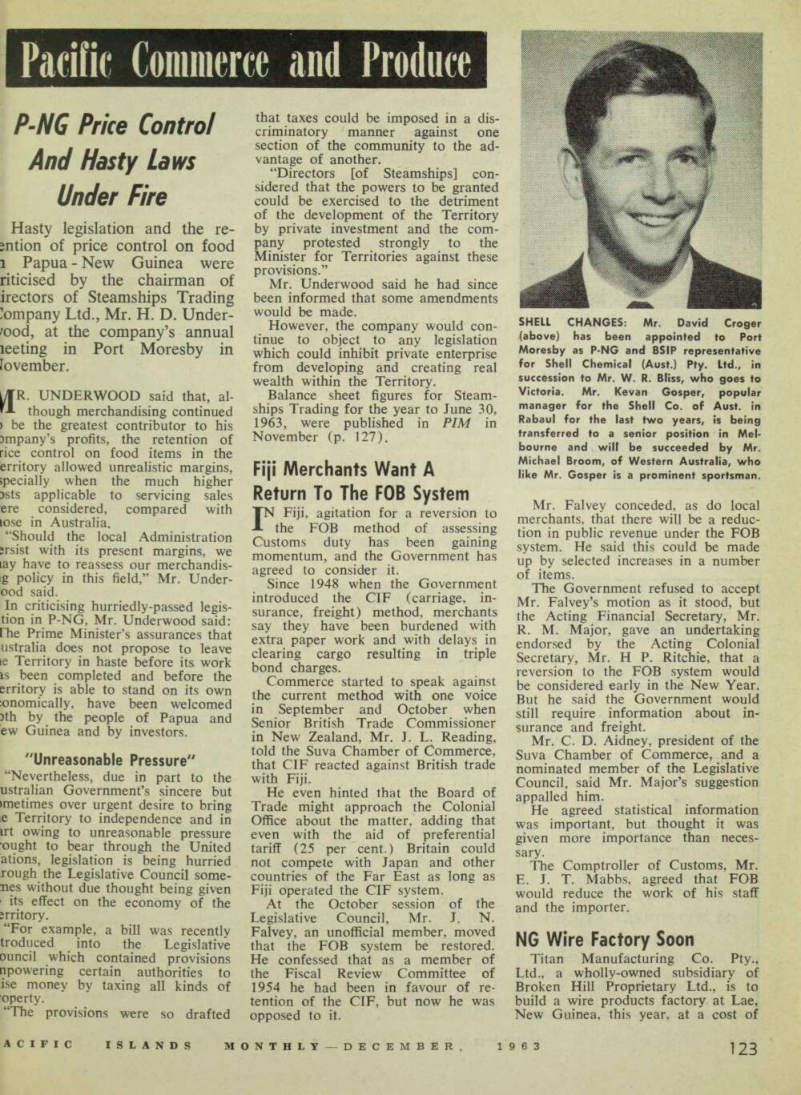
SHELL CHANGES: Mr. David Croger (above) has been appointed to Port Moresby as P-NG and BSIP representative for Shell Chemical (Aust.) Pty. Ltd., in succession to Mr. W. R. Bliss, who goes to Victoria. Mr. Kevan Gosper, popular manager for the Shell Co. of Aust. in Rabaul for the last two years, is being transferred to a senior position in Mel bourne and will be succeeded by Mr.
Michael Broom, of Western Australia, who like Mr. Gosper is a prominent sportsman.
£35,000. Lae was chosen because it was felt that the centre of the Terri tory’s wire market, with the expan sion of the cattle industry in nearby areas, provided a need for fencing— and barbed-wire.
Further Steps On
Decimal Currency
FIJI and Papua-New Guinea arc taking a closer interest in decimal currency, following Australia’s de cision to adopt the system, and a recent report issued in Britain which takes that country further towards the system.
In Fiji, a committee has been appointed to consider the question of its introduction. Chairman is Mr.
C. S. de C. Reay, who is chairman of the Public Service Commission.
Statements on the possible effect the Australian decision will have on P-NG were made in the P-NG Legis lative Council in Port Moresby in November.
Mr. B. Fairfax-Ross said he under stood it was the Commonwealth Gov ernment’s intention to have the same form of currency in P-NG as on the mainland.
But he thought it was quite pos sible this policy could change, and P-NG could end with its own currency, which might be at a lower premium than the Australian currency.
Loans He believed that there should be some currency repayment clause in connection with Commonwealth guaranteed loans raised in the Terri tory which had repayment dates ex tending into the future.
It has been announced that produc tion of the first of Australia’s new decimal currency coinage will start at the beginning of next year at Mel bourne and Perth mints. First will be the bronze coins, and production of other coins—to be in cupro-nickel (75 per cent, copper and 25 per cent, nickel) —follows later, probably when the Canberra mint is commissioned late next year.
The change-over to decimal currency will be gradual, and a definite change over date in which some part of the community will first commence to operate in decimals is yet to be an nounced.
Australian banks will be the first to change over and will probably close for three or four days preceding the change-over date, during which they will close off their LSD accounts and re-open in decimal currency alone.
No organisations other than banks will be obliged to change to decimal
operation from the change-over date, and other businesses will change over at their own convenience.
The Australian Treasurer, Mr. Holt, told Federal Parliament recently that the Government had no clear idea how long the entire conversion would last but it was likely that it would be a maximum of two years. Both systems of currency would operate side by side.
The banks would require all cheques to be written in decimals.
But for the duration of the transitional period there would be supplied LSD notes and coins to anybody wanting to use them.
The new decimal coins and notes would also be issued from the change over date, the rate of issuing being determined by the public’s demand for them.
The main units of the new Aus tralian currency will be the dollar, divided into 100 cents. An earlier de cision to call the main unit the Royal was altered following objections. The three cupro-nickel coins of 20 cents, 10 cents and 5 cents will be indis tinguishable in size and weight from the present 2/-, 1/- and 6d pieces.
Bronze Coins There will be two bronze coins of 2 cents and 1 cent. The 2 cent piece is between the present shilling and sixpence in diameter and the 1 cent piece is slightly smaller than 6d.
There also will be a prestige coin, predominantly silver, with a diameter between the penny and the British half-crown. This will be equivalent to the present 5/-.
Meanwhile, in Britain, a report just issued by a special committee is an important stage forward in the intro duction of decimal currency there, although no decision for or against the scheme has been made.
The report is being studied by the British Government, which wants to test public reaction before making a decision.
Two schemes have been proposed.
The first plans that the present £ should stay as the main currency unit and that it should be divided into 100 minor units, each worth 2.4 d, which might be called “cents” or “decimal pennies”.
The second plan employs a main unit worth 10/- and under this plan the sixpence and the half-crown would be 5 and 25 cent coins.
The committee estimates that at least three years would be needed to prepare for the change and a further two years to complete it, if a de cision is made to adopt it. • The Pacific Commerce and Produce Section continues on page 129.
Papua-New Guinea Will
Display At Osaka
A N indication of New Guinea’s in terest in the Japanese market is given by the fact that Papua-New Guinea will exhibit at the Osaka Trade Fair next April.
The New Guinea display will be part of the Australian pavilion at the fair and a number of New Guinea companies are interested enough to have arranged separate stands.
Papua-New Guinea companies ex hibiting will be W. R. Carpenter, New Guinea Lumber Development Company, Colyer Watson, Cottees, Burns Philp, Nelson and Robertson, and Robert Timms Pty. Ltd.
The New Guinea section will push sales of timber, cocoa, coffee, copra and its by-products, peanuts, passion fruit and crocodile skins.
The Papua-New Guinea exhibition is being handled by the Department of Territories, Canberra, which is producing 25,000 copies of a sup porting trade booklet in colour.
It will be the first time that New Guinea has exhibited in an overseas trade fair on any scale. New Guinea exhibited for the first time anywhere overseas, at the Cologne Fine Foods fair earlier this year and as a result there were a number of inquiries about New Guinea coffee.
Dispute Over Payment Of
Export Subsidy
T>ULOLO Gold Dredging Ltd. has ** issued a writ in the Australian High Court against the Commonwealth Government, claiming payment of an export subsidy of £257,543 and un specified damages. The payments are claimed for Commonwealth-New Guinea Timbers Ltd., of which the Bulolo company has nearly a 50 per cent, interest (and the Common wealth has the rest). No date has yet been fixed for a hearing.
The company’s statement alleges that the Commonwealth failed to honour an agreement to pay export subsidies to Commonwealth New Guinea Timbers Ltd. equivalent to the Customs duty paid on plywood exported from New Guinea to Aus tralia. It claims the Commonwealth had previously admitted its obliga tions to pay subsidies on the plywood but had since denied any obligation to pay.
The writ was filed by Sydney soli citor J. G. Palmer on behalf of the Canadian company.
VISITING THE EAST: Aboard the "Milos" for a holiday and business trip to the East recently was Mr. A. L. Lambourne, general manager of the New Guinea Co.
Ltd., Rabaul. He was to attend the Canton trade fair among other things.
Photo: C. H. Meen.