Territories TALK-TALK
pp. 111-113 · Read in the full issue
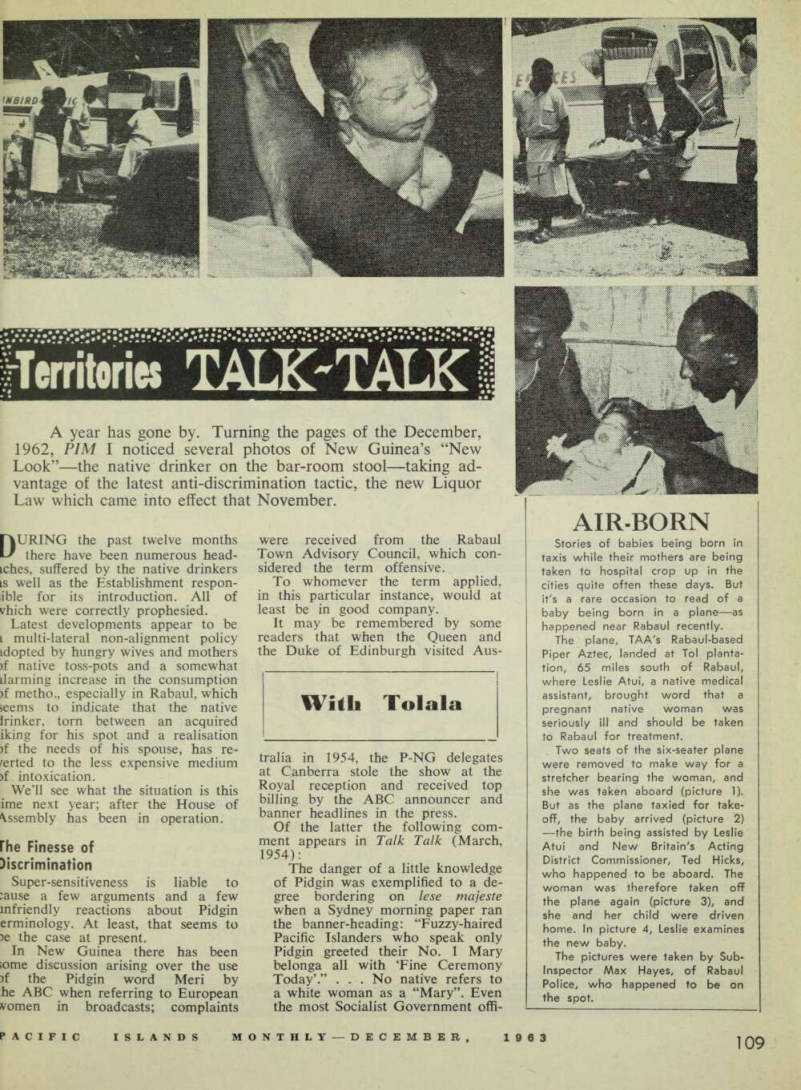
A year has gone by. Turning the pages of the December, 1962, PIM I noticed several photos of New Guinea’s “New Look”—the native drinker on the bar-room stool —taking ad vantage of the latest anti-discrimination tactic, the new Liquor Law which came into effect that November.
DURING the past twelve months there have been numerous head iches, suffered by the native drinkers is well as the Establishment respon ible for its introduction. All of which were correctly prophesied.
Latest developments appear to be i multi-lateral non-alignment policy idopted by hungry wives and mothers )f native toss-pots and a somewhat darming increase in the consumption )f metho., especially in Rabaul, which seems to indicate that the native Linker, torn between an acquired iking for his spot and a realisation )f the needs of his spouse, has re verted to the less expensive medium )f intoxication.
We’ll see what the situation is this ime next year; after the House of \ssembly has been in operation.
Fhe Finesse of Discrimination Super-sensitiveness is liable to ;ause a few arguments and a few mfriendly reactions about Pidgin erminology. At least, that seems to )e the case at present.
In New Guinea there has been some discussion arising over the use )f the Pidgin word Meri by he ABC when referring to European vomen in broadcasts; complaints
were received from the Rabaul Town Advisory Council, which con sidered the term offensive.
To whomever the term applied, in this particular instance, would at least be in good company.
It may be remembered by some readers that when the Queen and the Duke of Edinburgh visited Aus-
With Tolala
tralia in 1954, the P-NG delegates at Canberra stole the show at the Royal reception and received top billing by the ABC announcer and banner headlines in the press.
Of the latter the following com ment appears in Talk Talk (March, 1954): The danger of a little knowledge of Pidgin was exemplified to a de gree bordering on lese majeste when a Sydney morning paper ran the banner-heading: “Fuzzy-haired Pacific Islanders who speak only Pidgin greeted their No. 1 Mary belonga all with ‘Fine Ceremony Today’.” . . . No native refers to a white woman as a “Mary”. Even the most Socialist Government offi
cials will admit that; at least they should. ... It is safe to bet that every one of the native troops and bandsmen knew Her Majesty as “Queen”, and nothing else.
But back in 1954, when that was written, there had been no anti discriminatory legislation passed and white stocks on the Canberra-Kone dobu market had not fallen to such an all-time low as they are at present.
The Rabaul Town Advisory Coun cil was informed by District Com missioner Foldi that he expected “the Administration’s official attitude would be available before the Coun cil’s next monthly meeting.”
That, at least, is something to look forward to!
Naming The
Mortlocks From Honolulu comes another en trant in the “Mortlock-naming Stakes”. Irwin Howard, who confesses to a fascination for the Mortlocks, writes that these islands were dis covered by Le Maire and Schouten in 1616 and first named the Marqueen (Marcken) Islands, due to their simi larity of appearance to an island by that name in the Zuider Zee.
In 1643 Abel Tasman saw the
islands and recognised them from their location as the Marcken Islands of Le Maire. Mr. Howard confirms the Captain Mortlock of the Young William version in last month’s Talk Talk (p. 113); also that Morrell’s Massacre Islands are one and the same. Thank you, Mr. Howard.
So far, then, it looks like Le Maire and Schouten are in the lead to be first at the post for discovery, but Captain Mortlock gets the blue riband for naming the islands.
Any more bets?