Pacific Shipping
pp. 97-107 · Read in the full issue
Cruising Yachts
£2¾M. Papeete Port Plan
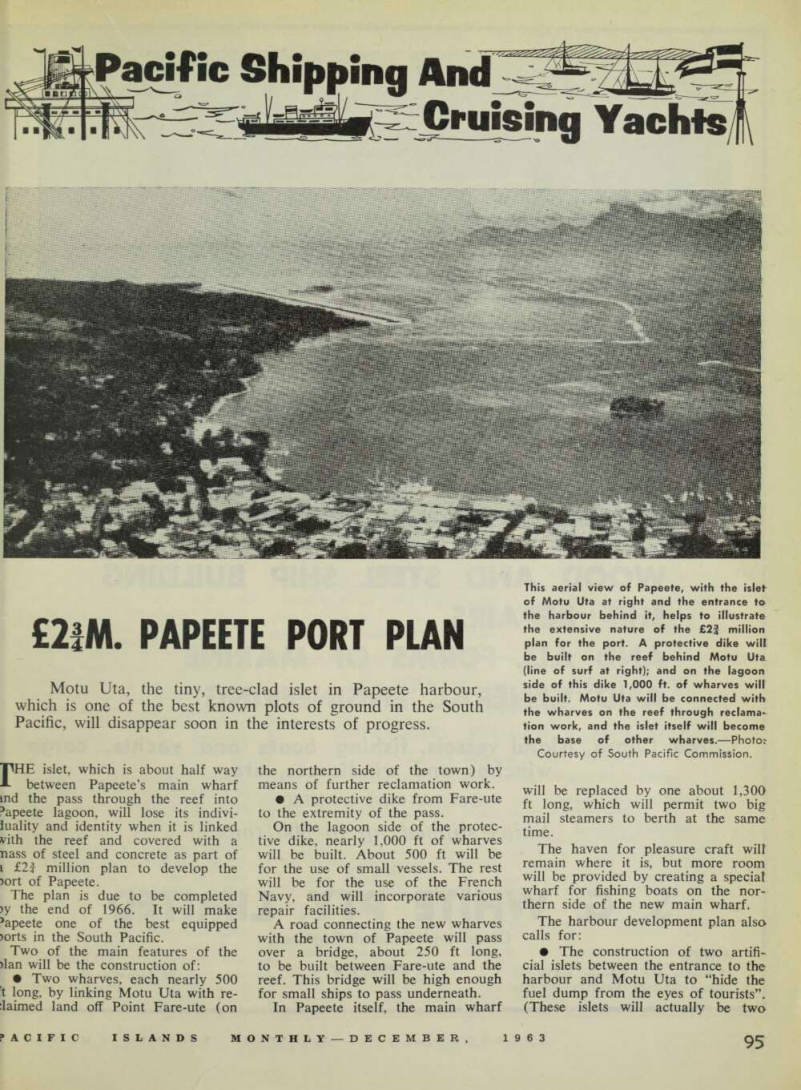
Motu Uta, the tiny, tree-clad islet in Papeete harbour, which is one of the best known plots of ground in the South Pacific, will disappear soon in the interests of progress.
rHE islet, which is about half way between Papeete’s main wharf md the pass through the reef into Papeete lagoon, will lose its indivi luality and identity when it is linked vith the reef and covered with a nass of steel and concrete as part of i £2i million plan to develop the )ort of Papeete.
The plan is due to be completed >y the end of 1966. It will make J apeete one of the best equipped )orts in the South Pacific.
Two of the main features of the )lan will be the construction of: • Two wharves, each nearly 500 t long, by linking Motu Uta with re :laimed land off Point Fare-ute (on
the northern side of the town) by means of further reclamation work. • A protective dike from Fare-ute to the extremity of the pass.
On the lagoon side of the protec tive dike, nearly 1,000 ft of wharves will be built. About 500 ft will be for the use of small vessels. The rest will be for the use of the French Navy, and will incorporate various repair facilities.
A road connecting the new wharves with the town of Papeete will pass over a bridge, about 250 ft long, to be built between Fare-ute and the reef. This bridge will be high enough for small ships to pass underneath.
In Papeete itself, the main wharf
will be replaced by one about 1,300 ft long, which will permit two big mail steamers to berth at the same time.
The haven for pleasure craft will remain where it is, but more room will be provided by creating a special wharf for fishing boats on the nor thern side of the new main wharf.
The harbour development plan also calls for: • The construction of two artifi* cial islets between the entrance to the harbour and Motu Uta to “hide the fuel dump from the eyes of tourists”. (These islets will actually be two
This aerial view of Papeete, with the islet of Motu Uta at right and the entrance to the harbour behind it, helps to illustrate the extensive nature of the £2¾ million plan for the port. A protective dike wilt be built on the reef behind Motu Uta (line of surf at right); and on the lagoon side of this dike 1,000 ft. of wharves will be built. Motu Uta will be connected with the wharves on the reef through reclama tion work, and the islet itself will become the base of other wharves. Photo: Courtesy of South Pacific Commission.
built-up shoals. At present, the shoals are awash at low tide.) 9 Extending and improving the system of beacons and buoys to per mit the movement of ships at night.
When the plan is completed, Papeete harbour will be almost un recognisable to anyone who has not visited it since reclamation work be gan north, south and west of Point Fare-ute four or five years ago.
• Bill Wilding Retires:
One of the Islands’ most colourful masters, Captain “Wild Bill” Wild ing, retired in October, a month ahead of schedule. As master of BP’s Bulolo, on the Sydney-Papua- New Guinea run, he was due to retire on the November voyage but he took ill in October with a heart attack and was unable to take the November trip.
Large and varied farewells which had been arranged all round New Guinea for Captain Wilding had to be postponed. Similar farewells within BP’s Sydney office also had to be postponed.
He was not well enough in Novem ber to supply PIM with the details of some of the highlights of his long career.
Captain Wilding is 61 now, and has been with Burns Philp since Septem ber 21, 1925. In all that time he has been visiting New Guinea off and on, but for the last 15 years he has been on the New Guinea service regularly.
It was Captain Wilding who some years ago organised the collecting of tropical fish for the Sydney Zoo.
On most voyages he has, as a free service collected and brought to Sydney, fish for the acquarium, carry ing them in special heated tanks
aboard ship. Other skippers have followed his lead.
His friends are still hopeful he will be well enough soon to make a re turn trip to New Guinea—this time as a passenger—and enjoy the post poned farewells.
Meanwhile he has taken up bowls in Sydney and has told his friends he will spend the time quietly at his Blakehurst home with his wife.
O Burns Philp Changes:
With the retirement of Captain Bill Wilding (see above). Captain N. S.
Bickle is now Senior Master with
Burns Philp. Captain Bickle, who joined BP’s in February, 1930, is master of the Burnside on the Singapore run and will remain with that ship. Captain Brett Hilder will take over the 6,600 ton Bulolo from the November voyage. It will be the first time he has served in her in any capacity. Captain Hilder’s previous command, the 3,310-ton Malaita, has already been taken over by Captain John Ealey, who started with Burns Philp in 1951, and who has been a relieving master.
• Reef Claims Another
VICTIM: Treacherous Middleton Reef, some 350 miles south-east of Brisbane, wrote “finis” to yet another ship on November 2 when the Japan ese tuna fishing boat Fuku Maru went aground there and became a total loss. However, all 26 members of the crew were saved.
The master, Captain M. Horio, said in Brisbane later that he knew the reef was there but believed he was standing far enough off to be out of danger.
But just on dusk, a very high tide and two huge waves picked the boat up and tossed it on the reef. Two other tuna boats, the Dai Maru and Katu Maru No. 16, sped to the scene in response to a radio call.
After the Dai Maru had shot a line 200 yards across the water to the grounded ship, a rowboat from the Dai Maru stood by the line 50 yards off the reef and waited to pick up the
fishermen as they swam, one by one, away from the wreck.
The Dai Maru landed them in Brisbane on November 6 where the fishermen told the Press, through an interpreter, that the men had had to swim through a school of sharks to the rowboat.
“The fishermen could see the sharks as they went into the water and started to swim,” the interpreter said. “The sharks came very close to some of the swimmers. All the time ;he sharks swam up and down, just matching.”
Exactly a week after this incident, ;he chief officer of the Japanese tuna 3oat Ebisu Maru No. 12 was Irowned and four crewmen were in
jured when a huge wave hit the ves sel off Middleton Reef.
The boat remained in the area for two days while an unsuccessful search was made for the missing officer, then made a 36-hour dash to Brisbane with the injured.
The injured men were admitted to Brisbane General Hospital soon after the Ebisu Maru berthed there on November 13.
Middleton Reef has taken a heavy toll of ships over the years. The most recent notable victim was the 13,587ton cargo ship Runic, which went aground there on February 20, 1961, and was abandoned.
• For Australia-New
GUINEA TRADE: A new motor vessel to inaugurate a direct cargo
service from Australia to Rabaul was due to leave Sydney for Rabaul on November 29.
She is the Sletta, built in Bilbao, Spain, for operation by the Karlander New Guinea Line Limited, of Lae.
After visiting Rabaul, she will call at Wewak, Madang and Lae.
Mr. H. L. Costello, shipping manager of F. H. Stephens Pty. Ltd., managing agents for the Line, said early in November that the Sletta would arrive in Australia from Liver pool on her main voyage during November with drummed cargoes for Melbourne and Sydney.
He said the ship was specially built for the New Guinea-Australia trade.
Her cargo facilities included “freezer” and “cooler” accommodation. (The Sletta has a deadweight lifting capacity of 1,850 tons and a cubic grain capacity of 2,036 tons. She is the sister ship of the Slitan, which the Karlander Line has been operating in the Islands trade for almost a year.) Mr. Costello said that under a new schedule, Slitan would provide a direct cargo service from Sydney and Brisbane to Port Moresby, then to Lae, Madang and Wewak.
“This integrated service by two sister ships of the New Guinea-owned line will give shippers a much faster turn-around service, providing for all requirements,” he said.
The Slitan, which is registered in Norway, signed on 13 Papuan seamen in Port Moresby in November. They are believed to be the first Papuan
MV "Sletta", Kar lander New Guinea Line's new ship, will provide a direct cargo service from Sydney and Brisbane to Rabaul. (See story this page.)
crew to sign on a foreign-registered vessel since the World War.
The Papuans will serve as deck hands, engine room attendants, stewards and one as bosun.
• Another Lurline: A
famous name in Pacific steamship travel—SS Lurline —will be restored to the California-Hawaii sea lanes on December 6. On that date, the 26,000-ton liner Matsonia will be re named Lurline, to become the fourth passenger ship in Matson Line’s 81year history to bear that name.
• Survey Ship Repaired:
The Royal Navy survey ship, HMS Cook, was refloated at Suva on Octo ber 27 after two weeks on the slipway for temporary repairs. About the middle of November she was still in Suva awaiting a movement order.
The Cook was badly holed in her bows when she struck a coral head off Ellington, north-east Viti Levu, on October 1. Major repairs will be carried out at an overseas port.
• For Fiji Passenger
TRADE: Mr. Tim Hurley, of Suva, has launched a 10-ton cutter for the passenger trade within Fiji. The hull of the cutter, the Malawai, was built at Kasavu, Vanua Levu, by Mr.
Eric Whippy, from timber salvaged from the Norwegian freighter, Ragna Ringdal, which was wrecked on Vatoa Reef in November, 1962.
With a high speed engine, Mr.
Hurley expects the Malawai to cruise up to 10 knots. The cutter has been fitted with 14 bunks because—Mr.
Hurley says—the time has gone when passengers pay to sleep on deck.
There is space for about 20 tons of cargo.
Mr. Hurley also owns the Adi Talei 11, a cargo cutter, and the Melanesia, a motor ship, which is engaged in the inter-island trade.
• Work On Vila Wharf:
Piledriving operations began again in Vila Harbour recently on the site proposed by Mr. Buck, of Messrs.
Wilton and Bell, London, for the new wharf. Corrugated sheets were driven nto the harbour bottom to measure he resistance of the underlying rock.
When the sheets had been driven ibout 100 ft down, the workmen had net only coral and sand.
The site, known as Site Six, is ibout 150 yards off shore, to the lorth-west of the Hotel Vailele.
• Bsip Passages Charted:
fhe BSIP Marine Department has nade a series of charts of anchorages md passages into Protectorate larbours, prepared partly from air
photographs and partly from observa tions and soundings. They include detailed charts of Ongtong Java Atoll and of the entrances to Munda and Kia. A new chart of Blackett Strait in the Western Solomons shows the entrance to a possible wharf area where it would be practicable to build a deep sea wharf for loading timber into overseas ships.
A series of charts of the passages into the Malaita anchorages, where the Malaita Council has built or intends to build wharves, has also been prepared.
• Ship Fetches A Fiver:
Captain Stan Brown, of Suva, has paid £5 for a wrecked Japanese
fishing ship, the Koyei Maru No. 2, which has been on a reef off Beqa Island since November 19, 1961.
In association with Mr. Barry Philp, who successfully refloated the Asahi Mam No. 8 from a reef off Sigatoka earlier this year, he has already made one unsuccessful attempt to get the Koyei Maru off with the aid of the Asahi Maru.
Another attempt will be made when there is an extra high tide.
“If that is unsuccessful we will not waste any more time with her,”
Captain Brown says.
“However, the Koyei Maru is mov ing about and she should come off without much trouble.”
• Long Drift In Punt: A
Fijian man and his son drifted 100 niles in 2i days without food and vater in late October on a punt on vhich they had spent a day’s fishing, fhe men are Kelemedi Vsuca, 36, and lis son Sanaila Kalakala, 15, of 'Jatovi, Tailevu, which is on the lorth-eastern side of the main island >f Viti Levu.
On October 26, they set out on the lunt for Naigani Island, six miles lorth-west of Ovalau. Their 5J- horse - •ower outboard motor broke down in the way back, and high winds and ough seas caused them to drift until hey sighted the island of Nacula, in he Yasawa Group, which is on the pposite side of Viti Levu. A quarter f a mile from Nacula, the punt cap ized and the two men had to swim dt their lives. If they had missed lacula, they would probably have rifted into the open Pacific. The next iland group westward is the New le brides.
Both men were near collapse trough the fatigue of continually aling their boat when they reached lacula. • REEF ESCAPE: The Methodist fission boat Tolai, which grounded ti a reef south of New Hanover iland on October 14, managed to get T again later that day. First reports lid no serious damage was done and a one was injured.
• Jap Ship Lost In Cooks:
he reefs of Pukapuka in the orthern Cook Group claimed lother victim on the night of ovember 10 when the Japanese hing vessel Daiese Maru was recked there in dark and stormy mditions.
The crew of 20 were brought fely ashore next morning and a lief vessel arrived in the early ternoon and stood off the wreck, le relief vessel was expected to :k up the stranded men later that y.
This was the second Japanese fish l vessel to be wrecked at Pukapuka the past six years—the Taiyo Maru ing aground there in October, 57.
• And One In The
OETIES: So many Japanese tuna ats are now operating in the cific that even keeping up with )se that get wrecked is a virtually possible task.
News of one such wreck that has ly just filtered through to PIM
occurred on July 24 when the Tenyu Mam, with a crew of 30, went aground on the reef at Mopelia (also called Mopihaa), a small atoll, at the far western end of the Society
Group.
The crew was rescued a few hours later by another Japanese tuna boat, Kibi Maru, and the wrecked ship was abandoned. A man described as the manager of Mopelia promptly went aboard and hoisted the French flag. • HOLED ON REEF: The Burns Philp motor vessel Moala was holed on the port side when she hit a reef while going into Tulagi, BSIP, about midnight on November 6.
The master tried to beach her, but she got her bow on a shelf near Sasape, and the after part of the
Kieta Wharf
Progress
Work is going ahead steadily on the building of Bougainville's first overseas wharf at Kieta. Work done so far has involved bull dozing a hill (above) to provide a flat area for two copra sheds and a cocoa shed. The wharf will be built off the bulldozed area.
It will be about 60 ft. long and 20 ft. wide, large enough to allow one hatch of a ship to be worked at one time. Bank Line ships and the "Tulagi" should be able to use the wharf. Below is Kieta's present wharf with the ship "Karu" tied up alongside.
ip sank. However, on November it was reported that most of the ater had been pumped out, that the ter end was afloat again, and that e ship was discharging cargo. It was >ped to refloat the ship that night.
• Raft Sailor Turns Up:
r illiam Willis, the 70-year-old merican raftsman, landed at Puipa’a, i miles from Apia, the afternoon of ovember 12 after drifting about 700 miles from Callao, Peru, since ly 4. Nothing had been heard from of him since a merchant ship »hted him on August 16.
Willis, who had hoped to drift non -3p from Peru to Australia, ex essed disappointment at running to Samoa, but said he looked rward to spending a few nights in e comfort of an hotel. He and his ily companions—two cats, Kiki and ussie—were fit.
Willis’ raft is called Age Un fitted. It is 33 ft long, and is made 10 tons of steel. It is the second ft that Willis has drifted in across e Pacific. The first, made of Isa and called Seven Little Sisters, ifted from Callao to Pago Pago lie years ago.
Willis said he would continue his voyage to Australia as soon as re pairs to his raft were completed and new rudders were built. This would be about the second week in December.
On his arrival in Samoan waters, Age Unlimited was flying the Stars and Stripes upside down as a distress signal. The raft had been in the grip of a heavy storm for three days.
During that time, Willis sent out an SOS, but it was not until after he arrived that he found his radio was not working.
Willis said that the rudders of his craft began to break up when he was 500 miles from Callao.
“I spent days over the side hanging on by my teeth trying to make re pairs, but it was no good,” he said.
Willis is making his voyage as a protest against the tendency to set arbitrary age limits for retirement.
“Most men of my age have 16 different kinds of heart disease, but not me”, he said.
Willis claimed that it was “absolute nonsense” to suggest that Polynesia had been settled by people who had drifted from South America.
“No family could survive the hell of such a trip and to say a whole people made the trip is ridiculous,” he said.
• For Bird Survey: The
United States vessel Tawakoni is to visit the Phoenix Islands to survey bird life in the Central Pacific.
Photographs taken by a former High Commissioner, Sir Robert Stanley, showed big concentrations of seabirds, many of them brilliantly coloured,
congregating on these low-lying islands.
Because the islands are not often visited, the birds are very tame, and the Central Pacific team from the Tawakoni expects to ring large num bers of birds and study their long range movements. The survey is being undertaken under the auspices of the United States National Museum.
• On Tourist Run; A New
cruise ship, the Kuala Lumpur, appeared on the South-West Pacific tourist run late in October. She is a 12,000-ton one-class liner, owned by the China Navigation Co., of Hong Kong.
The Kuala Lumpur, built in England in 1936, normally operates between Singapore and Jeddah.
NEW TONGAN SHIP: There were great celebrations in Nukualofa in October when the Tonga Copra Board's new ship "Niuvakai" ar rived on her delivery voyage from Holland. Queen Salote and all high Tongan Government officials went on board, where (as can be seen at right) Tongan dancers per formed before them.
Photo: Hettig.