Andrew Sharp Hits
pp. 91-93 · Read in the full issue

Back At Critics On Old Polynesia
When New Zealand scholar
Andrew Sharp published his
Ancient Voyagers in the Pacific in 1956, he put forward a theory that was virtual heresy to many people who care about how the ancient Polynesians came from wherever they came from.
THIS theory cut the ancient Poly nesians down from super- Columbuses (as many writers on the Pacific had pictured them) to almost ordinary mortals.
Sharp said that the islands of the Pacific (and Polynesia in particular) were not settled by courageous ex plorers, who, having found new islands, returned to their homelands, collected canoe-loads of colonists, and took them back to the newly-found lands.
On the contrary, he said, the islands were settled purely by accident —mainly by canoe-loads of people who were blown away from their own islands and cast up on others; sometimes by voluntary exiles who were searching for new lands; and sometimes by unwilling exiles.
Except for the part about the exiles, there was nothing new about this theory. Captain Cook had pro pounded it back in 1777. But Sharp, in his book, assembled so much data in support of his contentions that even the Polynesian Society could not find any single person learned enough to assess the whole range of his argu ments.
Anti-Sharp
Eventually, the Polynesian Society got a panel of reviewers to do the job. ( PIM, Dec.. 1962, p. 38). These experts filled 150-odd pages of the Journal of the Polynesian Society with their views, many of which were decidedly anti-Sharp. Only one ex pert said he fully accepted Sharp’s views. This was Captain Brett Hilder, well known to PIM readers for his profiles of Pacific personalities.
Meanwhile, other experts had had a dig at Sharp in books, reviews and articles; and Sharp, according to his own account, got involved in no less than 2,191 oral discussions on his book’s themes and exchanged dozens of letters with other experts.
Several million words must have
been spilled in these discussions, but Sharp maintains that he has still to hear or read an argument which “im pugns the basic contentions” of his book.
However, he has been sufficiently stung by all the argumentation to bring out another book in reply to his various critics.
This is called Ancient Voyagers in Polynesia. It is partly a rewritten ver sion of his former book, but it con tains, he says, “sufficient new material to justify the claim that it is in con siderable degree a new book” and it includes “some advances” on his pre vious views.
Generally speaking, it will not be obvious to the general reader where
the material in Sharp’s new book is new and where the views expressed are “advances” on old ones.
The first section seems to be largely a recapitulation of Sharp’s earlier arguments against the notion that the ancient Polynesian voyagers could navigate over long stretches of empty sea without instruments.
One point on which Sharp's new book differs from the former one is that there is much more emphasis on the idea that the Pacific islands were settled by exiles, both voluntary and forced.
This idea was so buried in Ancient Voyagers in the Pacific that many people, no doubt, read over or quickly forgot about it—leaving themselves with the notion that Sharp maintained that the only colonisers of Polynesia were blown-away voyagers.
Exiles The fact that Sharp does give the exiles “a go” is important for it means that he does believe that some of the ancient Polynesians went out deliberately in search of islands that they did not know existed. What he does not believe is that, the Poly nesians having found new islands—by accident—deliberately sailed home and told others about their landfalls.
Another aspect of Sharp’s new book that differs slightly from his earlier one is his attitude towards the link between Polynesia and South America. < over >
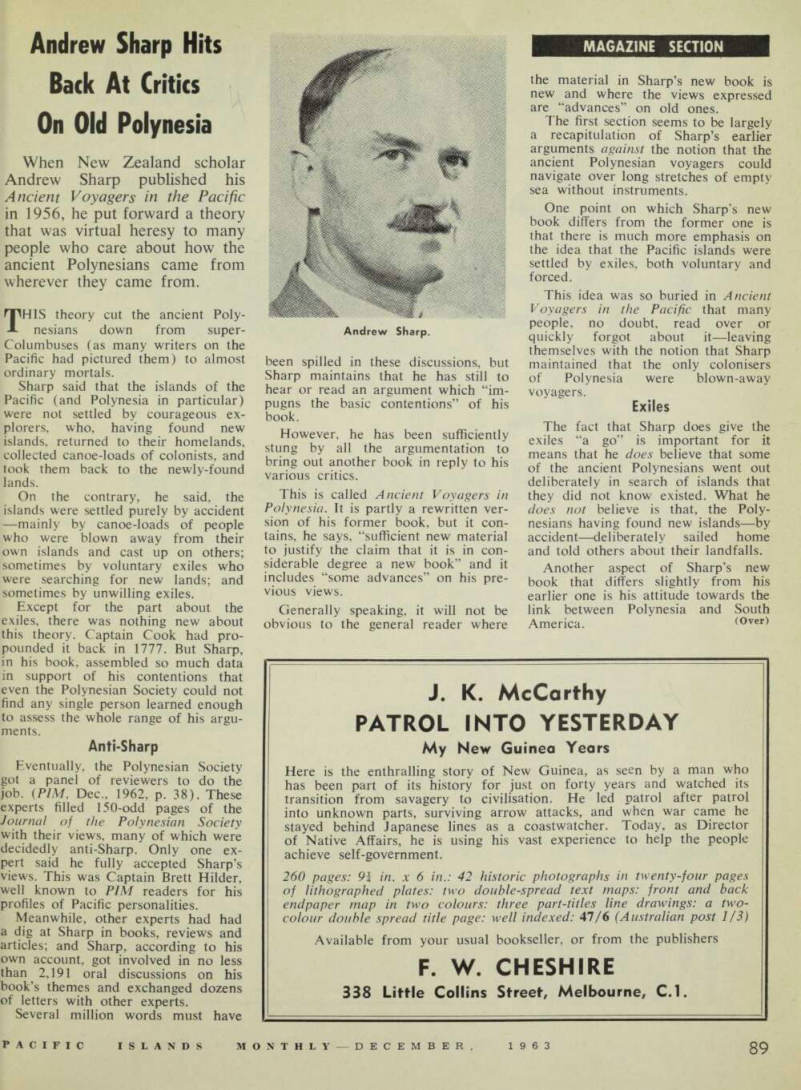
Andrew Sharp.
The two territories, it seems, must have been linked in some way in the past because of the sweet potato (called kumara or something like that on both sides of the Pacific) and be cause a cross between Old World and American cotton was found growing wild in Tahiti and Hawaii by early European visitors.
Sharp says he used to think that Polynesian voyagers, having reached America, may have pushed off again with American plants and got back to Polynesia.
But the failure of raft voyager Eric de Bisschop on both legs of his at tempt to get to America from Poly nesia and back again, despite modern geographical knowledge and naviga tional aids, has made his old idea un attractive.
Sharp says he now presumes that migrants from America brought the sweet potato to Eastern Polynesia after the Polynesians were established there—and, he infers, were absorbed by the Polynesians along with the word kumara.
Wild Cotton As for the wild cotton, Sharp says: “Perhaps the seeds were conveyed by casual migrants from America, who arrived before the Polynesians, but did not leave descendants. This could explain why the plants were growing wild.”
On the endlessly debated question of where the Polynesians came from.
Sharp plumps for the idea that they came from the west, through the waters between Buru and Yap, to eastern New Guinea and the Melane sian islands.
From there, he thinks, they spread into Polynesia by a slow succession of west-east voyages; that the Samoans were predominantly or ex clusively derived from Tonga; that the Marquesans came from eastern Savaii; and that the Eastern Poly nesians, Hawaiians and New Zealand Maoris descended from the early Marquesans.
The publication of Ancient Voyagers in Polynesia corresponds with the appearance in book form, under the title Polynesian Navigation, of the Polynesian Society’s sympo sium on Sharp’s earlier book. The symposium originally appeared in the Journal of the Polynesian Society for September and December, 1962.
In either journal or book form, the symposium—like Sharp’s books—is a “must” for everyone interested in the Polynesian problem.—RL.
(Ancient Voyagers In Polynesia.
Published by Angus and Robertson. 28/-.
POLYNESIAN NAVIGATION. Published by the Polynesian Society, PO Box 5195, Wellington, NZ. NZ 15/-.)