Bitter Naval Lessons Of
pp. 89-90 · Read in the full issue
The Pacific War
It has taken us a long time to realise just how harsh were some of the lessons taught by the Japanese in the Pacific War.
Two new books, one from Britain and one from the US, this month shed light on the bitterest pills that the Allies had to swallow—realisation of their own outdated naval techniques and their appalling underestimation of Japanese naval skill.
RICHARD Hough’s The Hunting of Force Z is an account of the sinking of the pride of the British fleet, the Prince of Wales and Repulse, within a few days of the opening of the war.
This, Britain’s greatest modern naval disaster, is set against the wider background of the “battleships v. bombs” controversy between wars, revealing how the debacle was virtually inevitable as a result of decisions taken many years before.
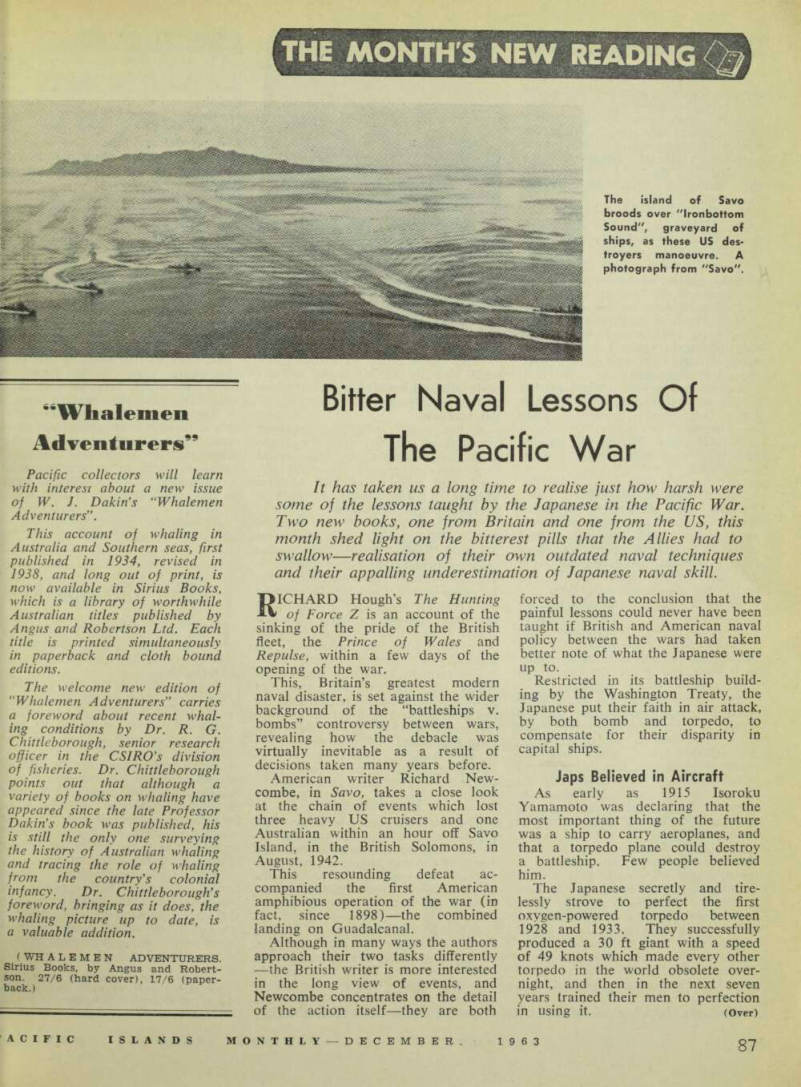
American writer Richard New combe, in Savo, takes a close look at the chain of events which lost three heavy US cruisers and one Australian within an hour off Savo Island, in the British Solomons, in August, 1942.
This resounding defeat ac companied the first American amphibious operation of the war (in fact, since 1898) —the combined landing on Guadalcanal.
Although in many ways the authors approach their two tasks differently —the British writer is more interested in the long view of events, and Newcombe concentrates on the detail of the action itself—they are both
forced to the conclusion that the painful lessons could never have been taught if British and American naval policy between the wars had taken better note of what the Japanese were up to.
Restricted in its battleship build ing by the Washington Treaty, the Japanese put their faith in air attack, by both bomb and torpedo, to compensate for their disparity in capital ships.
Japs Believed in Aircraft As early as 1915 Isoroku Yamamoto was declaring that the most important thing of the future was a ship to carry aeroplanes, and that a torpedo plane could destroy a battleship. Few people believed him.
The Japanese secretly and tire lessly strove to perfect the first oxygen-powered torpedo between 1928 and 1933, They successfully produced a 30 ft giant with a speed of 49 knots which made every other torpedo in the world obsolete over night, and then in the next seven years trained their men to perfection in Using it. (Over)
While the RN and the US Navy placed dummy cork warheads on their practice torpedoes, the Japanese exploded real ones with a lavish disregard for their cost. While the British and Americans dropped sand bombs on target battleships the Japanese sent their old battleships to the bottom with their oxygen torpedoes.
By 1941 Yamamoto had nine air craft carriers under his command, more than any other power, and his air crews were the most ex perienced. Crews of land-based torpedo planes consistently achieved an average of 74 per cent, hits against battleships on manoeuvres.
Most Japanese destroyers and sub marines by 1941 were equipped with the diabolical “Long Lance” under water killer, and their crews were trained in night fighting. The Navy had developed powerful night marine glasses and combed the fleet for men with exceptional eyesight. They were trained in special techniques until they could distinguish targets more than four miles away even on dark nights.
Big-gun Platform
Japan had battleships, too, but looked on them as big-gun platforms needed only until the enemy fleet could be destroyed by torpedoes from destroyers, submarines or from the air. Her faith was in the destructive power of the plane.
The US Navy’s strength still lay primarily in the battleship. There were officers in Washington who believed like Yamamoto that the Pacific war would be fought mainly in the air and under the ocean but they were a small minority.
The Royal Navy was even more wedded to the battlewagon than was America, where at least there were some finer shades of compromise.
The British naval plane was not intended primarily for striking, and the carrier’s role was still to help the fleet as an auxiliary. The important duty of the aircraft was seen as spotting the fall of shells for the capital ships.
Prince of Wales and Repulse were the only two heavy units in Force Z, when that British battle fleet arrived in Singapore just before the Japanese struck in December, 1941. They arrived amid world-wide publicity, for Britain was using them as gun-boat diplomacy. The dreadnoughts were meant to instill fear into the hearts of the cocky Japanese, but it turned out that the Japanese awaited their arrival with relish.
With the invasion of Malaya in
full flood, airfield after airfield was destroyed, cutting off British air support for the battle fleet, which meanwhile had taken to sea under Admiral Sir Tom Phillips. Phillips planned a surprise raid on Japanese landing operations along the coast, but he never got within cooee of his target before he was spotted by Jap submarines and aircraft.
After that, the two big battlewagons were virtually sitting ducks as air craft, all land based, hurled torpedoes and bombs from every direction of the compass.
Within a few hours the Japanese had granted the two ships the tragic distinction of being the first capital ships ever to be sunk at sea by air craft, and Britain had lost Admiral Phillips and 840 officers and men at a crucial stage of events, “It is fruitless now,” says Richard Hough, “to calculate that the most powerful British force of the most modern torpedo bombers stationed in Malaya could have crushed the Japanese invasion and that they would have cost far less to build, and main tain over the years, than the two capital ships that went down after destroying four per cent, of the enemy.”
The torpedo lessons learned by the Allies off Malaya, and again at Midway, were partly responsible for the enormous Allied defeat at Savo one night in 1942, when 1,270 men were killed and 709 wounded. Four heavy cruisers, including HMAS Canberra, and a destroyer were sunk and the Japanese escaped unscathed.
Savo Blunders The Allied force was covering the landing at Guadalcanal but be cause of the American fear of Japanese torpedo attacks against three aircraft carriers at the scene, the carriers sailed south after 48 hours, leaving the fleet without air protec tion.
But this was only one of a long series of blunders on that operation.
In the first place, the operation was badly planned. There was remark able inefficiency in reporting enemy sightings and there were long delays in getting reports through to the right
quarters —with Australian airmen as. much to blame as anybody.
The Allied fleet was wrongly split up so that some units couldn’t be used. There were confusion and timidity. And there were instances of “lack of battle mindedness”, which in some cases was due to lack of training and experience and in others to simple funk. Japanese torpedoes and Japanese battle training did the rest.
The blow to American naval and civilian morale in the debacle was harsh. “Americans”, says New combe, “were not accustomed to defeat. . . . Other shocks awaited, to be sure, but one could hardly perceive as yet that the era of romantic war was dead. ... In one night the United States Navy had been blasted from a distant and romantic past to a harsh and violent present”.
Meanwhile, the bones of the ships that were sunk at the Battle of Savo that night, together with those that followed in the next six months of the bitter Solomons campaign— in all, 24 combatant ships from either side, together with almost as many transports, auxiliaries and motor TP boats —resulted in a new name for Savo Sound. It is Ironbottom Sound to this day.—Sl.
(The Hunting Of Force Z. Collins.
32/6. SAVO. Ure Smith Pty., Ltd. 37/6.)