Magazine Section
pp. 79-82 · Read in the full issue

Pacific Islands Monthly
Long Arm Of Us Navy
Finally Caught Up
With Treacherous
Fijian Chief
From Captain Stan Brown In Suva
When the USS Vincennes returned to New York on June 16, 1842, after heading a squadron on a four year voyage round the world, there were two men on board who did not enjoy the homecoming.
ONE was Charles Wilkes, the 46-year-old commodore of the squadron. The other was a Fijian chief called Veidovi (pronounced: Vein-dor-vee).
For Wilkes, the homecoming was marred by the fact that several dis gruntled officers, whom he had disciplined and sent home from the Pacific, had laid a charge against him of “murder and cruelty to natives”, which he had to answer before a courtmartial.
As for Veidovi, he lay ill and forgotten in the Vincennes’ sick bay after two long years in captivity be cause of a crime committed in Fiji eight years earlier.
The Vincennes was the flagship of a squadron of six ships which left New York on August 18, 1838.
Known as the United States Explor ing Expedition, the squadron was the first that the United States Navy ever sent to sea on a voyage of explora tion.
Ports of Cali The voyage took in Madeira, Rio de Janeiro, Tierra del Fuego, Chile, Peru, the Tuamotus, Tahiti, Samoa, New South Wales, the Antarctic, New Zealand, Fiji, Hawaii, the Columbia River, California, the Philippines, the Sulu Archipelago, Singapore and St.
Helena.
The other ships in the squadron when it left New York were the USS Porpoise, Peacock, Relief, Seagull, and Flying Fish. Of these, only the Porpoise saw the voyage through to the end.
The Peacock was wrecked at the mouth of the Columbia River (and
was replaced by USS Oregon); the Relief was sent home early in the expedition because she was too slow; the Seagull was presumably lost in a collision with an iceberg in the Antarctic; and the Flying Fish was sold in Singapore.
The ill-fated Peacock was the ship in which Veidovi spent the first part of his captivity. This followed an inquiry in Fiji by the Peacock's commander, Captain Hudson, into the murder of several American seamen several years earlier.
The inquiry revealed that the sea men were members of the crew of the American brig Charles Doggett (Captain Batchelor) which had arrived in Levuka in August, 1834.
Warring Clans
Levuka, in those days, was the gathering place in Fiji for the few white traders in the Group. They banded together partly to protect themselves against themselves and partly as protection against the many warring Fijian clans.
Although a lone trading ship could expect little help from these men, Captain Batchelor did get an offer of help from a beachcomber called Paddy Connel, who had arrived in Fiji many years earlier after serv ing a stretch in the New South Wales penal settlement.
Connel, who dressed as a native, suggested that Batchelor should sail
to Rewa, on the south-east coast of Viti Levu, where he claimed that, if suitable presents were made to the chiefs, they would allow him to take trepang from the surrounding reefs.
Batchelor agreed to this plan, and sailed his ship the 45 miles to Nuiulau, a port in Rewa, where he anchored. At Connel’s invitation many of the Rewa chiefs and commoners came aboard. They noted that there was only a small number of men in the crew yet the ship had great wealth in the form of knives, adzes and similar trade goods.
Among the visitors to the ship was the chief Qaraniqio, half-brother to the King of Rewa, a tall, fierce looking man who arrived in a huge war canoe to approve final arrange ments for the collection of trepang and to make sure he got his share of the presents.
Having seen about his presents, Qaraniqio arranged for the chief Veidovi to go with the Charles Doggett to Kadavu where trepang were said to be plentiful.
As Veidovi was vasu to the chiefs of Kadavu, he was an ideal ambassador to make arrangements on the gathering of trepang, as a vasu is a nephew of an uncle from whom no request can be denied. (Over)
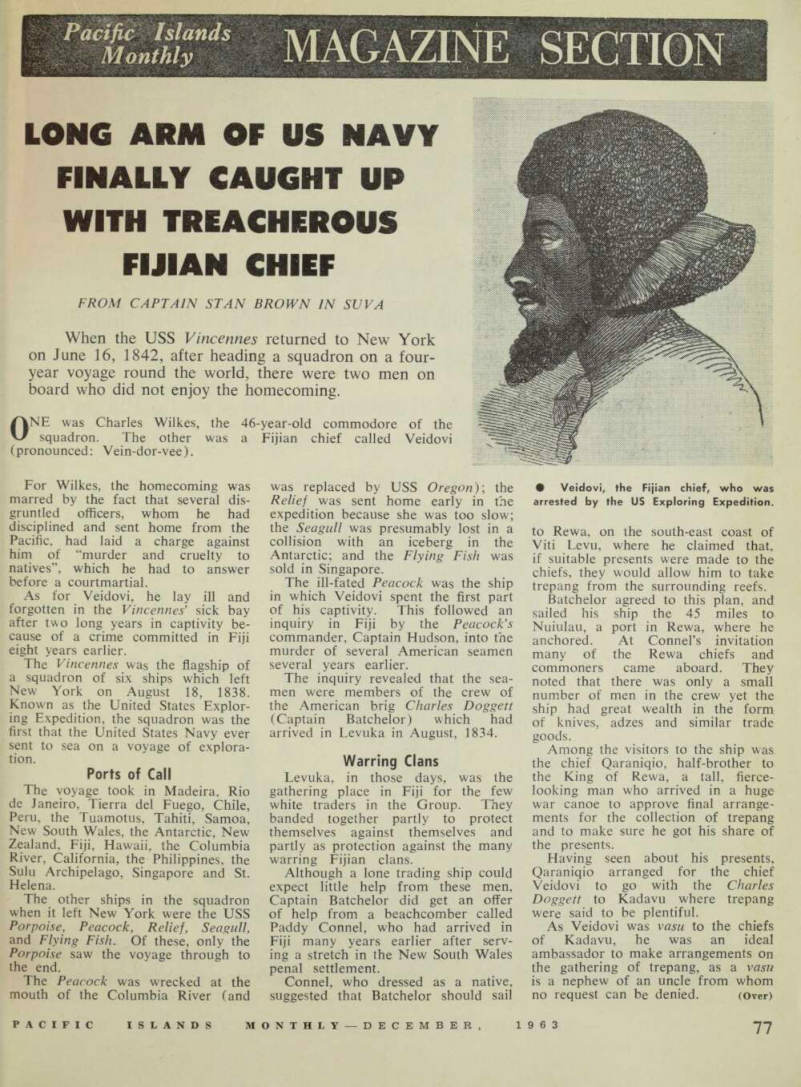
Veidovi, the Fijian chief, who was arrested by the US Exploring Expedition.
However, Qaraniqio was not sincere in sending Veidovi on the trepang mission. He wanted him to cut off the ship and capture the Americans’ treasure.
But Paddy Connel overheard Qaraniqio’s plot and put Captain Batchelor on his guard.
Batchelor took further precautions when his ship reached Bulia, a small island off the north-east coast of Kadavu, and 50 miles from Rewa.
Smoke Houses Before landing members of his crew to set up smoke houses to cure the trepang, Batchelor had the chief of Bulia seized and held on board as hostage for the good be haviour of the islanders.
An arrangement was then made for the islanders to collect the trepang from the reefs for the crew to cure.
Things went so smoothly that when the chief complained that the un familiar food on board had made him ill, Captain Batchelor allowed him to go on shore.
Next morning Veidovi, who was responsible for the shore arrange ments, came off to the ship.
He told the captain that the chief was still complaining of a stomach pan and needed medicine.
Batchelor replied that he would send medicine ashore with the mate, Mr. Chitman.
This obviously annoyed Veidovi, who had asked the captain to administer the medicine himself, but his anger quickly gave way to expressions of disappointment.
Veidovi’s brief display of anger was enough to put Batchelor on his guard again, and that morning instead of landing all available men as was customary to work ashore, he kept some back to man the brig’s guns.
Curing work was, of course, slowed down, and because of the danger, Batchelor became tempted to recall his crew and clear off to another island.
However, the Bulia people kept on bringing such large hauls of trepang from the reefs that Batchelor’s cupidity overcame his concern for his men ashore.
Fijian Attack
Then, suddenly, the Fijians struck.
Within a few minutes, they clubbed the Americans ashore and set fire to their curing house.
Only one American escaped death —a man named Housman—who swam off to the ship unnoticed by the natives.
Batchelor ordered the guns to be
run out and fired, but the natives quickly took cover on the far side of the island and the shots fell among the smouldering smoke houses. However, the gunfire was sufficient to deter the natives from trying to take the ship for the time being.
At this stage, Batchelor still hoped that his crew were captives and that it would be possible to ransom them.
For this reason, he did not sail immediately, but passed a miserable and wakeful night with all on board armed and watchful in case of an attack on the ship. , , , Unabashed Veidovi, unabashed at what had already happened, came off in a canoe the next morning to reconnoitre the possibility of taking the ship.
But as the guns were manned and every man had a loaded musket handy, he contented himself with offering the bodies of the crew in exchange for some of the ship’s goods.
Batchelor finally exchanged seven bodies for one musket. The eighth body never arrived—it turned out that the man, a Negro, had already been cooked and eaten.
As Captain Batchelor now wanted to sail before the Fijians could bring reinforcements from nearby islands to attack the ship, the bodies were hastily sewn in canvas and consigned to the sea. The ship then weighed anchor and sailed for Levuka.
The story of the Charles Doggett massacre reached the ears of Commodore Wilkes, of the USS Vincennes, when the United States
Exploring Expedition called at Levuka in 1840.
Commodore Wilkes heard it from David Whippy, a leading trader and United States citizen, who said it was a matter requiring the attention of the first US ship of war to call in Fiji.
As a French warship had recently called to punish those responsible for the loss of a French ship and her crew, the traders of other nations were intent on having their own ships show their power to the Fijians, as a deterrent against any future attacks.
Paddy Connel was also at Levuka when the exploring expedition arrived.
Although Wilkes considered him to be a flagrant liar and told him so, he was able to supply enough corroborative evidence to back up Captain Batchelor’s story and to fix the guilt for the Charles Doggett affair on Veidovi.
Wilkes decided to send the USS Peacock to Rewa to try to capture Veidovi and hold him aboard for trial while the other ships of the squadron did the survey work that had brought them to Fiji, . . .
Veidovi Missing
At Rewa, the Peacock attracted many visitors, but Veidovi was not among them. So Captain Hudson decided to hold a reception on board for all the chiefs in the hope that this would bring him in.
The chiefs came—Tui Drakett, the King of Rewa, and the treacherous Qaraniqio were among them—but not Veidovi.
As the afternoon dragged on, Captain Hudson decided to keep the
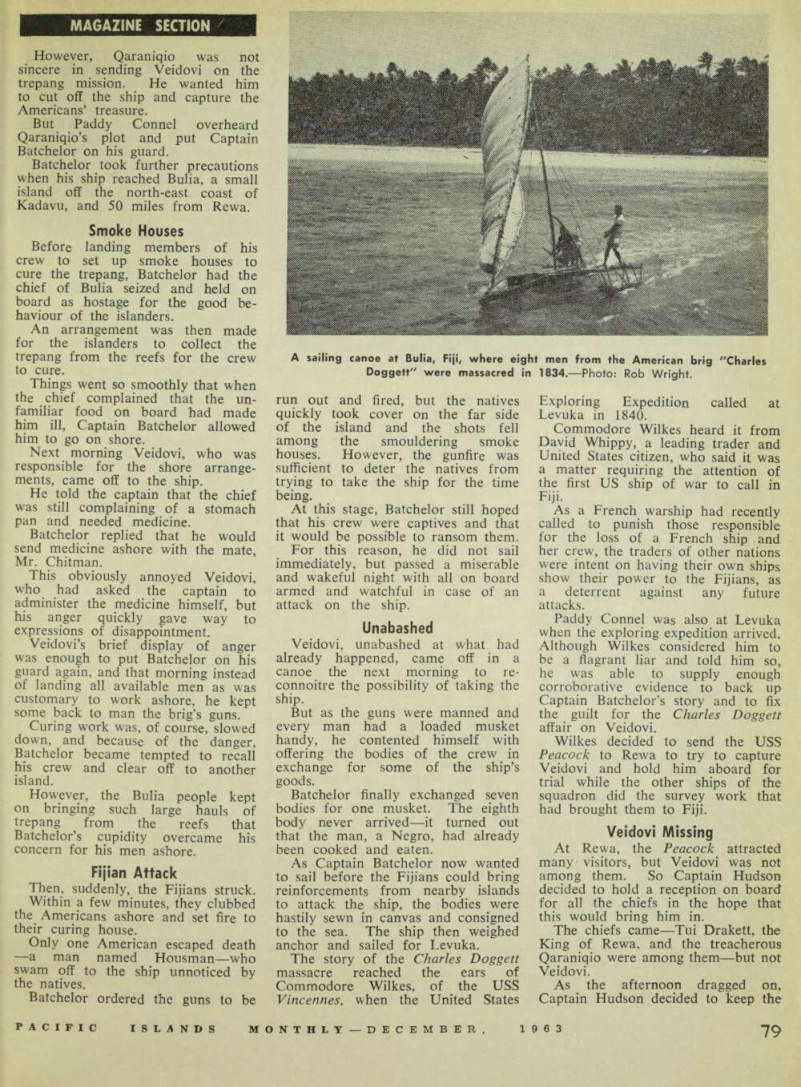
A sailing canoe at Bulia, Fiji, where eight men from the American brig "Charles Doggett" were massacred in 1834. -Photo: Rob Wright.
other chiefs and the king on board as hostages and demand that Veidovi be delivered up in return for their release.
When the chiefs were told that they were prisoners, and why, they pointed out that as they were all on board, no one ashore could give orders for the taking of Veidovi.
It was then agreed that Qaraniqio should be sent ashore to get him.
Qaraniqio, who was known to hate and fear Veidovi, now had an opportunity to rid himself of a rival —and he got him aboard the Peacock by telling him that Tui Dreketi wanted to see him on the American warship. Veidovi agreed to go aboard next morning.
On board, Veidovi admitted to Captain Hudson through an interpreter that he had been involved in the attack on the Charles Daggett’s men, and that he had pinioned the arms of the mate while he was struck down.
He added that, some years earlier, he had seized the mate of a trepang ship and ransomed him to the captain for 50 whales’ teeth.
Following this confession Veidovi was put in irons and the other chiefs were allowed to go ashore, after being told that Veidovi would be taken to Amercia.
Unhappy
Veidovi was an unhappy man when the squadron finally sailed from Fiji.
Wilkes records that only one person on board was able to talk to Veidovi in his own tongue. That was Mr.
Vanderford, the master’s mate of the Vincennes, who, before joining the Navy, had spent seven years in Fiji.
Vanderford formed a liking for the huge Fijian chief and declared his intention of becoming his protector after the squadron returned to America. But this was not to be.
On March 23, 1842, soon after the ship left Singapore on her home ward journey, Vanderford died.
From then on Veidovi pined away, and soon after the Vincennes reached New York, he was admitted to the Naval Hospital. He died a few hours later.
Wilkes’ homecoming did not turn out badly after all. He was exonera ted from blame at the courtmartial, and the following year was promoted to commander.
He went on to produce a narrative of his expedition that is now the source of much knowledge of the early Pacific peonies.