Topicalities
pp. 17-22 · Read in the full issue


“National unity”, is one of those phrases which gets bandied about in the South Pacific as elsewhere.
There has to be integration, unity, co-operation, if any big Island group is to advance—we all know that.
1%/TOST of us do not seriously feel IT A that town rivalries Port Moresby, v. Rabaul, Suva v. the Great Northwest, the Highlands v. the Coast amount to anything more than nere honest competition, and cer ainly nothing likely to endanger ‘national unity”.
But there are some people in New Tuinea who believe that district ivalries there have become so bitter hat they do endanger national unity —or more correctly, they are likely 0 prevent the development of lational unity in the much-fragmented 3 -NG society. They say the situation s in fact serious.
It has developed more swiftly as 1 result of the forthcoming elections, vhen New Guinea will for the first ime have a common roll. Now that Jectioneering has begun, the Port Moresby Administration appears to >e under severe attack for “taking verything and giving nothing”.
The recent inquiries throughout "Jew Guinea by the commission in stigating the needs of higher edu ction in the Territory were blasted >y the same kind of rivalry whenever he matter was raised of a site for a miversity. Most NG people were is violently opposed to having it put m the Port Moresby site as were *ort Moresby people to having it put inywhere else.
From what we hear, this particular acet of their report has given the ommissioners some unhappy noments and it is by no means cer ain that their report will recommend hat a university be established in •ort Moresby.
But there isn’t any doubt that the eport will recommend that a uni ersity be established in the Territory nd we rather suspect that it will Iso throw overboard the routine kind >f thinking on universities and suggest hat P-NG establish a completely free iody (not a university college) able o attract some academic brains on he teaching side. Brains, apparently, an be attracted to new universities if heir owners feel they will have a free
hand to try out their own methods.
Scientifically speaking, New Guinea is certainly not devoid of interest for academics looking for ready-made laboratories, and a careful choice of faculties could attract some interest ing people.
A New Guinea university would set standards lower than required on the mainland, but the commissioners have made it clear enough in their public statements that they don’t think this is a bad thing, because uni versity standards differ, and New Guinea can expect to take extra ordinary measures to meet an extra ordinary situation.
The report, when it is released in January, should make quite an impact on the academic world. Its effect on the New Guinea world we are not so bold as to attempt to calculate.
One Politician Who
Can Prove It
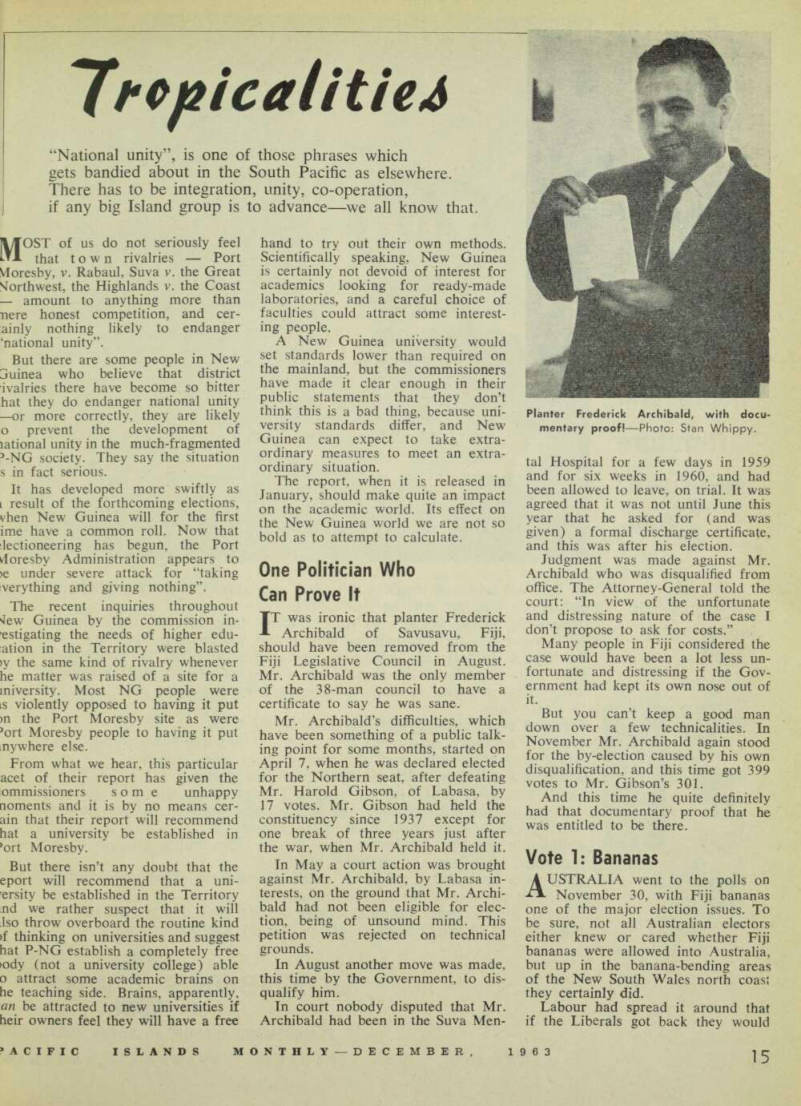
IT was ironic that planter Frederick Archibald of Savusavu, Fiji, should have been removed from the Fiji Legislative Council in August.
Mr. Archibald was the only member of the 38-man council to have a certificate to say he was sane.
Mr. Archibald’s difficulties, which have been something of a public talk ing point for some months, started on April 7, when he was declared elected for the Northern seat, after defeating Mr. Harold Gibson, of Labasa, by 17 votes. Mr. Gibson had held the constituency since 1937 except for one break of three years just after the war, when Mr. Archibald held it.
In May a court action was brought against Mr. Archibald, by Labasa in terests, on the ground that Mr. Archi bald had not been eligible for elec tion, being of unsound mind. This petition was rejected on technical grounds.
In August another move was made, this time by the Government, to dis qualify him.
In court nobody disputed that Mr.
Archibald had been in the Suva Men-
tal Hospital for a few days in 1959 and for six weeks in 1960, and had been allowed to leave, on trial. It was agreed that it was not until June this year that he asked for (and was given) a formal discharge certificate, and this was after his election.
Judgment was made against Mr, Archibald who was disqualified from office. The Attorney-General told the court: “In view of the unfortunate and distressing nature of the case I don’t propose to ask for costs.”
Many people in Fiji considered the case would have been a lot less un fortunate and distressing if the Gov ernment had kept its own nose out of it.
But you can’t keep a good man down over a few technicalities. In November Mr. Archibald again stood for the by-election caused by his own disqualification, and this time got 399 votes to Mr. Gibson’s 301.
And this time he quite definitely had that documentary proof that he was entitled to be there.
Vote 1: Bananas
Australia went to the polls on November 30, with Fiji bananas one of the major election issues. To be sure, not all Australian electors either knew or cared whether Fiji bananas were allowed into Australia, but up in the banana-bending areas of the New South Wales north coast they certainly did.
Labour had spread it around that if the Liberals got back they would
Planter Frederick Archibald, with docu mentary proof! -Photo: Stan Whippy.
it in those large, ripe, sound Fiji ananas and so starve all the north aast farmers to death.
The Libs fought back, and in the rocess had a few things to say which, e wager, they wouldn’t have been ime to say to Fiji Development ommissioner Rogers, who has been ressing for permission to send in ime of the bananas that the Aus alian law says he is entitled to send.
The Minister for Primary Industry, [r. C. F. Adermann, told a north >ast street meeting that he couldn't iderstand what all the fuss was Dout, as there had been no Fiji manas since the war (which isn’t fite true, because PlM’s staff and ime of the Sydney columnists en yed four cases of them recently— jry nice, too); that there was no celihood of any imports, and there id been “no inquiry from Fiji” about iports. He himself was for ‘TOO per mt. protection.”
While the Minister was thus going i record up north, Ratu Penaia anilau, visiting Deputy Secretary T Fijian Affairs, who wasn’t an elec an candidate, was telling Pressmen Sydney that Fiji hoped to export manas to Australia, and that the xleral Government “seems quite in rested in buying bananas from Fiji.”
Oh, wicked, wicked politics!
sky Lambert Bows Out
THE Federal elections affected - Islands development in various her little ways, even before the suits were announced. There was, r instance, no announcement in No imber about the successor to Mr. . R. (Esky) Lambert as Secretary the Department of Territories, though Esky himself left his big anberra office, overlooking the
slowly-filling Canberra Lake, for the last time on November 11.
There was a great deal of interest in who would be named, biggest bets being on the outsiders, of whom Dr, John Gunther was one (those who pooh-poohed him as a starter said he would probably want to finish his big job in New Guinea now it had got to such an interesting political stage, with high-ranking plums there yet to be plucked).
Anyway, it seemed certain the name of the Mystery Man wouldn’t be announced until after the elections, and meanwhile everybody was wish ing Esky Lambert a happy retire ment, which he deserves.
Even we think he deserves it, and we’ve said some critical things about Esky over the years (only in print, of course).
Esky Lambert became the first permanent Secretary of the Depart ment of Territories when it was formed in 1951, and in the whole 13 years that have followed he says he’s been “swimming against the tide’..
“Because of the swiftness of events, the work in this department has taxed the ingenuity of all of us,” he told us a couple of days before his re tirement. “It’s been hard work, bristling with problems.”
During those 13 years Esky has worked with the one Minister, Mr.
Hasluck, but he says it was never true —as some of his critics claimed— that Esky made many of the bullets that the Minister fired. ‘There has been no autocracy here,” he says. “All policy decisions are the responsibility of the Minister, and he’s not the man to approve of decisions that he doesn’t want.”
We agree with him there.
“Also,” adds Esky, “We’ve always been careful in the department to give proper regard to both sides of every question when we refer it to the Minister. When there have been differences of opinion these have been disclosed to the territories so they have the opportunity to say what they think. (Over)
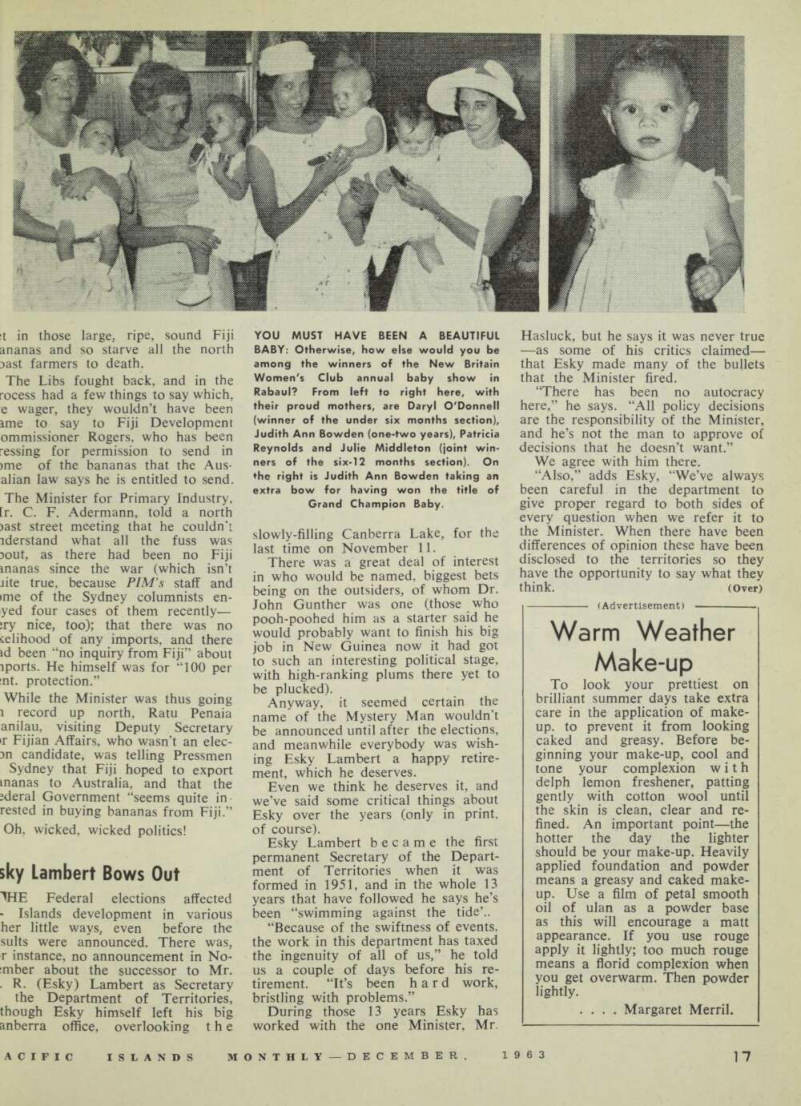
You Must Have Been A Beautiful
BABY: Otherwise, how else would you be among the winners of the New Britain Women's Club annual baby show in Rabaul? From left to right here, with their proud mothers, are Daryl O'Donnell (winner of the under six months section), Judith Ann Bowden (one-two years), Patricia Reynolds and Julie Middleton (joint win ners of the six-12 months section). On the right is Judith Ann Bowden taking an extra bow for having won the title of Grand Champion Baby.
“But personal criticism has never worried me.”
Esky has found his two biggest problems have been the framing of policies—especially as everything has been moving so rapidly and the de partment has always been under ex treme pressure—and the training of staff to keep pace with developments.
He is referring particularly to terri ;orial staffs, especially in New Guinea.
Training and gearing up have re quired much more effort than people realise, he says.
Esky Lambert, who is 65, started with the Commonwealth Public Ser vice in 1915, in the Taxation Depart ment, and went through a whole lot of departments and jobs before join ing Territories. One suspects his real love was his work for the Australian outback, when he was responsible for Farm reconstruction after the De pression, and with regional develop ment.
He found time in earlier days to play a lot of sport—captaining an all-Australian team of baseballers at one time, and he also played first grade cricket with a Sydney team. He has no special plans for his retire ment.
And how did he get the name Esky? We asked him that.
“Just about the first day I ever went to school the teacher gave us a lesson about Eskimos,” he explained.
Eskimos,’ said the teacher, ‘are swarthy, thick-set, short-necked people just like that boy there — :ome out in front of the class Lam bert.’
“And it was Esky ever after.”
He's The Man Who
Started It All
APIM reader, Mr. Norman B.
Casey, MBE, of Carabella Street, Kirribilli, New South Wales, was more than ordinarily interested in our story on p. 71 ot the September issue about the bakery at Suva Gaol. And with good reason. He was the man who started it. Mr. Casey was a member of Fiji Legislative Council For nine years. He will be 82 next April.
Mr. Casey writes: “The Suva Gaol Bakery was con ceived and inaugurated by me in 1920 while I was Superintendent of Prisons, Fiji.
“The bakery was actually built by unskilled prison labour under the per sonal supervision of the late Mr. Wil liam P. Marr, who was a European overseer at the Gaol at that time— he being a skilled bricklayer. He ac tually built the oven with his own hands.
“The question then arose: how was I to produce bread? Luckily I had at that time a life-sentence prisoner who had been chef at the Grand Pacific Hotel, Suva. He had some little knowledge of bread baking.
“Difficulties were overcome by trial and error, and with the advice and assistance of the late Mr. John Her rick, who was a retired master baker.
“In the first instance, flour was given free by the late Mr. Malcolm Brodie, who was manager of the Paci fic Biscuit Company. It was with this flour that the unskilled prisoners were taught and trained to bake bread, which as far as I am aware continues to this day.”
Some More Plans For
A Nukualofa Hotel
FOR years now, the Kingdom of Tonga has been toying with the idea of erecting a modern tourist hotel at Nukualofa to replace ancient and ugly Beach House, the capital’s only hotel. At one time the residence of a Chief Justice of Tonga, Beach House, with its additions and an nexes, is now leased by Fiji Airways, mainly to provide accommodation for their transit air passengers.
The latest contender in the Nukua lofa hotel-building field is the inde fatigable Mr. Barry Philp, of Fiji, who in November took time out from his Tradewinds Bay project along the Korotoga coast of Viti Levu, to fly to Nukualofa to put up to Prince Tungi a proposition for a joint Tonga Government-Philp Associates luxury hotel.
In addition to the drawing-board plans, Mr. Philp had an eye-catching scale model made to show the Ton gan Premier just how the seafront hotel would look to the hoped-for American tourists.
Cross-shaped, the four wings con verge on a central lounge; and scat tered in the grounds are six Tongan style thatched-roof bungalows (along the lines of the “modernised” bures of Fiji’s luxury resorts). These days one of the tourist-attracting gimmicks m the hotel business is the name most favoured for this one is “The Dateline” (Tonga’s western boundary
Esky Lambert.
being very close to the 180th paral lel of longitude).
Mr. Barry Philp, a Tasmanian— who had a varied career as a radio and sound technician, theatrical agent, and manufacturing chemist be fore he went to Fiji in the early 1950 s to establish Deuba Hotel (The Beachcomber) on Queens Road— probably has the drive and the “know-how” to make any .Nukualofa hotel proposition go with a swing and a profit.
For a number of years he ran the old Mocambo Hotel at Nadi air port; then he built a luxury home at Korotoga, now sold and being rapidly
converted into Reef Lodge Hotel, due for opening for its first party of NZ tourists on January 9.
Mr. Philp is now located at Trade winds Bay, farther along the same coast, at ludu, Nadroga, where he has assembled his concrete-block making and timber-turning machinery in readiness for the job of building his new resort.
A feature of the proposed accom modation will be new-style, two storey bure bungalows, with high pitched thatched roofs, It was strongly rumoured in North west Fiji in mid-November that Mr.
Philp had sold the Tradewinds Bay
property but the busy Mr. Philp, be fore he left for Tonga, paused only long enough to remove his habitual cigar and comment that it was “just a rumour”.
Repatriated Vietnamese
Find The Truth "Too Cruel"
MOST of the Vietnamese who have been repatriated to North (Com munist) Vietnam from New Caledonia and the New Hebrides this year are not finding life at home as agreeable as it was in the South Pacific, judging from the gloomy letters that filter back to relatives still in Vila, Santo and Noumea.
One such letter, written by a young man now in Haiphong to his fiancee in Vila recently, said that the truth about life in North Vietnam was “too cruel”.
The young man said that when he arrived home in the Eastern Queen, he and his companions were housed in long sheds, where everyone was brainwashed from early morning until late at night on what a good country North Vietnam was.
Of the money they had banked in the New Hebrides, they were allowed <£3 a month. To post a letter cost d day’s wages.
Food was pretty well limited to brown rice, green vegetables and 250 grams of meat a month. Medicines— even aspirin were unprocurable; hospitals put two sick people in each bed; babies were limited to one tin of milk a month; and petrol was limited to about 2i pints a month.
On the other hand, four bicycles could be bartered for a house.
The news about the bicycles has resulted in a rush on these vehicles in Vila. Early in November, one Vila business house had orders for 350 of them, but could supply only 280. As for tyres, they were being rationed at the rate of six per customer.
Strangely, few of the Vietnamese still awaiting repatriation seem to be deterred from returning to their home land by the gloomy news bulletins their friends send them.
Abc Studios On Schedule:
Work on the new ABC studios at Port Moresby should be completed at the end of December, two months ahead of schedule. The contractors, D. C. Watkins Ltd., of Port Moresby, say the original contract time was extended because of major design changes made early in the building, and work has been ahead at all stages.