Five-Year Development
p. 14 · Read in the full issue
Plan For Fiji Opens
Up A New Frontier'
Fiji hopes to spend £F15,000,000 in a five year develop ment programme between 1964-68, the Acting Governor, Mr.
P. D. Macdonald, told the Budget session of the Fiji Legislative Council in November. Describing the plan as a (< new frontier” for Fiji, Mr. Macdonald said agriculture was to be transformed throughout the Colony from a subsistence level to one of a cash economy.
HE said the Fijians could not cling to the methods of the past. The time had arrived when they had to contract into the Western economic system, even at the expense of an adjustment of their traditional way of life.
“There must, I suggest, be an open ing up of more economic opportunity to the Fijian people on an indi vidualist basis. Indeed, I believe that has already begun to be appreciated.” he said.
In the five year plan Fiji plans to spend roughly two thirds as much as it has in the past 19 years. The plan is both social and economic.
The distribution of the spending will be as follows, with the figures in brackets showing expenditure for the 19 years from 1945 to 1963.
Planning, surveys and census, £250,000 (£357,041); communica tions, £3,000,000 (£11,163,892); economic, £6,500,000 (£2,313,952); social, £3,500,000 (£5,277,788); mis cellaneous, £1,750,000 (£4,194,681).
The programme of economic de velopment calls for: • A cocoa industry of £5,000,000 to £7,000,00 by planting up to 40,000 acres in the next 10 years, particu larly in the Wainibuka, southern Vanua Levu and Taveuni areas; • A doubling of copra production to 80,000 tons, accompanied by im provements in copra quality. By the end of September 569 applications for subsidy had been received, and 538 had been approved); • Increased efforts to reduce food imports wherever that seemed likely to be successful, examples of which were an increase in the cultivation of rice, potatoes, and the introduction of sheep farming; e An increase in the production of local staple crops to keep pace
with mounting demand and to reduce the cost of living; • An improvement in quality and increases in banana production pro vided additional markets could be found; • More effective and less waste ful internal marketing arrangements; and • Experiments to be initiated for other crops which looked as though they might have potential.
Mr. Macdonald said Fiji could sup port its growing population under conditions of political and economic stability only if an imaginative, far sighted development plan was vigorously prosecuted.
Mr. Macdonald sounded a note of warning in his otherwise generally optimistic address about economic de velopment. As land settlement and development went ahead it would be come increasingly necessary to make use of areas with less fertile soils.
Mr. Macdonald recently made an extensive tour of the Colony, and told the council of what he described as the “beginnings of an agricultural revolution” of which city dwellers, and those who lived in the towns and townships were not fully aware.
Finance for the plan is expected to come from local revenue, from loans, and from CD&W grants.
The Government expects to contri bute £2i million from local revenue, to receive £6i million in loans, £250,000 from miscellaneous sources and £2f million from CD&W Funds between 1964 and 1966. The Colonial Development Welfare Act expires in 1966.
Biggest single item in the plan is for a new hospital for Lautoka at a cost of £1,100,000. There has been much agitation for this hospital for years.
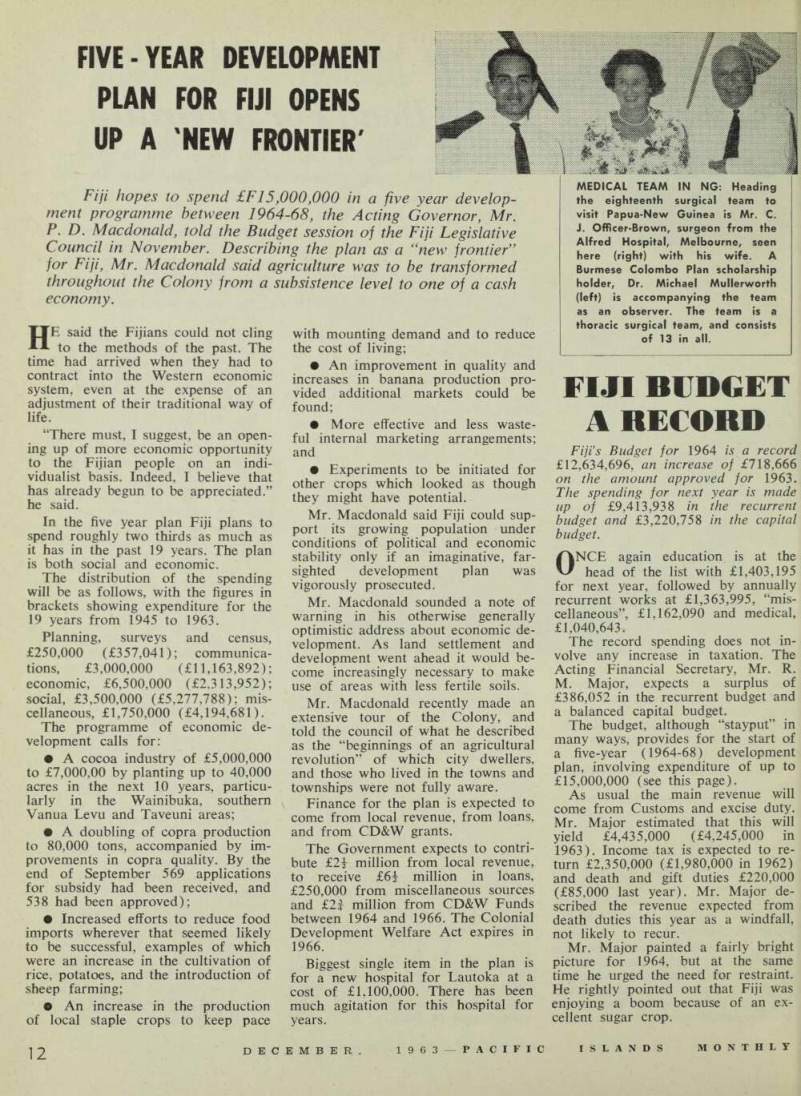
Medical Team In Ng: Heading
the eighteenth surgical team to visit Papua-New Guinea is Mr. C.
J. Officer-Brown, surgeon from the Alfred Hospital, Melbourne, seen here (right) with his wife. A Burmese Colombo Plan scholarship holder, Dr. Michael Mullerworth (left) is accompanying the team as an observer. The team is a thoracic surgical team, and consists of 13 in all.