Changes In South Seas
Speedy And Far-Reaching
Political Scene
The spotlight on South Seas events in November was on political moves. Important changes in Papua-New Guinea and the Cook Islands were the main developments during a period when there was greater political movement throughout the South Seas than at any time before.
THE overall picture was one of a South Pacific which was advanc ing at a surprising speed.
Besides New Guinea and the Cooks there were developments in the Solomons, the Gilbert and Ellice Islands, French Polynesia, Fiji, Nauru and Norfolk Island.
Papua-New Guinea in November saw the end of a political era. The P-NG Legislative Council, which was Established in November, 1951, sat for the last time. Early next year there will be general elections on a common roll and 54 members out of 64 will be elected. The Administrator for the first time will not be presi dent. Details of the final Council meeting are on page 10.
A White Paper released in Honiara proposed that the first steps be taken next year to elect for the first time, sight of the ten unofficial members of the BSIP Legislative Council.
Plans for a common roll there are especially significant in a Territory which has no experience of direct elections even for local government (see p. 41).
The Gilbert and Ellice Islands Colony in September inaugurated its first Advisory Council (photographs p. 8) and it was announced on Tarawa on November 1 that an Exe cutive Council would be created from January 1 next. Britain is obviously now building up both these territories speedily, politically and economically.
Cooks 7 Plans In the Cook Islands in November the Legislative Assembly accepted a report proposing that the Cooks be given full internal self-government by 1965, with a Cabinet and Chief Minister, and with the Queen as Head of State. New Zealand would be rep resented by a Commissioner who would have no powers to over-rule the Assembly.
As the New Zealand Government announced that it, too, accepted the report, the Cooks Assembly elected
Mr. D. C. Brown as first Leader of Government business. A secret ballot resulted in 11 votes for him and 10 for Ngatupuna Matepi, the only other nomination (see p. 33).
Fiji’s political future may be wrapped up in a conference to be called in London in 1964 or 1965, and in November there was a report (p. 54) that work to this end was now going on.
Both Nauru and Norfolk Island (p. 8) have been given different powers as a result of amendments granted by the Australian Government, in each case at the instigation of the Island councils.
In Tahiti two French Polynesian political parties were outlawed in November by a decree signed by President de Gaulle.
The two parties had 15 members in the 30-member Territorial Assembly (see p. 13).
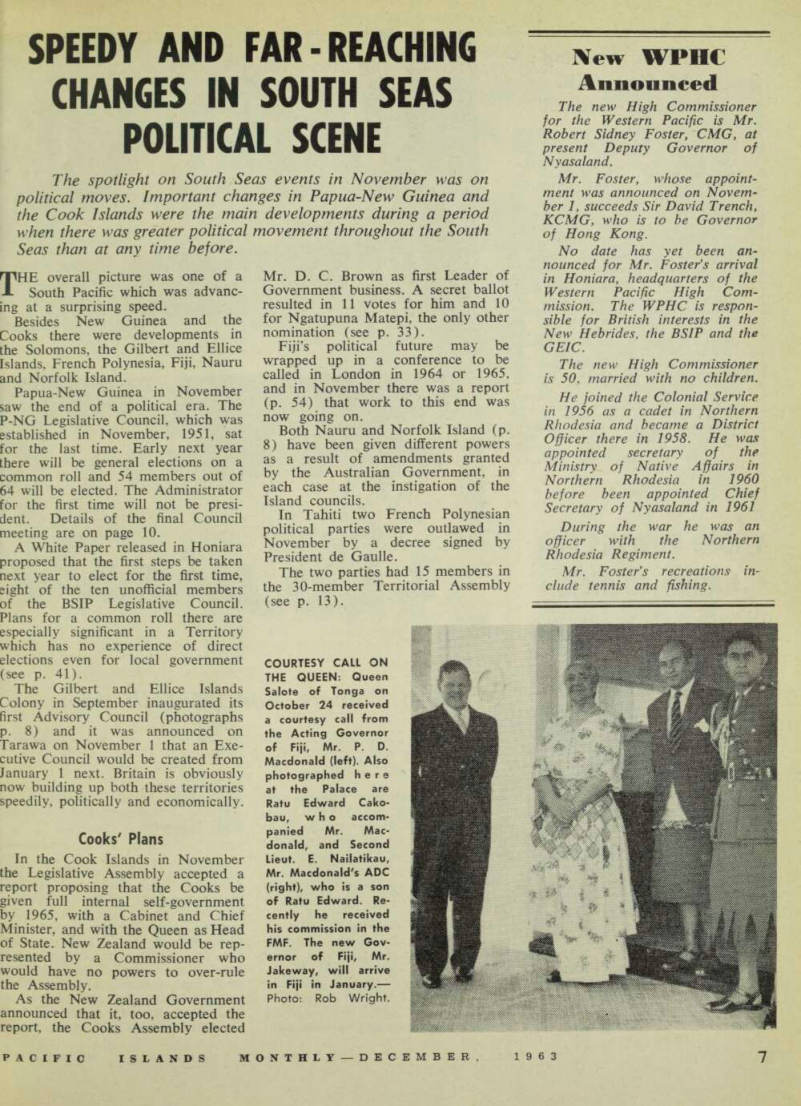
Courtesy Call On
THE QUEEN: Queen Salote of Tonga on October 24 received a courtesy call from the Acting Governor of Fiji, Mr. P. D.
Macdonald (left). Also
photographed here
at the Palace are Ratu Edward Cako bau, who accom panied Mr. Mac donald, and Second Lieut. E. Nailatikau, Mr. Macdonald's ADC (right), who is a son of Ratu Edward. Re cently he received his commission in the FMF. The new Gov ernor of Fiji, Mr.
Jakeway, will arrive in Fiji in January.— Photo: Rob Wright.