Fiji Tourism
pp. 135-136 · Read in the full issue
New Hotels Keep Pace With Increased Fiji Tourism
Prom a Suva Correspondent It is not long since well-wishers of Fiji, and critics of economic conditions here, were comment
ing savagely upon the fact that,
while the group had an enormous tourist potential, Fiji did not have suitable first-class hotel ac commodation for tourists, even if they could be persuaded to come.
CONDITIONS have changed for the better, are still improving.
There is now accommodation for a very large number of tourists.
Here are the establishments that may be rated as first-class, or close to first-class, and which are—or are about to be—fully equipped to take care of overseas travellers.
Grand Pacific Hotel: Built 50 years ago, and conducted efficiently, but unimaginatively, for 40 years by Union Steam Ship Co., it was bought about 1958 by the powerful Cathay interests of Singapore, modernised and greatly enlarged. For very many years, it had no competitor in Fiji, until the late Sir Hugh Ragg estab lished the Korolevu Beach Hotel.
Korolevu Beach Hotel. A luxury tourist resort on the South Coast of Viti Levu. This probably has contri buted more than any other single factor in creating overseas interest in Fiji’s holiday attractions. Its unique
“bure” accommodation has been expanded considerably in recent months, and it seems always to be full.
Club Hotel. After long, earth quake-induced hesitation, Morris Hedstrom Ltd. finally built the modern Club Hotel in the middle of Suva, and leased it to the Ragg interests. It is admirably conducted, and commands a substantial share of the growing overseas traffic.
Nadi Hotel was built by Northern Hotels Ltd., in modern style, in Nadi town, to cater in some degree for air travellers.
Hotel Suva was built recently on a hill into the Suva city area. It is well-managed and can claim a share of both pleasure and commercial travellers.
Beachcomber Hotel, Deuba, 30 miles along the South Coast from Suva, was develoned by the Ragg interests in recent years as a holiday resort, and makes an appeal to tourists. It was sold in October to interests which plan to modernise
the buildings, and go after “the one day tourist traffic” out of Suva.
Mocambo Hotel, at Nadi Airport.
After World War 11, a new force entered Fiji hotel-development in the person of Mr. Barry Philp, who took over the old American mess-hall alongside Nadi air-strip, and made of it a famous, colourful stop-over for trans-Pacific air-travellers. When this was swept away in the construction of the new Nadi Airport, a couple of years ago, Mr. Philp moved over to nearby Namaka Hill, and built— and sold to largely American interests —the very modern, luxurious Mocambo Hotel, for incoming and departing air travellers. A big new block now is being added to the Mocambo, doubling its already large capacity.
Sky Lodge. About the same time, a group of enterprising men estab lished Sky Lodge, a modern type of hotel, well managed by Mr. Paddy Doyle, between Namaka Hill and the airport.
Reef Lodge. After Mr. Philp sold his new Mocambo Hotel to the American group, and retired to the delightful Korotogo Coast (south west Viti Levu) he built a super bungalow overlooking the lagoon, with a farm behind it, extending up into a fertile valley. Within a year, he had sold it to a New Zealand group; and the latter, at the moment, is adding extensive, modern, lagoon side accommodation to the big bungalow. It is to be called Reef Lodge, and it will cater for the luxury class of tourists, A La Korolevu Beach Hotel.
South Pacific Hotel. Having greatly enlarged the Grand Pacific Hotel, the
The “Pacific Islands Monthly" is a member of the Australian National Travel Association (ANTA) and the Pacific Area Travel Association (PATA), which are pledged to promote tourist travel in their areas.
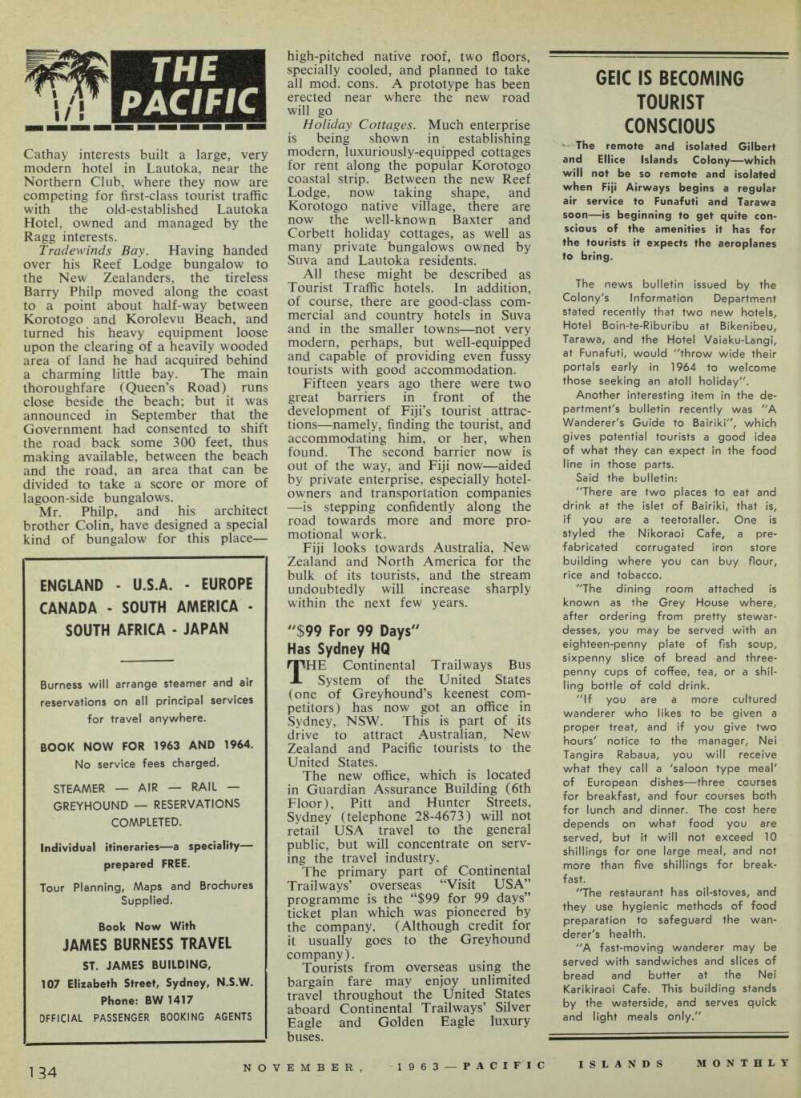
RIGHT: Two views of the prototype of Mr. Barry Philp's new style tourist accommodation in Fiji. Mr. Philp can be seen at the door.
Cathay interests built a large, very modern hotel in Lautoka, near the Northern Club, where they now are competing for first-class tourist traffic with the old-established Lautoka Hotel, owned and managed by the Ragg interests.
Tradewinds Bay. Having handed over his Reef Lodge bungalow to the New Zealanders, the tireless Barry Philp moved along the coast to a point about half-way between Korotogo and Korolevu Beach, and turned his heavy equipment loose upon the clearing of a heavily wooded area of land he had acquired behind a charming little bay. The main thoroughfare (Queen’s Road) runs close beside the beach; but it was announced in September that the Government had consented to shift the road back some 300 feet, thus making available, between the beach and the road, an area that can be divided to take a score or more of lagoon-side bungalows.
Mr. Philp, and his architect brother Colin, have designed a special kind of bungalow for this place—
high-pitched native roof, two floors, specially cooled, and planned to take all mod. cons. A prototype has been erected near where the new road will go Holiday Cottages. Much enterprise is being shown in establishing modern, luxuriously-equipped cottages for rent along the popular Korotogo coastal strip. Between the new Reef Lodge, now taking shape, and Korotogo native village, there are now the well-known Baxter and Corbett holiday cottages, as well as many private bungalows owned by Suva and Lautoka residents.
All these might be described as Tourist Traffic hotels. In addition, of course, there are good-class com mercial and country hotels in Suva and in the smaller towns—not very modern, perhaps, but well-equipped and capable of providing even fussy tourists with good accommodation.
Fifteen years ago there were two great barriers in front of the development of Fiji’s tourist attrac tions—namely, finding the tourist, and accommodating him, or her, when found. The second barrier now is out of the way, and Fiji now—aided by private enterprise, especially hotel owners and transportation companies —is stepping confidently along the road towards more and more pro motional work.
Fiji looks towards Australia, New Zealand and North America for the bulk of its tourists, and the stream undoubtedly will increase sharply within the next few years.
"$99 For 99 Days"
Has Sydney HQ THE Continental Trailways Bus System of the United States (one of Greyhound’s keenest com petitors) has now got an office in Sydney, NSW. This is part of its drive to attract Australian, New Zealand and Pacific tourists to the United States.
The new office, which is located in Guardian Assurance Building (6th Floor), Pitt and Hunter Streets, Sydney (telephone 28-4673) will not retail USA travel to the general public, but will concentrate on serv ing the travel industry.
The primary part of Continental Trailways’ overseas “Visit USA” programme is the “$99 for 99 days” ticket plan which was pioneered by the company. (Although credit for it usually goes to the Greyhound company).
Tourists from overseas using the bargain fare may enjoy unlimited travel throughout the United States aboard Continental Trailways’ Silver Eagle and Golden Eagle luxury buses.