Pacific Commerce and Produce
pp. 129-132 · Read in the full issue
More Millions In The Carpenter Empire
The Carpenter empire grows and grows. The report of Carpenter Moldings Ltd. for the year ended September 30 was distributed in late October {quick accountancy and auditing!) and shows a rise in profits from £702,687 in 1962 to £1,342,204. Dividend goes up from 15 to 20 per cent, for the half-year, or an average of 17i per cent, for the year.
LAST year’s share units (5/- each), which numbered 15,732,372, are being increased by 4,267,628, which will make the issued capital £5 millions. The share premium account is now just under £2 millions, and the unappropriated profits just over £2 millions, which means that the shareholders’ funds now are just under £9 millions.
Little wonder that the Sydney market, smelling something good coming along, lifted the 5/- stock units from 27/- to 35/- in three months.
The old board (Messrs. R. B.
Carpenter, C. H. Carpenter, W. S.
Bennett, B. B. Perriman, W. G.
Johnson, C. D. Brownhill, H. E. Snell, G. C. Remington and W. A. Ince) is being joined by Messrs. W. R.
Carpenter and S. S. Proud as associ ate directors.
The former is known in the city as “young Randolph”. He is the son of Mr. H. C. Carpenter and grand son of the founder, Sir Walter Randolph Carpenter, and, in the city’s respectful opinion, he will be a force to be reckoned with in the Carpenter structure in the years ahead.
The following list of the Holdings company subsidiaries shows how carefully this organisation has been following a policy of diversification: !N AUSTRALIA f 24): W. R. Carpenter SL C ?- Ltd , : Southern Pacific Insurance r o. Ltd.; Morris Hedstrom (Aust.) Pty. *“ erlc «» Trading & Shipping Co. -wi Lt £ : P- B ‘ Jeffer son Pty., Ltd.: Jaude Neon Industries Ltd.; Claude Neon J f d ' : T Cl i ud ® Neon Lights (Victoria) T L ;. G - : Burley Pty., Ltd.; Marvelcraft W. i, Ltd -: Scanlan’s New Neon Ltd.; Neon loldings Ltd.; Consolidated Neon Ltd * Endurance Electric Pty., Ltd.; Motor >ervices (Gladesville) Pty., Ltd.; lonllte Queensland) Pty., Ltd.: Neon Supplies ty., Ltd.; Neon Luminous Products Pty.
J td-: Neon Signs Ltd.; W. R. Carpenter
& Co. (Solomon Is.) Pty., Ltd.; J. B.
Carpenter & Sons Ltd. (Non-operative); Artcraft Neon Signs Pty., Ltd.; T. E.
Page & Co. Ltd. (Non-operative); On Chong & Co. Ltd. (Non-operative).
In Papua And New Guinea (12):
Pacific Trading Co. Ltd.; New Guinea Co.
Ltd.; Coconut Products Ltd.; Island Estates Ltd.; Gama Plantations Ltd.; Tovarur Plantations Ltd.; Repairs & Sales Ltd.; W. R. Carpenter (New Guinea) Ltd. (Non-operative); W. R. Carpenter Oversea Shipping Ltd. (Non-operative); Island Transports (New Guinea) Ltd. (Non operative); Island Products Ltd.; Southern Cross Marine Insurance Co. Ltd.
IN FIJI (13); Pacific Products Ltd.; Morris Hedstrom Ltd.; Island Industries Ltd.; W. R. Carpenter & Co. (Fiji) Ltd.; Millers Ltd.; Suva Motors Ltd.; Pacific Shipowners Ltd.; The Lau Traders Ltd.; Fiji Pastoral Co. Ltd.; Cicia Plantations Ltd.; Kanacea Ltd.; Austral Motors Ltd.; Island Transport Ltd.
IN NEW ZEALAND (1): Paramics Ltd.
IN CANADA (1); BC Ship Chartering Co. Ltd.
In United Kingdom (1): W. R.
Carpenter & Co. (London) Ltd.
'Steamships 7 Bigger Profits
In Papua-New Guinea
IN the year ended June 30 last,
Steamships Trading Co. Ltd., of
Papua, had a net income, before
tax, of £332,866 from trading, and
£66,704 from its subsidiaries and investments, which gave it a total income of £399,570, as compared with £320,455 in the previous year.
Tax provision this year is £68,000 (up £11,000); which means a net revenue of £331,750, for disposal.
The proposed dividend is 8d per share unit of 5/-, slightly more than 13 per cent., which is slightly less than the previous year. This will leave an accumulated unappropriated profit of £341,520 (last year it was £250,101).
The company has an issued capital of £1,481,900 in 5/- stock units.
With reserves of £1,688,674, and unappropriated profits of £341,250, the shareholders’ funds, in addition to subscribed capital, are £2,029,194.
In other words, the company’s work ing capital is £3,511,094.
But this is not enough. The company’s recent expansion into New Guinea (purchase of Colyer Watson Ltd.) and into other things (Goroka Coffee Producers Ltd., Lamington Hotels Ltd., Sagarai Estate Ltd., Mango Avenue Motors Ltd. and Rabaul Stevedores Ltd, in Rabaul, and Brown River Timber Co. Ltd.) have created a somewhat cramped capital position, seen in a bank overdraft of £225,759 (£170,718 last year) and short term loans, £105,000 (last year, £135,000).
The directors now propose to ease this by making another 1,193,628 ordinary 5/- shares available to shareholders (1 for 5) at a premium of 2/6 each. This should provide another £420,000 of additional capital.
The Australian market, in October, valued the 5/- units at over 14/-. the company is well managed; and the economic prospects are such that the company’s earnings should more than cover the dividend requirements of the new capital. The new issue is almost certain to be promptly taken up. If it is not, it will be due, not to trading prospects, but to the Territory’s uncertain political ou 11 o o k—an uncertainty that Canberra’s reluctance to give any promise of security to Territory in vestors has done nothing to alleviate.
More Angles on Fiji's
Banana Export Trade
THE idea of growing and packing bananas in Fiji for the market in Japan has not so far made much real progress; but it has not been given up. There could be an an nouncement soon about Government arrangements with Japanese interests.
Mr. P. D. Lakshman has also in recent months been trying to get official permission to create an organisation for the shipment of bananas to Japan. But the chair man of the Banana Marketing Board (Mr. J. A. Sandys) informed him in October that “an exclusive licence to export bananas to Japan was given last year to the Land Development Authority; and, while the Authority’s managing agents (Fiji Development Company) are engaged in active negotiations with a Japanese firm of importers, I regret that the Banana Marketing Board cannot issue another licence to you”. (Over)
Mr. Lakshman, for many years, was a prominent industrial and political figure in Lautoka, and last year he retired from public life in Lautoka and took up residence on a large area of land in the Deuba district of Fiji, which he purchased from the late Mr. J. P. Bayly. Since then he has been planning to develop the land’s natural resources, and has been engaged in the saw-milling business.
Early this year Mr. Lakshman entered into negotiations with an overseas company, formulated a plan for planting up 2,000 acres of land near Deuba with bananas (with a view to exporting from 16,000 to 20,000 cases per fortnight to Japan) and applied for an export licence.
It was then he learned that, at this stage, it is not intended to issue more than one such licence.
Since then he has renewed the application, and has had vigorous arguments in the old Lakshman style, but he has not made much progress.
Mr. Lakshman proposed that since he cannot get a licence to export to Japan, he be given the right to export to Australia or Canada or the United States, if suitable arrangements for such a traffic could be made.
He reported on October 4 that the chairman had replied that “the board would view with favour such an application”.
It Had Its Roots
In Bulolo Gold
"FHE annual accounts of Placer A Development Limited, a 38nillion-dollar organisation with head juarters in Vancouver, are to hand.
This huge organisation, now
)wnmg enterprises—mostly mining—
n all continents, really came into )eing because a group of Adelaide nen, some 40 years ago, had con idence in Cecil Levien’s plan to Iredge gold out of the Bulolo flats, n New Guinea. They formed Guinea 3old NL; and out of that syndicate ame Bulolo Gold Dredging, Guinea Airways and other money-makers.
Placer spread its wings and flew ar out over the globe, and in its 7 years of activity it has earned normous profits. It still has a nllion-dollar interest in Bulolo Gold hedging Ltd.; and, through Bulolo, i Associated Plywoods Pty. Ltd., of ydney, and Commonwealth-New rumea Timbers Ltd., of Bulolo. Of le latter, the annual report says: “Sales generally continue to be epressed, and the necessary with rawal from the United States market n account of low prices caused a
stock accumulation which could only be rectified by a cut-back in pro duction until conditions improve.
The dividend received by Bulolo, of $180,750, is in line with the amount received in the previous fiscal year.”
Fiji's Sugar Hopes
Remain Bright
HURRICANE Flora in the Carib bean in mid-October did not do the Cuban sugar crop any good, and it was reported to have damaged machinery in some of the mills.
There was an upward trend in world prices immediately after the hurri cane. In late October London price was £Stg.lo2—a new postwar peak.
When Cuba lost the lucrative United States market not long ago the United States reallocation of the Cuban quotas were of immediate benefit to Fiji, which secured an allocation of 10,000 tons a year.
But the Fiji sugar exports to the U.S. are much higher because of the allocation of additional tem porary quotas, and in the current year the Colony will export about 40,000 tons to the United States.
The United States shortage had an immediate world reaction for every country which could grow sugar began planting more, hoping to get a new or additional quota.
From the Fiji point of view that could have meant next year guaranteed markets of only 10,000 tons in the United States, plus its British Com monwealth Sugar Agreement quota of about 125,000 tons, and the 15,000 tons it sells locally and to neighbour ing Pacific Islands.
With a production target of 30,000 tons sets for 1964 that means that half of the output would have to go on the world market, which has been subject to violent price fluctuations.
Sugar marketers don’t like selling in such conditions. They much prefer a stable price for several years, even though that price may be below the peak free world prices.
In the meantime the chairman of the Fiji Sugar Board, Mr. Justice Marsack, has told the International Sugar Council that Fiji wants a bigger sugar quota. He will make every effort to get one when the Inter national Sugar Agreement comes up for re-negotiation (it has been in abeyance for some years).
He rightly pointed out that if Fiji’s quota were doubled it would have little effect on world markets, but would make a very material differ ence to the prosperity of Fiji, and Fiji would have no trouble in pro ducing the tonnage, or dealing with it in the mills.
Fiji Tobacco Opens
Enlarged Factory
THE Fiji Tobacco Co. Ltd., a sub sidiary of the British Tobacco- Wills group, officially opened a new factory at Nabua, about four miles from Suva, on October 16.
Executives from the Australian headquarters who attended were Mr.
T. J. N. Foley, chairman of British Tobacco-Wills, and many of its sub sidiaries, Mr. C. B. Noble, director of production, Mr. B. E, White, pub lic relations manager, and Mr. J. D.
Hood, export manager, Mr. Hood, in cidentally, was a former manager of the Fiji Tobacco Co.
The company was the first to en gage in the cigarette manufacturing industry in Fiji, and is now in strong competition with Carreras.
The demand for Fiji Tobacco’s products has increased rapidly, and three or four years ago it was evi dent that the leased factory at Walu Bay, Suva, could not cope. They started the Nabua project in 1961, and altogether it has cost them about £l6o,ooo—site work, buildings and services, including fumigation plant at £75,000, and installed value of mach inery and equipment at £85,000.
The new factory, designed to with stand hurricane-force winds of up to 150 miles an hour, is a portal steel frame structure, 80 ft by 180 ft floor area.
Working jointly with the tobacco factory is a leaf development project in the Sigatoka Valley, started in
1956, and managed by Leaf Develop ment Ltd., another British Tobacco- Wills subsidiary.
The company has invested about £50,000 in the project, and has already received some return in the way of leaf exports, mainly to Aus tralia. Some of the local leaf is used in the Fiji-manufactured cigarettes.
Fiji Tobacco distributes its pro ducts throughout the 170 inhabited islands of the group, and has a small export trade with both Samoas and Tonga. It is now looking east to the BSIP and the New Hebrides and north to the Gilberts.
The staff has grown from 35 in 1956 to more than 100 today.
The manager is Mr. John Morgan, who has Mr. J. E. Cowell as his fac tory manager and Mr. B. Bentick as his accountant. Mr. J. A. Colgan and Mr. A. O. Bishop look after the leaf projects.
In New Guinea, Wills’ locally produced Players Gold Leaf cigar ettes, which sell for 2/- for 20, have already outstripped production capa city at the company’s new factory at Madang. The factory will be en larged, more staff will be put on, and supplies will be airfreighted to Madang to supplement supplies sent by ship.
Qantas and Fiji Airways
Up, TEAL Down
QANTAS made a record profit for the year ended March 31— £1,406,246. This compared with a profit of £408,817 in the previous year. Revenue for 1962-63 was £40,845,700. The chairman reported that the international air transport in dustry was a valuable barometer of world trade which, in recent years, had tended to move in sympathy with the US economy. “The continued buoyancy in the USA undoubtedly contributed to the resumption of the traditional growth pattern in world air traffic in the past year,’ he said.
The company was concerned about its ability to provide adequate ser vices until the two additional 707 s on order were delivered in the second half of 1964. Among other things there was a big upsurge in the growth of tourism and 150,000 visitors were expected in Australia next year.
Fiji Airways Ltd., which is owned equally by Qantas, BOAC and TEAL, made a net profit of £F 1,681 for the year ended March 31. 1962, follow ing a loss of £8,094 in the previous period of 15 months. Results for the 1962-3 year were expected to show an improved profit the Qantas chair man, Sir Hudson Fysh said.
TEAL for the year March 31,
1963, earned a profit of £NZ10,958, after taxation, compared with £63,572 for 1962. Total gross operating revenue for 1963 was £3,523,185. The chairman, Sir Leonard Isitt, said the year saw the final transition of TEAL from multi-ownership to full New Zealand ownership and the future would probably prove that this transi tional year represents a trough in the company’s financial health. Natural traffic growth should compensate in future for the sharing of Tasman ser vices with Qantas and BO AC.
Much Trading In
Pacific Islands Mines
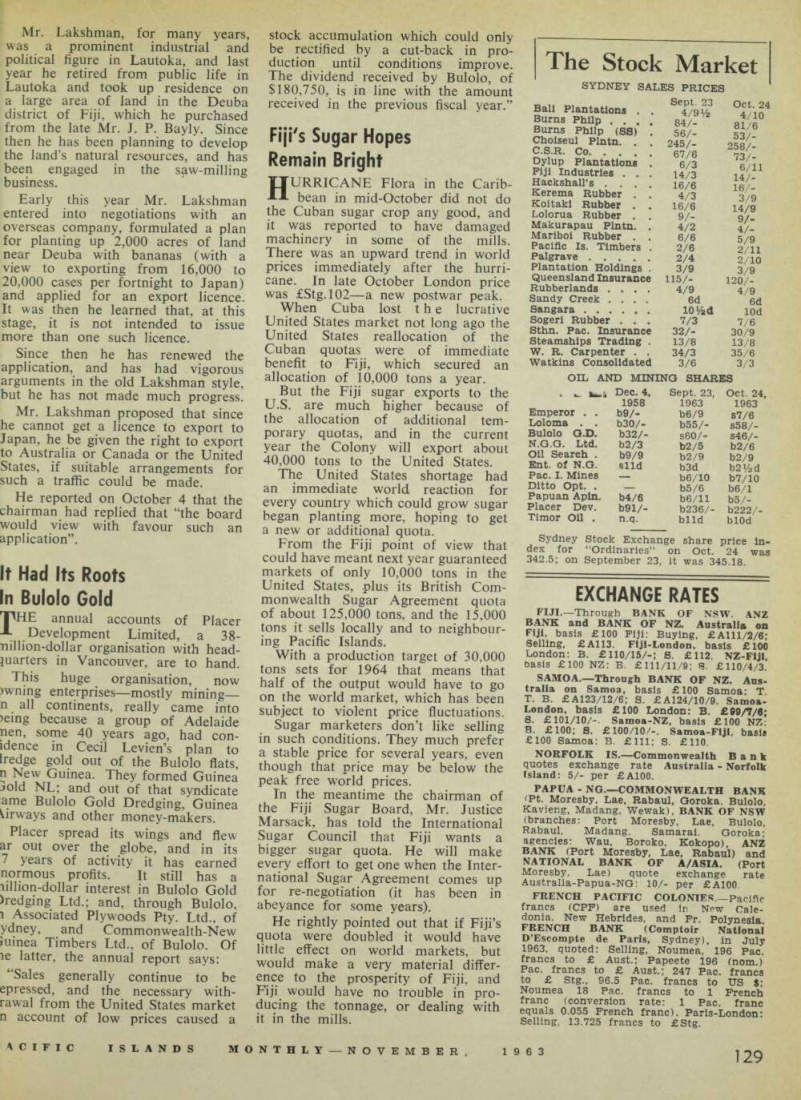
THE 2/6 shares in Pacific Islands Mines, a company which has ex cellent prospects with gold on Misima Is., Papua, fluctuated in September- October and many happy investors who had bought into this company last year took their profits. Over a period of a few weeks the shares went up to 9/- and more.
A company report on October 29 said the company was having talks with overseas mining companies about a possible joint-venture. Con sulting geologist Mr. F. G. Forman endorses the deep exploratory pro gramme, involving 10,000 ft. of underground headings, recommended by the company’s consulting engineer.