Will Be Collectors' Pieces
pp. 90-91 · Read in the full issue
New Guinea Books of Birds Will Be Collectors' Pieces
Tom Iredale’s Birds of New Guinea (in two volumes) have the distinction of being the most beautiful books ever printed about any aspect of the Territory. For the layman they are worth possess ing for that reason alone.
THE author himself, in a foreword, admits their attraction as picture books but it would be foolish for any one to overlook the detail of the text or the meticulous research and corre lating that has gone into producing the volumes.
The production of a “bird book” of any country is a laborious and ex pensive business; for New Guinea, where so much work has yet to be done, it is a pioneering effort requir ing missionary zeal. In this case, publishers, author and artist have combined to produce the most signifi cant results.
The two volumes were originally issued in 1956, at 24 guineas the set.
The limited remnants of that original edition are now selling at half price —that is £l2/12/-. The books are from the same printing, the only dif ference being that they now are no longer offered in a special cloth covered slipcase. Each volume instead has a coloured dust-jacket, and as such is now uniform with Iredale’s Birds of Paradise and Bower Birds
which was published in 1950 (This dealt with these particular birds in somewhat greater detail than in Birds of New Guinea.) The market for books worth £25/4/- is limited—at least in Aus tralia—and this the publishers have apparently found out the hard way.
The fact is, of course, that if the books were worth that in 1956 when printing costs were very much less, they should be worth more today when interest in New Guinea is greater and collectors of Pacific books are springing up like mushrooms all over the world.
Locals Don't Know How little local residents know of local birds was amply proved a few years ago when Trans Australia Air lines decided to introduce their local “Sunbird” air services (in contradis tinction to Qantas’ old Bird of Para dise services), and the TAA sign writer proceeded to paint a curved beaked bird with a yellow pot-belly on the tail assembly of the company’s
planes. Territorians, almost to a man, swore that no such bird existed —or if it did, that no one in New Guinea had seen it.
New Guinea, according to Iredale, has two species of sun-bird, and several sub-species.
There are 650 species of birds that inhabit the New Guinea mainland; 347 of these are illustrated, in full colour, in these two volumes.
Each of the bird portraits was painted by Iredale’s wife, Lilian Med land, the artist (who died shortly be fore the book was published) and printed on specially grained art-paper that gives such an illusion of reality that it is almost possible to count each feather.
Although New Guinea’s glamour birds—the various Birds of Paradise —are well known, few people, includ ing those who live in the Territory, realise the extent of the number of lesser species.
Even when living in the New Guinea bush, birds do not obtrude their presence upon you. The height of the rain forest is one reason for this; and New Guinea man’s everlast ing quest for something to put in his stomach—even if it’s only black cockatoo—is, no doubt, another. The New Guinea bush is, by and large, a silent place, except for the occasional squark of a flight of white cockatoos high above the forest, or the dusk or dawn steam-train chuffing of the 3-ft wingspan of a so-called “kokomo” or hornbill.
Two other attempts only have been made to list New Guinea birds—
Gould’s famous folios of coloured plates issued last century and now worth well over £l,OOO each on the rare occasions one becomes available; and Salvadori’s descriptions (no illus trations) issued in three volumes of 80 copies only, in Italian and Latin, early in this century. It is pretty ob vious, therefore, that it is only a matter of time before Iredale’s volumes also enter the rare book class and become collectors’ pieces.—lT.
(Birds Of New Guinea. In Two
volumes. Published by Georgian House Pty. Ltd., Melbourne. £l2/12/-.)
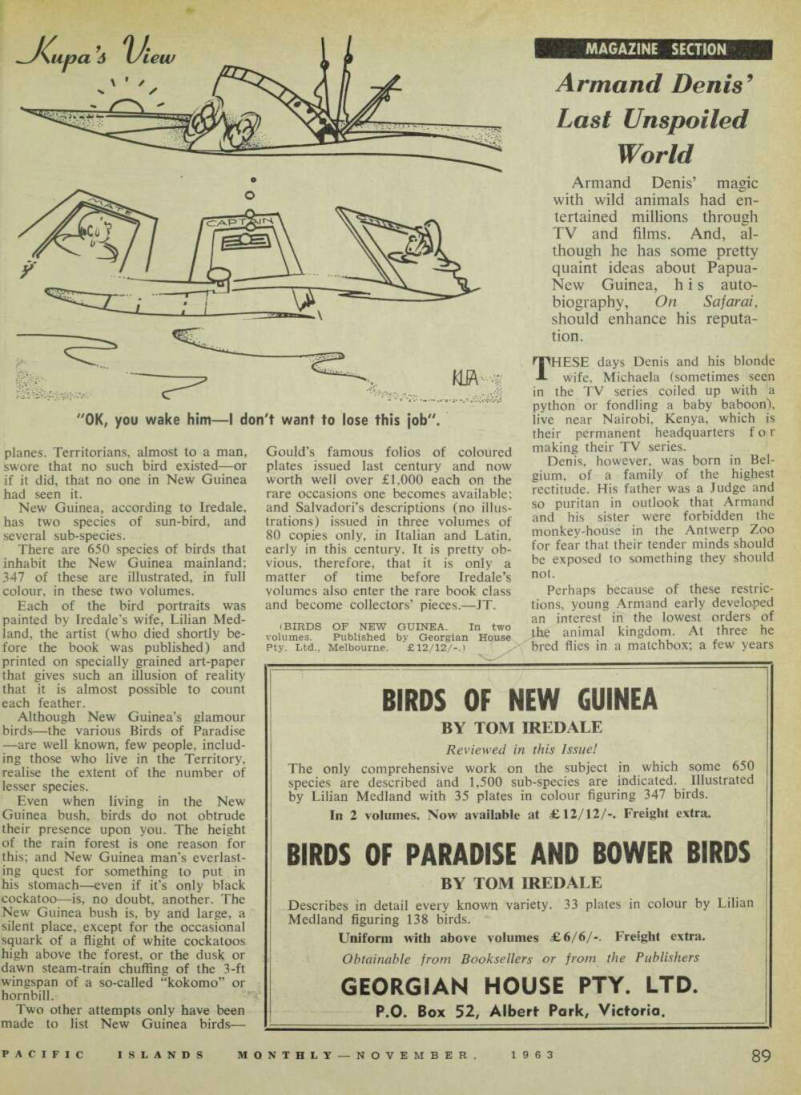
"OK, you wake him—l don't want to lose this job".