Magazine Section
pp. 79-81 · Read in the full issue
Pacific Islands Monthly
Tahiti's Nature Man Could Not Find An Eve For His Garden Of Eden
By Robert Langdon
One day in January, 1913, as the steamship Mariposa was about to leave San Francisco on a voyage to the South Pacific the captain suddenly yelled from the bridge: “Lower the gang way, there’s a stowaway aboard!”
AMID the shouting of more orders, all hands began a systematic search of the ship.
Fifteen minutes later, the second officer, the purser and a steward ap peared on deck hustling a powerful, sun-tanned man towards the gangway.
They had found him hiding in a linen closet, disguised, so the steward said, as a “bloomin’ barth towel”.
The passengers on deck roared with laughter when they caught sight of the man, for he looked like a partly dressed prophet from an Old Testa ment religious painting.
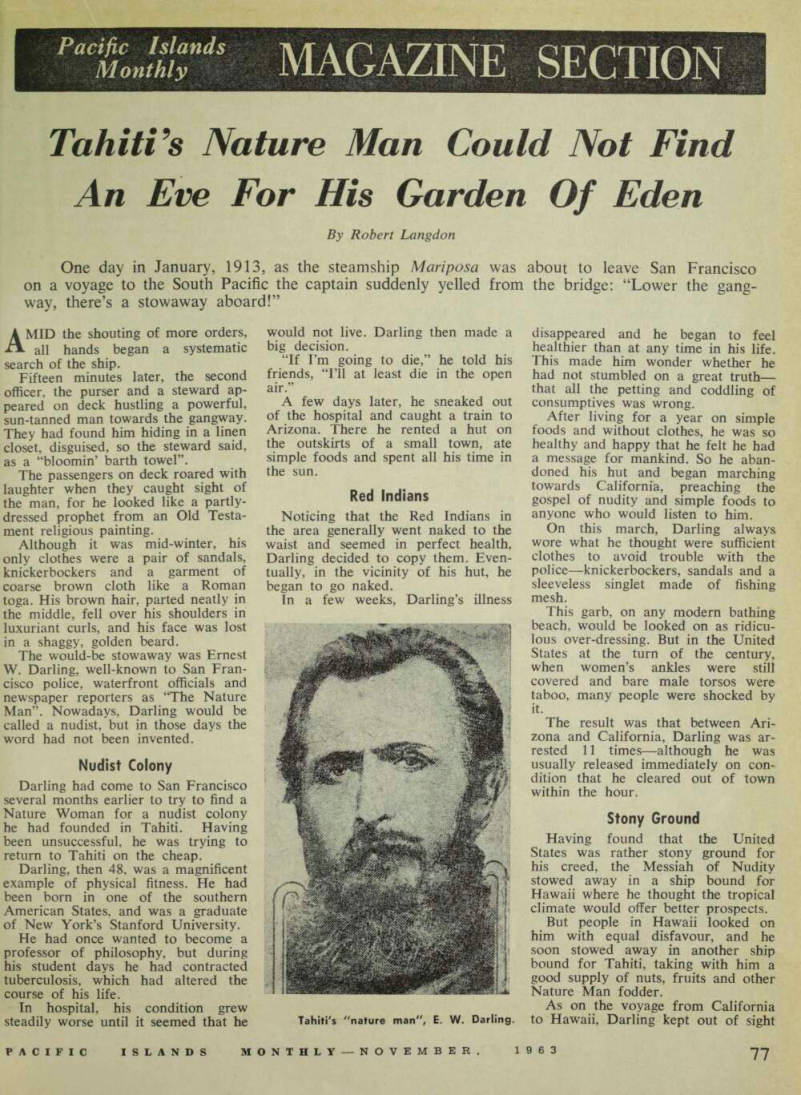
Although it was mid-winter, his only clothes were a pair of sandals, knickerbockers and a garment of coarse brown cloth like a Roman toga. His brown hair, parted neatly in the middle, fell over his shoulders in luxuriant curls, and his face was lost in a shaggy, golden beard.
The would-be stowaway was Ernest W. Darling, well-known to San Fran cisco police, waterfront officials and newspaper reporters as “The Nature Man”. Nowadays, Darling would be called a nudist, but in those days the word had not been invented.
Nudist Colony
Darling had come to San Francisco several months earlier to try to find a Nature Woman for a nudist colony he had founded in Tahiti. Having been unsuccessful, he was trying to return to Tahiti on the cheap.
Darling, then 48, was a magnificent example of physical fitness. He had been born in one of the southern American States, and was a graduate of New York’s Stanford University.
He had once wanted to become a professor of philosophy, but during his student days he had contracted tuberculosis, which had altered the course of his life.
In hospital, his condition grew steadily worse until it seemed that he
would not live. Darling then made a big decision.
“If I’m going to die,” he told his friends, “I’ll at least die in the open air.”
A few days later, he sneaked out of the hospital and caught a train to Arizona. There he rented a hut on the outskirts of a small town, ate simple foods and spent all his time in the sun.
Red Indians Noticing that the Red Indians in the area generally went naked to the waist and seemed in perfect health, Darling decided to copy them. Even tually, in the vicinity of his hut, he began to go naked.
In a few weeks, Darling’s illness
disappeared and he began to feel healthier than at any time in his life.
This made him wonder whether he had not stumbled on a great truth— that all the petting and coddling of consumptives was wrong.
After living for a year on simple foods and without clothes, he was so healthy and happy that he felt he had a message for mankind. So he aban doned his hut and began marching towards California, preaching the gospel of nudity and simple foods to anyone who would listen to him.
On this march, Darling always, wore what he thought were sufficient clothes to avoid trouble with the police—knickerbockers, sandals and a sleeveless singlet made of fishing mesh.
This garb, on any modern bathing beach, would be looked on as ridicu lous over-dressing. But in the United States at the turn of the century, when women’s ankles were still covered and bare male torsos were taboo, many people were shocked by it.
The result was that between Ari zona and California, Darling was ar rested 11 times—although he was usually released immediately on con dition that he cleared out of town within the hour.
Stony Ground
Having found that the United States was rather stony ground for his creed, the Messiah of Nudity stowed away in a ship bound for Hawaii where he thought the tropical climate would offer better prospects.
But people in Hawaii looked on him with equal disfavour, and he soon stowed away in another ship bound for Tahiti, taking with him a good supply of nuts, fruits and other Nature Man fodder.
As on the voyage from California to Hawaii, Darling kept out of sight
Tahiti's "nature man", E. W. Darling.
until the ship was well out to sea.
Then he gave himself up to the cap tain and offered to “pay” his way by shovelling coal in the stokehold.
He said that he would be happy to sleep on the forecastle head, and that as he had brought his own food, the only thing he asked for was water.
The captain was not amused, but he agreed to let Darling have his way.
On reaching happy-go-lucky, French-ruled Tahiti, Darling gave boxing lessons in Papeete to earn money. Then he bought some land in the mountains behind the town and settled down to establish a colony for Nature Men.
Ten Commandments By this time Darling had worked out all the details of the Nature Man’s creed, and had even had his Ten Commandments printed as pamphlets. The main articles of the creed were: Nakedness, non-acid foods, socialism, no religion, no drugs and simplified spelling.
Two of the Ten Commandments were: “Thou shall not eet meet” and “Vizit troppikle kuntriz”.
Darling’s land was the ideal spot for a colony of Nature Men. It was 1,500 feet above sea level and up a track so steep that only the most
energetic natives, hunting for wild pigs, had ever climbed it.
As the pigs had once used the spot as a wallow, the soil was so rich that anything would grow there.
After clearing away guava scrub, Darling built a hut five yards long by five wide and planted coconut trees, mangoes, breadfruit, papaws, avo cados and vegetables. He then put up a notice for the benefit of any would be Nature Men who might happen to come along. It said: “U R free 2 D-nude rite now.’
Darling’s next move was to bom bard the American health and physi cal culture magazines with letters and articles inviting anyone who was will ing to obey his creed to join him in his Garden of Eden.
Too Much Hard Work One or two potential Nature Men were attracted to join him from time to time, but most of them soon drifted away again when they found how hard they were expected to work.
Meanwhile, people all over the world had become curious about Dar ling’s unique colony. Passengers in ships touching at Tahiti climbed to his eyrie to get a glimpse of him; journalists arrived to write articles about him; and travel writers in
eluded chapters about him in their books.
Most of the writers could not resist the temptation to be funny at Dar ling’s expense; but none could deny that he was handsome, civilised, in telligent and superbly fit.
An English writer, George Cal deron, who lived with the Nature Man for several days in 1906, found that it was part of Darling’s philo sophy “to emit wild cries of delight whenever he entered sunshine or water, or reached the top of a hill”.
If the take-off was suitable, he would also fling a pirouette.
Rhyming Couplets
At meals, which consisted only of fruit and coconut milk (extracting the milk was called “milking the coco cow”), the Nature Man would make up rhyming couplets such as: If U don’t eet meet U won’t get sore feet.
Or The coconut cow Can’t pull a plow.
On the more serious subject of good health, Darling told Calderon; “You’ve got to go right back to Nature, brother, and live according to her rules. What you need is pure air, hard work and a diet of non-acid fruits”.
Although Darling practised what he preached, many people in Tahiti thought he was a poseur who simply
liked notoriety. They said that when ever he saw a ship coming in, he would race down to the waterfront, swim out to a canoe, and bask in it, apparently absorbed in contemplation, for the benefit of the passengers.
This, however, was Darling’s way of trying to attract disciples. It was a rule of his never to force his ideas on anyone, and he would only discuss them with others if he thought they were genuinely interested.
Jack London When the famous American novelist Jack London and his wife Charmian visited Tahiti in the ketch Snark in 1907, they thought Darling was a model of good manners and generosity.
Charmian London described their first encounter as one of the most picturesque incidents in the Snark’s voyage. The Snark had barely passed through the reef into Papeete’s lagoon when the Londons saw Darling’s “startlingly Biblical figure” standing in a small outrigger canoe that a native was paddling towards them.
Darling was waving a blood-red Socialist flag and bringing them gifts of mangoes, coconut cream and avo cados.
The second time the Londons met the Nature Man, he completely trounced Jack, who was no mean pugilist, in a boxing match. Jack London later described this incident in one of the finest chapters in his book The Cruise of the Snark.
Like A Wild Animal Another writer who visited Tahiti several years after the Londons said that the trail to the Nature Man’s eyrie was so steep that most people had to crawl up on all fours. Darling, however, could bound over it like a wild animal, and on one occasion when he invited a party to visit him, he ran ahead so quickly that he had a meal of breadfruit and fei prepared by the time the party arrived.
Darling finally left Tahiti towards the end of 1912 because he was lonely and wanted a wife to share his existence with him. When he reached San Francisco after his third stowaway voyage, the local news paper reporters greeted him with whoops of delight, and enjoyed them selves mightily in trying to help him find a Nature Woman.
One reporter wrote: “He has no preference in the matter of race or colour. She must be in good health.
She must be willing to dispense with raiment except in such places as are
burdened with a chief of police of conventional ideas. And she must be willing to subsist on uncooked food.
In return for these sacrifices, she gets Darling.”
Darling, however, did not find his Nature Woman, and within a few weeks he was haunting the San Fran cisco waterfront, trying to stow him self away on another ship bound for Tahiti.
Nowhere In Sight His efforts to do so kept everyone in San Francisco amused—everyone, that is, except ships’ captains and waterfront officials.
Darling did not manage to get to the South Seas again until 1918 when he raked up enough money to pay for a passage to Suva, Fiji. He arrived in Suva wearing a one-piece romper suit of dark grey material, sandals, and an incongruous, dark-green celluloid eye-shade.
The Fijian boys were delighted to have the bearded prophet among them, and for a week or two they
followed him every time he went to market from a hut he rented just outside Suva.
Then the Nature Man was accepted as part of the Suva scene, and no body troubled him unless they were interested in discussing his ideas.
A Pacific Cable Company official who met Darling at this time wrote later that his arguments on the philosophy of life were “really con vincing” and “one felt that here was a man who was at peace with the world”.
Darling was then 52 and was still able to turn hand-spring somersaults with the agility of a youth.
However, a few months after his arrival in Suva, he became a victim of the great influenza epidemic that swept the world towards the end of World War I. A doctor who attended him prescribed drugs, but Darling, true to his faith to the last, refused to take them.
He died there on December 9, 1918, and was buried in Suva Ceme tery.