In Copra Report
pp. 63-65 · Read in the full issue
Lessons For All Planters In Copra Report
Sweeping changes in the Fiji coconut industry are recom mended by Lord Silsoe in his report just issued.
HIS major recommendation is that a statutory board be set up to: • Control copra and coconut prices; ® Issue licences for all coconut or copra buyers and makers of coconut products; • Prescribe grades of copra; and • Seek to raise and maintain the standard of Fiji copra.
Supporting the board will be a widely representative advisory council which Lord Silsoe wants to meet frequently to discuss, and advise the board on, all aspects of the industry.
Lord Silsoe trenchantly criticised the present standard of Fiji copra and recommended methods of improving quality, including the prohibition of smoke driers.
He proposed a Government operated grading system, and a price differential of £5 a ton between grades. Bad copra will be rejected and destroyed.
Double Output
Lord Silsoe commended the Gov ernment’s replanting and subsidy scheme, and suggested a development plan for doubling the output to 80,000 tons a year. The plan in cludes using 50,000 acres of Fijian land at Natewa Bay, Taveuni, Gau, Koro and Moala to establish 30-acre coconut farms on which to settle about 1,600 new planters and their families.
N Under this plan he wants the Copies of the “Report of the Fiji Coconut Industry Survey”, by Lord Silsoe, are obtainable from The Government Printer, Suva, at F4/-.
smaller islands of Gau and Koro (Lomaiviti) and Moala (Lau) reserved for Fijians, and Natewa Bay and Taveuni for growers of any race.
In several parts of his report Lord Silsoe was critical of marketing arrangements.
He was also critical of “on the beach” trading, which resulted in sharp differences in prices, and suggested it should be prohibited. He also wanted the long-established cess of £lO a ton on Fijian copra reduced to £5.
Lord Silsoe proposed a develop ment programme which included: The
local manufacture of more coconut products, such as margarine, desiccated coconut and coconut fibre; and starting a new export trade limited to top-class copra at higher prices.
He did not have his tongue in his cheek when he recommended the manufacture of local products, for he gave the full history of the un fortunate consequences of the Car penter attempt to operate a margarine factory profitably in the 1950’5.
He received encouraging letters from the chairman of W. R. Car penter Ltd. and also of Hackshall Ltd., who own all the share capital of Island Industries Ltd. and Union Soaps Pty. Ltd., and who are the major processors of copra in Fiji.
Would Expand
Each said he would desire, under certain financial conditions, to expand his investment in Fiji—Carpenter’s to restart making margarine and edible fats, and Hackshalls to enlarge their recently-launched enterprise of making and selling toilet soaps.
Lord Silsoe hit hard, when he remarked that it was doubtful if there were many countries in the world which had lower reputations than Fiji for their copra. It was a half-truth which suited lazy people to say that there would always be a market for poor copra.
Copra had no value at all, except for its oil and the by-product, meal.
Coconut oil had two main uses — foods and soaps (including technical uses). Foods included margarine, cooking oils, biscuits, sweets and cakes. . (Over)
Soaps included various grades of toilet soaps, body oils and laundry soaps. Good copra would be used for both foods and soaps. Bad copra could only be effectively used for some soaps. Good copra made good meal for cattle, and bad copra at best made poor meal.
It was true that in Europe, where most copra in the form of coconut oil from Fiji found its way, coconut oil makers would not, at present, pay a higher price for the minority of good copra.
But Unilever did offer higher prices for the better copra and other selected markets did exist for good and the best copra. Coconut oil sold as Ceylon Standard 1 per cent, free fatty acid, sold at a higher price than the lower quality Straits 3i per cent, ffa, now sold from Fiji.
Better priced oil could only be made cheaply from the better grade copra. Extra processes in crushing bad copra could make coconut oil much better, but only at a higher cost in money. Those processes could never make such oil fit for high class cakes and sweets at an economic cost.
Best Market At present it was beyond argu ment that the best market was copra for use in foods. That meant that there must be made in Fiji only copra from which the oil was good enough at a reasonable cost of crushing to sell for making foods and good toilet soaps abroad and locally.
Those who argued it was a waste of time and money to make decent copra, would condemn Fiji to sell its oil mostly for soap. They would also prevent foods and the best toilet soaps being made cheaply in Fiji— surely a foolish result when good
copra was simply a matter of method and care. It did not involve high capital outlay.
Lord Silsoe expressed himself in favour of hot air driers, and against smoke-drying, which he wants prohibited by law. Sun-drying is out, unless it is in the most expert hands, and in the driest parts of Fiji.
In recommending three grades of copra initially Lord Silsoe said there should be a premium for the top grade of plus £5 and a reduction of minus £5 for the bottom grade. The price of the middle, or second grade, was intended to correspond exactly with the average price payable by
the coconut oil maker over a period of time for all his copra of all grades.
Care had to be taken in fixing prices that the coconut oil maker paid over a period no more and no less for copra in total than the average price produced by the pricing formula.
Lord Silsoe said it should be open to the board and the coconut oil makers, to suggest that the average prices were too high or too low. At that stage there should be only two grades, first and second, and the board should try to fix the price difference. If there were arguments an umpire should be appointed.
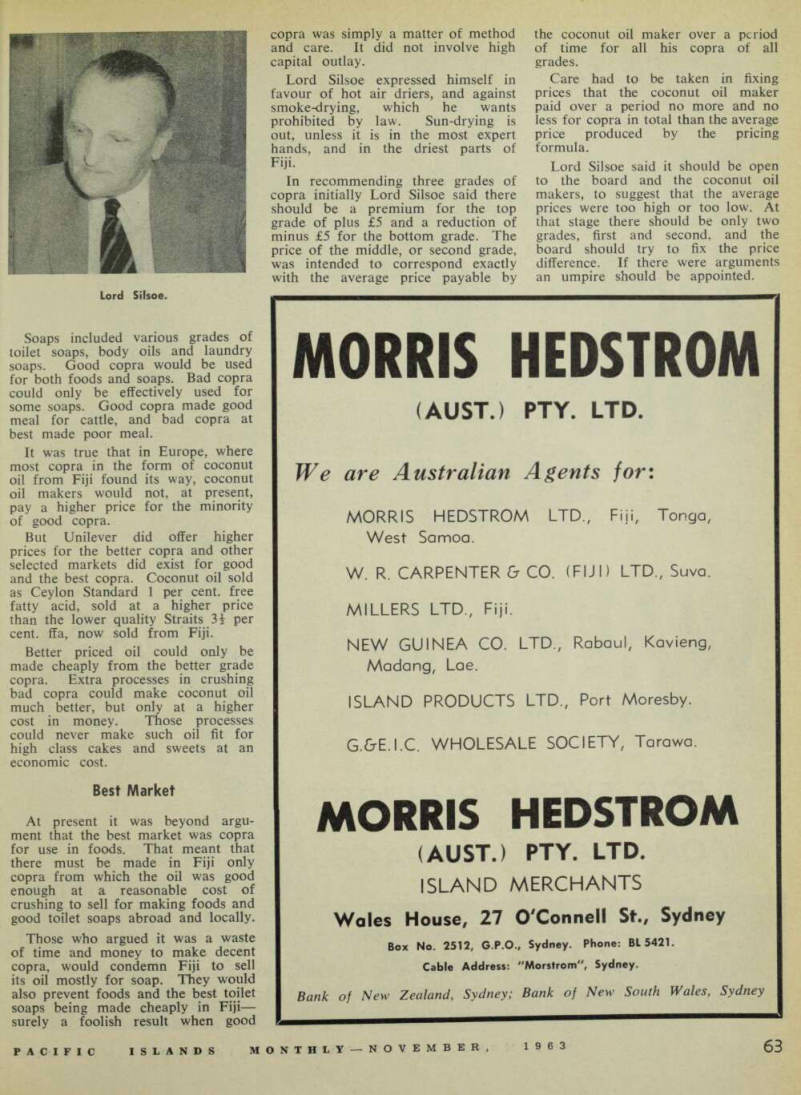
Lord Silsoe.