South Pacific Copra Producers
pp. 59-60 · Read in the full issue
"Should Speak In One Voice"
From a Suva Correspondent If South Pacific copra producers spoke with one voice they could have a greater influence over the sale of copra and coconut oil, in the view of Lord Silsoe, who has just released an important report on the Fiji copra industry. The report has valuable information in it for all copra producers.
LORD SILSOE points out that the total copra production of the area covered by the South Pacific Commission accounts for more than 10 per cent, of world production— larger than that of the whole of Central and South America and nearly three times that of the whole of Africa.
Fiji’s production was only about 1 per cent, of world production, and the production from New Guinea— which was the largest South Pacific producer—was, in 1961, just over 24 per cent., and these small percentages in themselves gave no influence to the producers.
But a collective view expressed by 10 per cent, might be fairly effective, and he hoped somebody might take the initiative in organising a collective Vie Lord Silsoe said the South Pacific area had even a bigger percentage of the export market (as against the total production). Because some of the large countries of Asia had already stopped exporting copra or
coconut oil, the South Pacific had, on the last figures (1961), a 15 per cent, share of the export market in copra and home-made coconut oil.
It was almost certainly more now.
Parifir Nppded Exports Pacific Needed It seemed that the South Pacific as a whole should, in future, carry an increasing influence on exports of copra and coconut oil. As popula tions and needs grew in the great producing countries of Asia those countries would export iess and less, ‘ln the South Pacific, fast as these countries will also grow in P<JPul a tion, never will they be able to consume inside their own areas, all the copra produced, Lord Silsoe said.
D L^ r is f a sente officer of the Ceylon Coconut Research Institute and now on the staff ot the Foodl and Agnculture. tion of United nations, had about eight years ago, reported that an examination of the requirements of
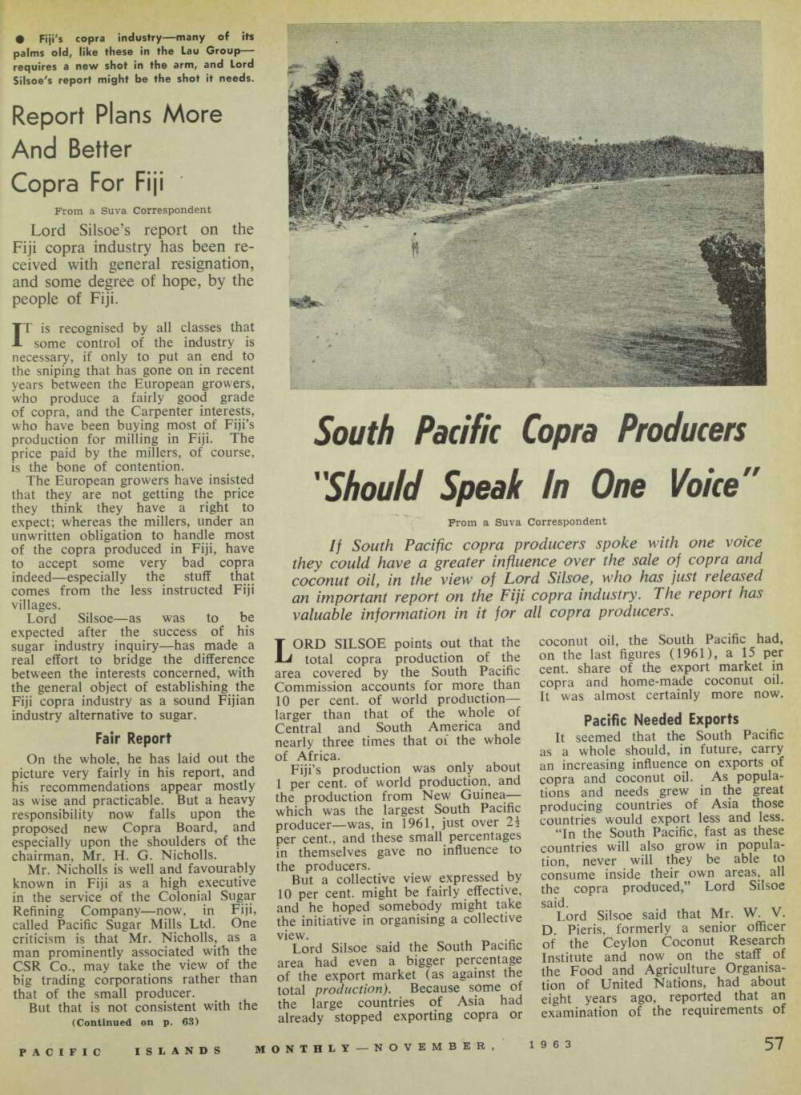
Fiji's copra industry—many of its palms old, like these in the Lau Group— requires a new shot in the arm, and Lord Silsoe's report might be the shot it needs.
makers of margarine, edible fats or soaps, showed that the aim of countries in the Pacific should be not only the improvement of copra quality within individual territories, but also its standardisation through out the region served by the South Pacific Commission”.
Mr. Pieris had proposed that an attempt be made “to formulate and introduce a simple, uniform inter terntorial grading system”. He had ended: “This will be greatly assisted by standardisation of methods of copra manufacture over the entire region”.
Copra Meeting Needed
Lord Silsoe said as far as he knew nobody had since even tried to call a meeting to discuss these proposals.
“Indeed, I cannot find that a meet ing of the coconut industry or any part of it has ever been held to discuss the regional problems of coconut growing, making of copra or coconut oil or selling coconut pro ducts”, Lord Silsoe said.
“It is true that some territories have their special protected markets, but there is a vast field of problems where there should be not only no conflict, but great benefits to all territories, if leaders of the industries were to meet.
“Prices of products, rates of freight, markets, whether to sell copra or make coconut oil, grading, driers for making copra, the making and selling of other products such as desiccated coconut and fibre are but a few suggested headings for an agenda.
“I am venturing to send a copy of this report to the copra boards in the South Pacific in the hope that someone will take the initiative.”
Make Soap Locally
Lord Silsoe said it seemed there might be one or more centres in the South Pacific where it would be advantageous to buyer and seller to make oil and cake rather than send copra huge distances to Europe or elsewhere.
“End products, such as margarine, oils of all sorts, laundry and toilet soaps, could perhaps be made some where in the South Pacific, rather than be imported from Great Britain, Australia or from European or American countries,” he said.
“In the last resort, these are matters of price, but I have heard of no argument yet to convince me that margarine has to be made in Europe and sent back again, so that people can eat their own coconuts after a complete circuit of the globe!”