Neither French Nor British"
pp. 43-49 · Read in the full issue


Letters To The Editors
New Hebrides Europeans Must "Think
Sir, —I have read your article titled “France Goes All Out To Win Influence In The New Hebrides” published in your September issue. Hidden behind the anonymity of a “Staff Writer’s” signature is a person who wilfully has done a lot of damage in this group to your magazine, to British-French amity, and no less important, the situation of Australian residents and interests in the New Hebrides.
IN other circumstances and all things being equal the treatment of such an article ought to be for all to ignore it. My understanding, how ever, is that this article has been written by an Australian, and even if this assumption is proven in correct it has been published by an Australian magazine.
Far from being an apologist for either National government and being, I understand, what is termed a vocal member of a number of consultative councils, I would not at any cost want to take this opportunity to defend, or in fact comment on, the so-called abuses your com mentator has found in the New Flebrides French or British Admini stration, I would prefer to reserve the right to discuss these Governments’ actions or in-actions at another opportunity in what I would hope to be con structive terms, if and when the proper representations do not yield results.
This, and I sincerely regret it for your magazine, has not been the case in your article.
Had your comments been signed, or for that matter some of its points been more humorously presented, I feel sure that the article would have received a few chuckles, and this would have had beneficial affects on your readership. But the author’s purpose was to embarrass not only governments but institutions, some of which in fact have been on good terms with PIM for a number of years.
Reply in Detail I do not see any constructive aim or positive result. In view of the bad feelings this has created I feel it is my duty to discuss it impartially and objectively: WARSHIPS: Having been a wit ness to and sometime participant in
the number of Australian and Royal Navy ships’ welcomes at Vila and Santo I feel the remarks in regard to this item are not valid.
French, British and Australian and Melanesian peoples’ outstanding hospitality has been appreciated by all ships’ crews irrespective of their flags.
The success of the French Navy’s calls attests to the happy disposition of all concerned. May I add that given the same opportunity all seg ments of the population would react similarly to any other Navy’s calls, be it British or Australian.
As to the frequency of call one can only deplore the fact that neither Britain nor Australia has yet opened a base in the SW Pacific. Perhaps then would your magazine’s oft proclaimed concern for the security of the SW Pacific be answered.
DECORATIONS: I have mixed feelings about these myself but con sidering that they are given generally to people who in one way or another have helped their own countrymen, is it in essence a bad policy? Is wearing a shirt a necessity to receiv ing a public “accolade”?
Perhaps Australians generally might conceivably show similar recognition to their own people and in this I refer to such persons as aborigines who have contributed to their own people’s improvement. One person I think of was the late aborigine artist, whose name now escapes my memory [Albert Namatjira].
I see no valid reason why a French or British decoration might give a Melanesian, or anyone for that matter, a tendency to be subservient to the giver.
My recollections are that a number of civilian Australians were given decorations by General de Gaulle
for their assistance during war years in the New Hebrides.
Effect of Awards Knowing one personally, an Aus tralian resident, I don’t think that receiving such a medal made him compliant to the French Govern ment’s later views, for instance, on the Common Market membership restrictions or its effects bn Britain, or Australia in any case.
I also do not think that it made him less critical of any other matter on which he thought or felt there was abuse of in the New Hebrides.
BASTILLE DAY: It seems to have irked your informant that this day was celebrated at different dates in all parts of the group. Is non conformity bad government?
As a Santo resident and consider ing the effect of this celebration and the results of participating with jolly people, dancing to a good band and sharing the spirit of a typical Bastille Day atmosphere, I must confess that your informant must have felt as I did, and that is quite candidly, that Australian and British Navies have yet a lot to learn on peacetime social gatherings.
They could try and I hope that they do so at Santo. It improves morale tremendously.
Overseas Trips: Your In
formant has suggested that Mr. Ilo’s trip to France was planned as a countermeasure to his British decora tion. I am not aware of this.
Mr, Ho however has a distinguished record and I feel sure that as previous deserving Melanesians have been sent to France his invitation to Paris had been in the offing. I understand also that he was invited to London and we all note that this fact was omitted in your article.
EDUCATION: May I suggest to you, since I have discussed this in the Advisory Council, and more par ticularly the effect of dual languages in this education problem, that two Melanesian members were outspoken on;— (a) The necessity to increase the number of schools; (b) The benefits derived by the New Hebridean population on having not one language but two possibilities to improve themselves.
French Schools Having been a student in a French run and paid for Government school at Vila as early as 1936, when in fact there was then no British Gov
ernment school there, your in formant’s remarks on education are of extremely bad taste to me and to a lot of other Australian residents in the New Hebrides, who still send their children to French schools at Vila and Santo. Let us note that there is as yet no British school at Santo as of this date, but that one is abuilding.
BANKING: The statements made in this respect are, as the remainder of the article, only half of the story.
Suffice it for me to say that copra was at a time, when it mattered a lot, paid for by France in sterling at considerable exchange loss. That particular sterling went and still does go through Australia. It helps pur chase Australian goods and Aus tralian money has still the biggest circulation in the New Hebrides.
Where is the monopoly? Your statements aggravate Australia’s and Australian banks’ position in respect of the New Hebrides when two things are known:
(a) That Australia’s economy and banks benefited by more than 8 million dollars of the New Hebrides foreign exchange collected during the war years; (b) That an Australian savings bank collects quite considerable sav ings in the New Hebrides, but so far has failed to suggest that it would reinvest same in these islands. We must also deplore the fact that it has only appointed collecting agents with no invest ment in the New Hebrides.
I feel certain that any bank would be welcomed in the New Hebrides.
Let your informant prove to us that the bank in question has been refused entry by one means or another.
In fairness also to a bank that has helped development in the New Hebrides—l refer here to Banque de ITndochine—l feel that the article in question is unfair.
LAND CLAIMS: I cannot answer your correspondent’s statements on
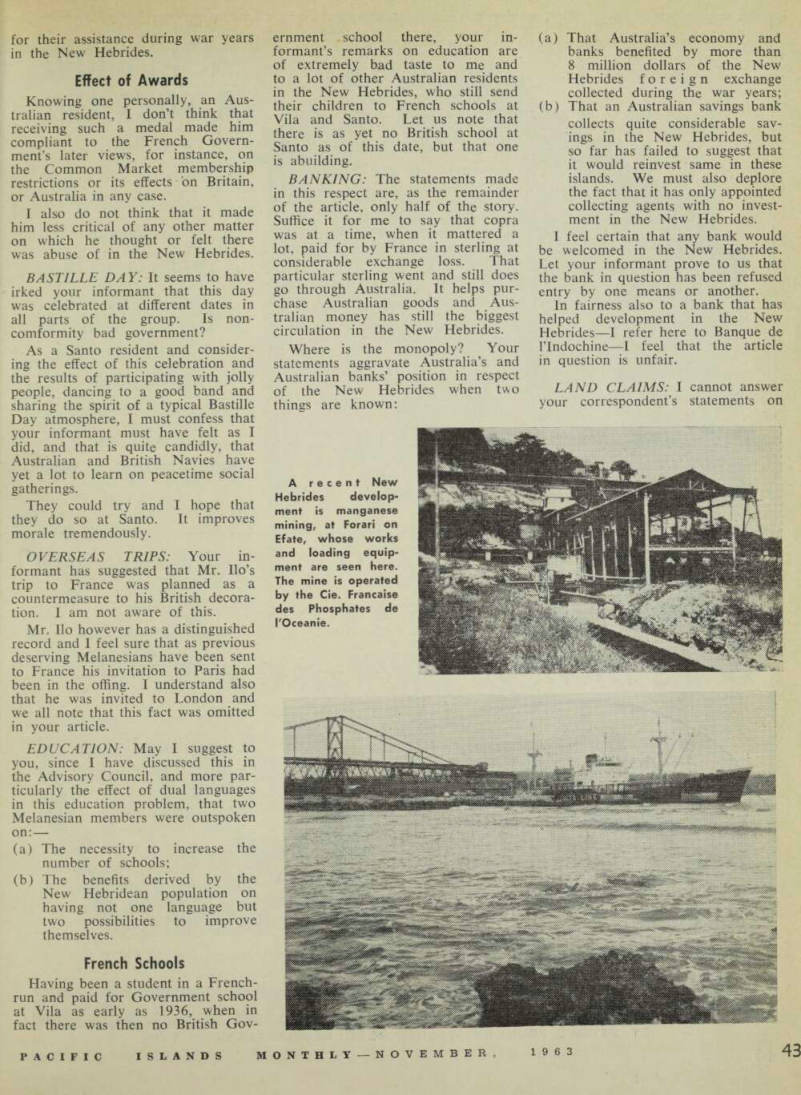
A recent New Hebrides develop ment is manganese mining, at Forari on Efate, whose works and loading equip ment are seen here.
The mine is operated by the Cie. Francaise des Phosphates de I'Oceanie.
this matter, but will certainly inquire. 1 know of certain French land interests who have and need to be further censured most strongly for land matters.
As for PIM, it really ought to make sure that development will be forthcoming on Australian Common wealth-owned land now dormant for half a century or thereabouts.
British Outnumbered As for French representation on the Chamber of Commerce, let us face the facts. Australian or British interests are outnumbered in the New Hebrides. I dare say not for the lack of opportunity.
Why then should we, or how could we, expect that representation be different? This is not a valid objection. Objection would not have to be made through PIM should our interest or our representations ever be treated unfairly in any Council or Chamber. Clearly I can assure you that this is not the case.
Two other matters also need some clarification:— (a) The Southern Group Admini stration. From my recollection both National administrations until after the last war did not have District Agents there. That is, career officers. When the war was over both Governments did replace these with Admini strators when these became available. (b) It seems odd that in your article no mention has been made of
hospital facilities and medical care given in all parts of the group by French medical officers and the substantial investment of the French, and later, British Governments in this field, A serious and unfair oversight and one that all will consider as chauvinistic to the extreme.
Concluding, and as for “presence de la France” or “presence of anyone”, my convictions are that, we, as Members sharing our peoples hopes and aspirations (and whether we are British, French, Melanesians, or Australians and this goes for all SW Pacific Territories) will not be judged by what we have done but rather by what we have not done.
In a country such as this, and considering that we are under developed, under financed, under educated, and geographically under privileged, I take the view that any effort, irrespective of nationality, which has a lasting value on the population or the economy is, in the long run, worthy of consideration, encouragement or praise, /# /
'Petty"
Sincerely, I hope that you, as an articulate member of this Pacific community, may proceed on a course of helpful criticism and not publicly associate yourself to petty and envious concern.
I further hope that you may
endeavour to show that, apart from the significant, and often selfless, exemplary work of Australian missions and missionaries, Australia, the only and I dare say constant beneficiary in the New Hebrides, has done precious little to help.
You might assist us in obtaining perhaps an offer from Australia in development help.
I can assure you that an oppor tunity was recently given, at high level, with deplorably negative re sults.
However, were PIM to associate itself with such desirable goals the benefits would not only be shared by the New Hebrides but by a magazine which generally had a good follow ing.
May I suggest that a pertinent aim for your editorials would be that of Colombo countries being granted help as they are by Australia, and how this may produce questionable results.
Perhaps as a starter in “largesse”
Australia could help its “customers” and more precisely for the New Hebrides what amounts to be an economically dependent territory.
Some suggestions are: • Extension of Development Bank loan facilities directly or through private banks; • Extension of CSIRO research facilities and other agricultural research in tropical areas; (Queensland for instance). • Assistance in mining research and development; • Higher education scholarships for Melanesians.
Finally, and whilst I do not want to be the advocate of all, there is a growing feeling within all segments of our community that, in this group, we can neither think “French” nor “British”.
In the long run, we, as Europeans must show understanding, unity and similarity of purpose. Whilst in application we might differ, in sub stance our plans must and should be the same.
So far the results obtained by both Administrations have been good and 1 dare say the element of competition has never hurt anyone.
I am not particularly keen to have this letter published unless you feel and admit that it will be in the interest of all concerned in publicly righting a slight which a great num ber of people consider has been inflicted, by reflections on the Joint Administration, and, by implications on the French Administration in the New Hebrides.—Yours etc.,
D. J. Gubbay,
Member of: Standing Committee, New Hebrides Advisory Council;
New Hebrides Chamber of Com merce, Santo, New Hebrides. • We are extremely pleased to be able to publish Mr. Gubbay’s valuable letter, which puts an impor tant, although not unanimous, point of view. “PIM” time and again has pointed out editorially that Australia has done little for the South Seas, although its interests are as much there as in Asia.
"They're Pretty Good"
Sir, —Your article about the French being ahead of the British has hit the nail on the head. It caused some very good comment among the British here, as it was true. You can say it was true, but don’t use my name as I have to live here.
Besides the French personally are pretty good types—it’s only the nationalistic, flag-waving part that’s a bit off.
Yours etc.,
“Anglo Saxon”
Vila, New Hebrides
French Are Keen Developers
Sir, —Your September article was read with interest by most local Euro peans as well as the few natives who are able to read English.
However, some of us pray that no one will translate the contents to the Big Nambas (cannibal country) and hurt the feelings of Chief Virambat, who, we are certain, is proud of his French medal for being a good boy and not eating any more missionaries of late!
Indeed, the French are keener than ever before to develop these islands to meet with progressive times.
As for the British, they have never much cared about anyone except “trading”, for which they are noted.
British planters were never given encouragement by their Government and a number pulled out in disgust long before the war. The French, on the other hand, have always shown an interest, and helped plantations to develop with the assistance of im ported Tonkinese workers over 30 years ago.
The French also installed two im portant hospitals in Vila and Santo several decades ago, as well as a public school in Vila which accepted all races including British children.
The British simply left native children under the despotic guidance of missionaries where they were taught that “everybody is evil except a missionary”.
The Condominium Government finances these mission schools to some degree, but we believe that natives are not aware of this fact and
probably imagine that funds fall from the sky.
When the French Tonkinese were free to leave plantations after their contracts expired, most planters had to resort to native labour, which they recruited in small vessels around the islands. It became a costly under taking, as boys would seldom stay for longer than three months at a time.
As soon as they learned the art of copra-cutting, or their other chores, it would be time to go home. Here, again, the French Government was helpful in permitting Wallisians and Tahitians to migrate for plantation work.
The few remaining British planters are also able to employ these people whom they find more satisfactory than our good-natured but otherwise indolent natives. However, we under stand some move is being made in the direction of importing Gilbertese workers —it has taken years to negoti ate with the British Government for this migration, even though the Gilbert Islands are said to be over populated and a lot of natives are anxious to leave.
Your article mentions (according to the Protocol) that “no native may become a subject or citizen of either Britain or France, and neither Power may exercise a separate authority. ..”
Thus, you say, awards to New Hebrideans by the French Govern ment “seem decidedly out of place”.
Several paragraphs later, mention is made of Phillip 110, Assistant MO, as being “one of only two New Hebri deans to receive a British award this year. .
Are readers to assume that British awards for New Hebrideans are “in order” and in keeping with the Protocol?
Flag Waving is Wonderful
For those of us who live in isolated areas, we were delighted that the French “flag-waving warships” graced our shores and no one seemed to mind Bastille Day celebrations last
ing for “fully a fortnight”, neither did anyone object to the naked Chief Virambat, of Big Nambas, sporting the Star of Anjouan around his neck Black, white or brindle, most people are generally glad of pomp and flagwaving, even when we pretend to be blase.
And, for an insignificant little place such as ours, imagine how flattering it was to have warships in port as well as Minister Jacquinot’s recent visit “all the way from Paris”. When the band played in the public square, all the hard-boiled grouchers who spend their time complaining about
being forgotten by the two home countries, stuck out their chests and truly felt elated.
Although the Britishers on Santo are proud to be British, I must say they have a tendency to side with the French because of the helping hand France has offered over the years.
The Syndicat-Agricole (French and British memberships) receives a subsidy from the French Government, and so do most other local organ isations.—Yours, etc.,
“Condominium-Ite”.
Santo, New Hebrides.