Ocean Islanders Make A
pp. 33-38 · Read in the full issue


Success Of Their Move
By a Staff Writer
The Banabans of Ocean Island, who shifted their island home to a new one on Rabi in the Fiji Group in 1945 as a result of the depletion of their phosphate supplies, have finally settled down to their new life.
FT’S been a long haul, with many L problems and some unhappiness, ut the future now looks brighter tian it has been for 18 years. There re still problems left, but now that :ie earlier heart burnings are over le Banabans are themselves meeting ic challenges with more confidence ian they ever had before.
There are lessons in the Banabans’ xperiences for the people of Nauru, dio were their neighbours on Ocean dand and whose problems of re sttlement are the same.
The entire population of Ocean sland, 1,300 people, moved out in )ecember, 1945, to Rabi (prounced Lambi) a fertile, 26-square-mile speck ist off Vanua Levu, one of the main ilands of the Fiji Group. With their hosphate money the Banabans ought Rabi freehold, at a cost of :A25,000.
Nobody knew then just how the xperiment would work out. But opes were higjb. And probably be ause hopes were high and too much 'as expected of the grand new life, ic first few years weren’t easy. There r as much dissatisfaction as the com mnity was confronted with develop ig a new spirit of togetherness in ieir new home.
Once Misery, But Not Now Many people were homesick, and xen sickness added to the worries nd reduced morale. There was a igh incidence of TB, and many suf ;red from a serious protein defici ncy.
Others, unable to become acclima sed, were anxious to return to Ocean iland irespective of whether the old land had a future or not. It was ill “home”.
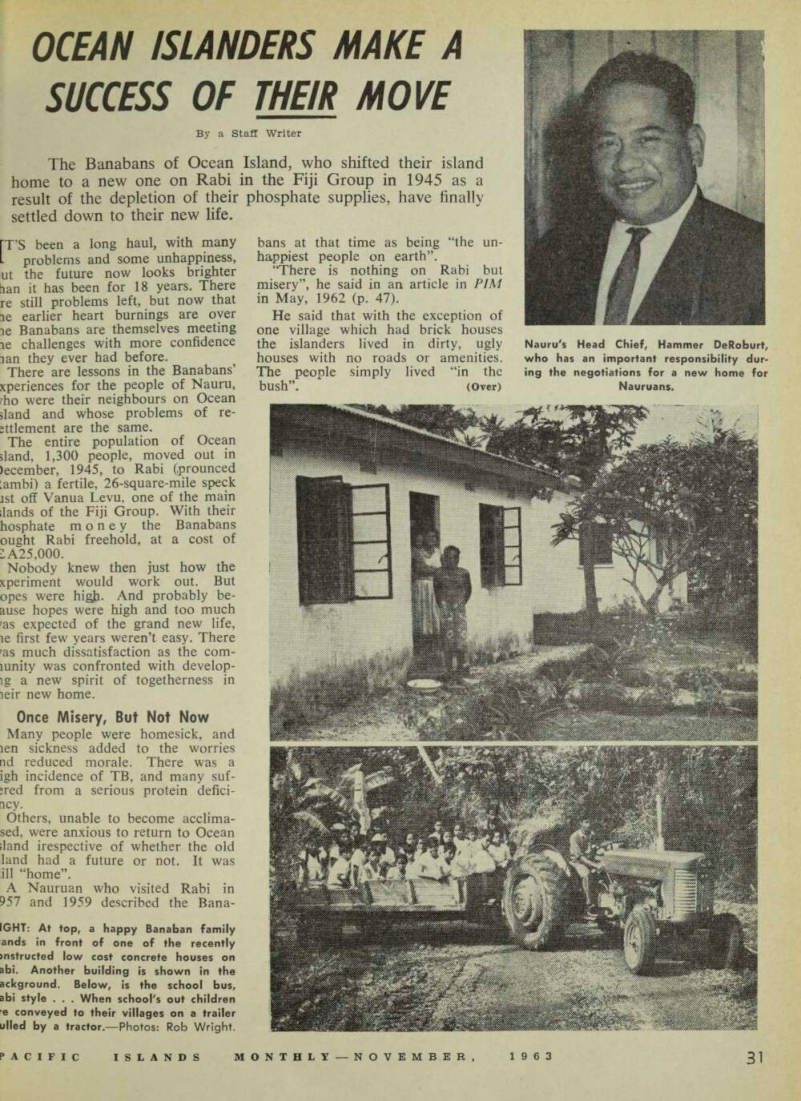
A Nauruan who visited Rabi in 957 and 1959 described the Bana- IGHT: At top, a happy Banaban family ands in front of one of the recently instructed low cost concrete houses on abi. Another building is shown in the ackground. Below, is the school bus, abi style . . . When school's out children ■e conveyed to their villages on a trailer ulled by a tractor. — Photos; Rob Wright.
bans at that time as being “the un happiest people on earth”.
“There is nothing on Rabi but misery”, he said in an article in PIM in May, 1962 (p. 47).
He said that with the exception of one village which had brick houses the islanders lived in dirty, ugly houses with no roads or amenities.
The people simply lived “in the bush”. (Over)
Nauru's Head Chief, Hammer DeRoburt, who has an important responsibility dur ing the negotiations for a new home for Nauruans.
Nothing had come of promises made to them, he said, and the re sult was that the Banabans were “stranded”.
If that was the picture in 1959 it is not the picture today.
Rabi now has roads, with new ones being built. There is a big house-building scheme going on, and plans are afoot for economic de velopment which will increase local economy and make more jobs avail able—for the shortage of work is one of the problems the Rabi islanders are still facing.
The islanders plan to build 250 houses of concrete block in the next 10 years, and they have been given a special grant from the BPC to get on with the work. Forty-six houses have already been built. Each is about 700 square feet and the islanders are paying themselves wages to do the job, thus helping the economy.
The health problem has been beaten and today the incidence of TB on Rabi is no higher than the figure for Fiji as a whole.
Development Plans
There is still a protein deficiency, although it is not as serious as it was, but the Banabans plan to fight this with the aid of more meat in their diet.
They would get the meat through cattle raising, and this is part of their development scheme which is three pronged: • Planting of more coconuts • Cocoa planting • Cattle raising
They are also looking at the pos sibility of putting in a small sawmill.
There are cattle on Rabi left from the former Lever’s plantation. If the cattle could be built up, they would supply the local dietary needs as well as bring in an income from sales in nearby areas.
Prospects for cocoa look bright, as they do in other parts of Fiji, and the coconut planting scheme is in line with the general plans for de velopment in Fiji, following the Silsoe report.
The population today of Rabi is 1,551, a big proportion of them young people. There are 300 heads of families.
As always, it’s still a community life on Rabi. All take their share in cleaning and working the plantations and in other communal activities.
Each man is free to do what he wants, or to do nothing at all. The Banabans live rent free.
However, the average income on Rabi is lower than the general Fiji average, and an other 50 to 100 people could be kept in full employ ment if there were work enough for them on the island.
The treasurer of the Banabans’
Trust Fund Board, Mr. Keith Christopher, who is a Banaban, says that if the island had a greater in come it would spend it on develop-
Banaban women on Rabi checking on coconut husk fibre which will go into the making of rope, lines and other articles. — Photo: Rob Wright.
g more jobs which in return would iin a greater income. Economic de dopment was the key to Rabi’s pro •ess.
Rabi's Annual Income Present communal income of Rabi about £47,000 —about £24,000 om copra (the islanders cut about )0 tons a year) and £23,000 in hosphate royalties for the land hich they still own on Ocean Island.
This gives a very low income per ;ad of population, lower than the iji average, and the islanders have icently been negotiating with the ritish Phosphate Commission for an
additional grant to help them get their development plans moving.
Rabi Island has its own council, with eight members elected by uni versal adult suffrage. There is also an officer with the title of Banaban Adviser, who is Mr. Paul Laxton, a former Colonial Service officer who was a district commissioner on Can ton Island with the GEIC Adminis tration, before being appointed to his present position in July, 1961.
He has no vote on the council and he has no control, nor seeks any, over island affairs.
Rabi has one central school under a New Zealand school teacher and a small village school.
Mr. Laxton acts as liaison officer between the Banabans and the Fiji Government when this is required, for the Banabans are left to run their own affairs. The island is theirs, and the Island Council has the right to make local regulations to suit itself and the community. It has full con trol over visitors and would-be residents.
Rabi islanders can travel outside of Fiji with a special certificate of identity and don’t require a passport, but most intending Banaban travellers apply for and are issued with a British passport.
The Banabans pay normal Fiji in come tax and are subject to the laws of Fiji.
Generally the only people who live
[?]r. Paul Laxton, Banaban adviser, with
[?]crew of assistants who have been check ing on alignment of a new road.
[?]ere has been much [?]ad-building going [?] in Rabi recently, [?] the villages are [?]ked. For many [?]ars the people [?]erely lived "in the bush".
on Rabi are Banabans of th o s married to Banabans.
Peculiarly enough, Rabi, is no registered as being owned by thi Banaban community, because of loca registration difficulties which so fa have made it impossible for such lam to be owned by a community rathe than a person. island Not Registered This facet has never been any par ticular worry, although there has re cently been interest in it on Rali itself by some who take the view ths the title deeds should be finalise: before there are any sweepim political changes in Fiji which coull make the Banaban occupancy of thei own island a matter for controversy..
The Banabans freely move aroum Fiji and some men prefer to wor in Suva, where wages are higher thai currently being paid on Rabi. Labou for Rabi house-building is paid at 1/' an hour, up to 2/6 for the mor skilled. In Suva, Rabi men can ear 7/- to 10/- an hour, but their livint costs there would be higher.
The Island Council plans, throug: its development programme, to ai tract back to Rabi every Banabai who desires work.