Pacific Commerce and Produce
pp. 137-140 · Read in the full issue
Pacific Currencies To Be Dominated By The Dollar
Australia’s currency will be adapted to the decimal system in February, 1966. The principal unit will be called dollar, and it will be divided into 100 cents.
THE Australian dollar will be worth exactly 10 of the present Australian shillings, or half of the £1 Australian, which is to be dis carded.
The term Royal, which the Aus tralian Government suggested as the name of the new unit, was over whelmingly rejected by the Australian people. Dollar was a popular choice.
Most type-setters and typewriters already carry the $ sign. Presumably Australian currency will be indicated in 1966 by SA, just as it now is the practice to use £A.
The most awkward change-over will be from pence to cents. The 10/-, which becomes the dollar, will be equal to 100 cents, or 120 pence.
One cent, therefore, will be equal to 1.20 (one and one-fifth) pence.
Traders for a long time will need to keep conversion tables handy.
In the South Pacific, at the present time, the pound is the unit of cur rency in Australia, New Zealand, Papua-New Guinea, the Solomons, New Hebrides, Fiji, Norfolk Island, Tonga, Western Samoa, Gilbert and Ellice Islands, and the Cook Islands.
In Papua-New Guinea, the Solomons, New Hebrides, and Tonga, all of which use the Australian pound, the currency will change automatically with the Australian conversion to dollar.
Change Likely
There are indications that New Zealand will convert to the decimal system when Australia changes, and this will affect the Cook Islands. Wes tern Samoa’s Cabinet decided in Sep tember to change over to decimal currency in 1966.
Fiji has its own pound, which ranks in value half-way between the NZ £ (which is at par with Sterling) and the Australian £ (which is 25 per cent, under Sterling). It is expected that Fiji will also convert to the decimal system, A committee
to consider the matter is to be ap pointed soon.
There has been no indication of a name for either the New Zealand or the Fiji unit.
The Australian decision will make the term “dollar” dominant in the Pacific area.
Many countries call their principal currency unit the dollar —the United States, Canada, Hong Kong and Singapore among them. All are decimal based—loo cents to the dollar. The adoption of dollar by New Zealand and Fiji would make dollars and cents except for French francs, the only names for money in the Pacific Islands.
Unless the old $ sigrv is varied somewhat, by international agreement, the different dollar currencies will be indicated by an additional symbol— i.e., SUS, $C (Canada), $A (Aus tralia), $N (New Zealand), and so on.
Origin Uncertain
The origin of the dollar sign is uncertain. It has been ascribed to (1) a combination of the initials US; (2) a modification of the figure 8, a “piece of 8” being once indicated by 8-8; (3) a form of HS, which marked the Roman unit; (4) con traction of P and S, used in Spanish accounts to represent peso; (5) a device once seen on the reverse of the Spanish dollar, and since 1848 on the peso duro, representing the Pillars of Hercules, at the entrance to the Mediterranean.
It was reported on September 24 that Britain seems inclined to change over to the decimal system, but to retain the £, at its present value.
The £ then would be divided into 100 cents, which would mean that one British cent would be equal to 2.4 British pence. That, in turn, probably would make it necessary to issue half-cent and quarter-cent coins.
Norfolk Is. Fishing Co.
In Business in October
Work is proceeding on the factory premises of the newly-formed Norfolk Island Fisheries Ltd. in New Cascade Road, Norfolk Island. In August, the secretary, Mr. J. A. Davidson, stated that the company expected to be in operation in October.
As the name indicates, the primary concern will be with local fish caught by local fishermen, then filletted and snap-frozen. Freezing of local poultry, eggs and vegetables is also contemplated.
Due shortly from NZ is the com pany’s own boat which will be fitted with 2-way radio and echo fish-find ing equipment. With fishermen and factory personnel it is hoped to employ 80-odd persons.
The latest processing equipment will shortly arrive from Australia. In processing, no wastage will occur as the by-products will be converted into stock foods, fertiliser and fish oil.
An important object of the com pany is to materially assist Nl’s balance of trade by virtue of its ex ports and the reduction of imports of fish, etc., to the island, Norfolk Island Fisheries Ltd. officials are Mr. T. Hamilton, man ager; Mr. J. A. Davidson, secretary.
Mr. Hamilton, until recently, owned and managed Hotel Paradise at Kingston.
Boom in Misima
Gold Mine Shares
Extraordinary liveliness in the shares of Pacific Islands Mines Ltd. developed on Sydney Stock Exchange in late September.
Within a few days, the 2/6 shares, which were quoted at 1/7 in July, went up to 7/-; and the options, which were worth Bid in July, were selling at over 5/-.
There was no particular reason for the sudden demand for the shares.
The company was formed five years ago to investigate the well-known gold deposits on Misima Island, in Eastern Papua; and, with very small capital, it has slowly, but very com petently, tunnelled into the hillside in a search for the famous Umuna lode.
This year, it found the lode and the chairman, Mr. G. W. Noe, at the annual meeting in July (PIM, Aug. p. 9) described the company’s pros pects. A geologist said that the gold field “was the most important and promising mineral deposit known to him in Australasia”.
The company announced in Sep
ember that an analysis of the naterial found in the lode showed an iverage of 14 dwt. of gold to the on, irrespective of other minerals, fhe average is good enough but not ipectacular, but a few days later the itock Exchange boom started —and :ontinued into October.
Mr. Frank G. Forman, of Perth, s the geologist who has formed the ugh opinion of Misima, and he is vorking closely with Mr. John G. -uller, of Planet Oil fame. Mr. Fuller ecently gave the company an in erest-free loan of £lO,OOO, on condi ion that the company gave him an >ption over 322,000 shares (2/6) at >ar.
Mr. Fuller has joined the board of he company, which is negotiating vith an overseas mining group, with i view to exploiting Misima’s mineral iches.
Probably, it was knowledge of hese movements which triggered off he rush of speculators to be in on the new gold mine”.
According to Sydney city com nents, the Papua-New Guinea Ad ninistration has shown very little in erest in the possibility of the gold ndustry being revived at Misima. formally, governments are very ager to encourage this kind of enter irise.
“What’s the use of a gold mine to hem?” was Sydney city comment.
Don’t they get an annual gift of £25 lillion from Canberra without trings?”
’lans for New Fiji
Mneapple Cannery
According to Mr. H. W. Simmonds, )BE, a noted Fiji entomologist, Fiji reduces the best pineapples in the forld, and he should know as he as visited most of the prolific pine pple producing countries.
He says that Malaya, for example, diich has built up a big pineapple anning trade, and even sells tinned ineapples in Fiji, frankly admits iat they cannot grow a pineapple diich compares with the Fiji product or quality and taste.
It has been a mystery in the ’olony for many years why Fiji did ot make more of her pineapples and diy previous canning enterprises ave failed. The CSR Co. Ltd. did accessfully operate a cannery at .autoka before the war but they losed it several years ago because le venture did not pay—partly be ause Nadi International Airport was uilt on the Co.’s best pineapple land.
The attitude has since been, “If
the CSR can’t make it pay then no one can”.
But a Nadi surveyor, Mr. E. C.
Ewins, and his son, Mr. G. S. Ewins, for the last two years have been working quietly on a venture in valleys in the Nadi area which promises to see a cannery operating at Nadi by June, 1965.
They have registered a firm, Fiji Pineapples Ltd., which expects a run of 55,000 tins when the factory opens at Nadi. This will be sold locally and exported to some Commonwealth countries.
The venture did not have an easy passage, but the promoters have re ceived a lot of encouragement from the Department of Agriculture, the Commerce and Industries Officer, Mr.
R. W. Parkinson, and, since his arrival in the Colony in April, the Development Commissioner, Mr. W.
B. Rogers.
Mr. Ewins and his son made inquiries overseas but did not receive much encouragement, probably be cause those in the business did not want a new competitor. The Depart ment of Agriculture found 40,000 suitable plants in Fiji and sent them by ship and lorry to Nadi.
Although crop losses were initially as high as 33 per cent., Mr. Ewins was able to allocate the rest to farmers in the Sabeto and Mulomulo Valleys. He has signed a contract with these farmers, and expects the first marketable crop in December and January.
Tentative plans at this stage are to sell the first crop, expected to number about 15,000, in polythene bags to airlines. South Pacific Host ings Ltd., of Nadi Airport, will co operate with the Ewins in this enter prise.
Mr. Ewins is confident that the quality of the canned pineapple, which will be known as Fiji Golden Queen, will create its own market at competitive prices. Capital will be
available from Australia if required, but the company’s policy is to finance the venture with local money as far as possible.
The CSR Co. Ltd. has given Fiji Pineapples Ltd. access to the plans of the old Lautoka factory, and will sell them one of the main items of machinery still in the factory. Both fruit and juice will be canned.
As far as possible the company will employ local staff, and will train them where required.
Although there are only 35,000 plants under cultivation this year, Mr. Ewins says it is the company’s intention to triple the crop annually till the market is saturated.
NZ Manufacturers on
Mission to Fiji, Samoa
The Hawke’s Bay (NZ) branch of the Wellington Manufacturers’ As sociation is sending a trade mission of its own to Fiji, Western and American Samoa in October.
The following NZ businessmen and businesses will take part: Mr. K. R. Gillon, Napier, president of the Hawke’s Bay branch of the New Zealand Manufacturers’ Associa tion, and managing director of the Supreme Soap Co. Mr. Gillon will lead the party.
Mr. D. R. Stephenson, Napier, president of the Napier Chamber of Commerce and managing director of the Stephenson Trading Co., Napier.
Mr. Stephenson will be the party’s deputy-leader.
Mr. J. S. Millar, Napier, managing director of the New Zealand Paint and Varnish Co., Ltd.
Mr. R. K. Briasco, Napier, man aging director of Peros Quality Umbrellas, Ltd, Mr. H. A. Green, Hastings, govern ing director of H. A. Green, Ltd.
Mr. Green has been retained for
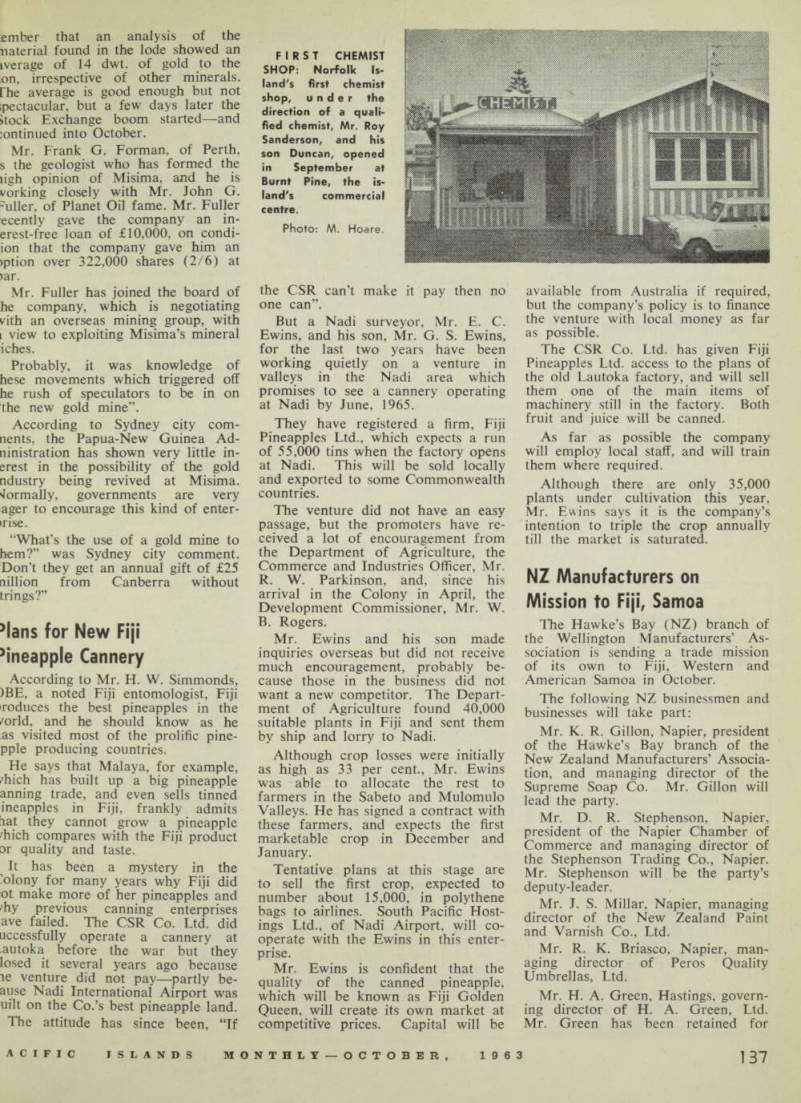
First Chemist
SHOP: Norfolk Is land's first chemist shop, under the direction of a quali fied chemist, Mr. Roy Sanderson, and his son Duncan, opened in September at Burnt Pine, the is land's commercial centre.
Photo: M. Hoare.
several firms to report on trade prospects.
Mr. W. Nuttall, Napier, managing director of Weldwell NZ, Ltd.
Mr. D. G. J. Walker, Hastings, managing director of Douglas Walker, Ltd., agricultural contractors, Hast ings. Mr. Walker is primarily in terested in Pacific sales for potatoes and onions.
A representative of Soma Textiles, Ltd., a firm which has an underwear factory in Hastings.
Mr. R. H. Stewart, an electrical manufacturer of Christchurch who is the retiring president of the New Zealand Manufacturers’ Association, and who led a mission to the Pacific last year.
"Flexible" Marketing Board
For P-NG Coffee
THE legislation setting up the Papua-New Guinea Coffee Mar keting Board went through the Legis lative Council in September without any let or hindrance —probably be cause it was grower-inspired and very much grower-framed.
The legislation provides for the setting up of a board of five grower members and one Administration member (probably from the Depart ment of Agriculture), who will elect a chairman from amongst their own number.
Although the legislation provides for complete direction over the in dustry, it also leaves a considerable leeway for manoeuvring.
It will not, in the first instance anyway, compulsorily acquire coffee —as the P-NG Copra Marketing Board does copra. Producers are per mitted to continue what marketing arrangements they like.
And it is unlikely to assume these powers, according to Mr. lan Downs, one of the architects of the legisla tion, President of the Highland Farmers and Settlers’ Association, and elected Highlands’ member of the P-NG Legislative Council, unless a plebiscite of growers is held first.
In speaking during debate on the bill in the Council, in September, Mr.
Downs said that the legislation was very flexible, but the very existence of a board would allow negotiations with users in Australia that would not be associated with one brand or a plantation or even an area—the board would be able to speak with one voice.
From 1959 onwards, he said, through the close co-operation of the Administration and the Department of Territories, representatives of growers had gone to Australia and conferred with users on conditions of sale.
This had been successful for a year or so but ultimately fell down on the matter of quantity. As P-NG produc tion rose, Australian consumers were reluctant to absorb it at a price growers thought reasonable.
An appeal had therefore been made to the Australian Tariff Board and a “very reasonable decision” was reached. However, that was 12 months ago and P-NG growers were still waiting for it to be implemented.
Before it could be, under the provi sions of the General Agreement on Trade and Tariffs (GATT), to which Australia was a party, all coffee-grow ing countries had to be consulted and everything was now held up for want of assent from one African country, Uganda.
Until the Tariff Board can be per mitted to put its decisions into effect, the Australian Government has insti tuted a tariff remission scheme. Users in Australia who take 28 per cent, of their total coffee requirements from Papua-New Guinea are allowed a duty remission on the coffee they im port from elsewhere.
In Mr. Downs’ opinion, while this arrangement is fairly successful, the Tariff Board arrangements, when they come into operation, will be more so.
Concurrently with Papua-New Guinea’s efforts to regularise its coffee
marketing in recent years have been international measures to control the world market. This culminated in the International Coffee Agreement which is still awaiting the signatures of some exporting countries.
Under the agreement, when it be gins to operate, P-NG has been given a quota of 13,200,000 lb (about double present production), but is al lowed five years to reach it.
Although there is no division in the Territory between Administration and producers on the wisdom of setting up a Coffee Marketing Board, there does seem to be some divided opinion as to whether present plantings of coffee, when they are all in bearing, will be sufficient to meet the inter national quota, with some over for accidents.
Some sections of the Department of Agriculture believe that present plantings will be adequate. Many private producers feel that they are not.
The variable element is probably in native plantings which are usually in small plots that could, under certain circumstances, become uneconomic and allowed to deteriorate as pro ducers.