Jap-Supplied Tuna Cannery
pp. 119-121 · Read in the full issue


Cook Islands Rejects Plan For Jap-Supplied Tuna Cannery
After an acrimonious debate, the Cook Island Legislative Assembly decided in September not to allow Japanese fisher men to land in Rarotonga to supply fish to a tuna canning factory. Voting was 15 to 6.
THE question of a Japanese-supplied tuna cannery had been a lively topic in the Cook Islands for the previ ous two years, and had been officially supported by the New Zealand Ad ministration.
The Assembly rejected the idea after debating a motion, moved by Mr. W. Estall, which was slightly amended in the course of the debate.
The text of Mr. Estall’s motion, as amended, was: ‘That as a means of increasing revenue to enable this Government to carry out its many commitments, and as a means of further developing the economy of the Cook Islands, this Assembly gives its formal approval to the establishment of a tuna canning industry on Rarotonga with fish supplied by Japanese fisher men, who will be permitted to land under strict controls set by this As sembly, and that in the event of a contract between Islands Foods Limited and the Japanese being drawn up, such contract shall first be dis cussed with the Executive Com mittee.”
Speaking to the motion, Mr. Estall said the establishment of a cannery would: • Give employment in the factory for Cook Islanders. • Bring a return in taxes for the exported products. • Bring in more revenue and so help the Cook Islands stand on their own feet without too much reliance on New Zealand taxpayers.
Mr. Estall said that as the Cook Islands population increased, more and more planting land would be used as living space, and it was there fore necessary to look to the sea as a source of income.
To Help Cook islanders The idea was not to sell the Cook Islands to the Japanese, but to get revenue to help the Cook Islanders.
“It is no good saying keep the Japanese out in order to concentrate on local industry,” Mr. Estall said.
“While we wait for the local industry to be established, there will be other places which will take the services of the Japanese.
“The establishment of the Japanese
industry will not cost the Cook Islands a single penny. American Samoa is going in for a second factory, a second factory will go up in the Caro lines, there is to be a new factory in Fiji, in Tonga, etc.
“There will be stern competition in the world—the longer the Cook Islands wait, the worse it will be for them.”
Mr. Estall said the Cook Islands could not be kept pure—he was not pure himself—and very few full blooded Cook Islanders were left.
“This is the 20th century,” he said.
“The Cook Islands must keep up with the changes. Let not the Japanese be kept out because of the colour of their skin.”
Opposing the motion, Mr. Julian Dashwood said he challenged the statement that taxation would be sub stantially increased if the Japanese industry was established.
He said half-truths and downright inaccuracies were being aired to give an impression that canneries serviced by Japanese vessels were springing up like mushrooms all over the Pacific, and that the Cook Islands would be too late if they left it too long.
"Easy To Talk"
“It is easy to talk of strict con trols,” Mr. Dashwood went on. “It is quite another matter to get the Jap anese Government to accept them.
“There was once a time when the people of Tahiti and Fiji thought the importation of Chinese and Indian labourers would make little difference and that they could easily be repatri ated later.
“How many Tahitian names are now above the stores in Papeete, or Fijian in Suva? Yet both the Chinese and Indians went there as common labourers.
“If the Japanese come, they will be here for a long time —let the Cook Islanders be sure they want them.
“Neither Maoris nor Europeans are any match for the Japanese—they are the most industrious people in the world. What they lost by the sword, they are attempting to win by ex ploitation.
“I do not want to see the day come when Cook Islanders are no longer
the masters in their own house, but the servants of others, whom the Legislative Assembly, the guardians, have permitted to come into the house.”
Mr. V. Rere said he agreed in prin ciple with the motion but could not support it in practice. He said the Cook Islanders should first be given a chance to supply fish to the cannery.
“If it is proved they can’t fish,” he said, “that will cut out all the argu ments against the Japanese fisher men.”
Mr. T. Tuavera said most Cook [slanders were in favour of the motion, but they, themselves, should be allowed to vote on it in a referen dum.
Opposing the motion, Mr, Napa Napa said: “In the Cook Islands there are set rules about noxious weeds and bush beer, and yet they go on, they cannot be controlled. It is better to lay down rules before the trouble starts to prevent the entry of the Japanese.”
Mr. Kau Mapu, who supported the motion, said the Japanese had not asked to come to the Cook Islands, [t was the Assembly that did the ask ing.
Mr. Rapley, who spoke against the motion, said: “If the Japanese come and the industry is supported by the
Cook Islands Government, people think there will be cheap fish. There is no cheap orange juice at the moment and little chance of cheap fish.”
Referring to the Chinese in Tahiti, Mr. Rapley said people could be forgiven for making a mistake once, but not twice. That experience must be the guide. The record of the Japanese in the Philippines, Solomons and New Guinea was not good.
Mr. D. Hosking said the common people would gain little from a tuna cannery either in fish or revenue. He added: “The Japanese will never be
controlled. If they come in, it is the end of the people.”
Opposing the motion, Mr. T. Tan garoa said that the Indians had “taken over” in Fiji, and that if the Japanese were allowed into the Cook Islands, the same thing could happen there.
“The Japanese will marry and breed Japanese children,” he said. “Next they will be asking for land. They are a small country and must spread out if they can get space.
“The Cook Islands birthright should not be sold to the Japanese for tuna.”
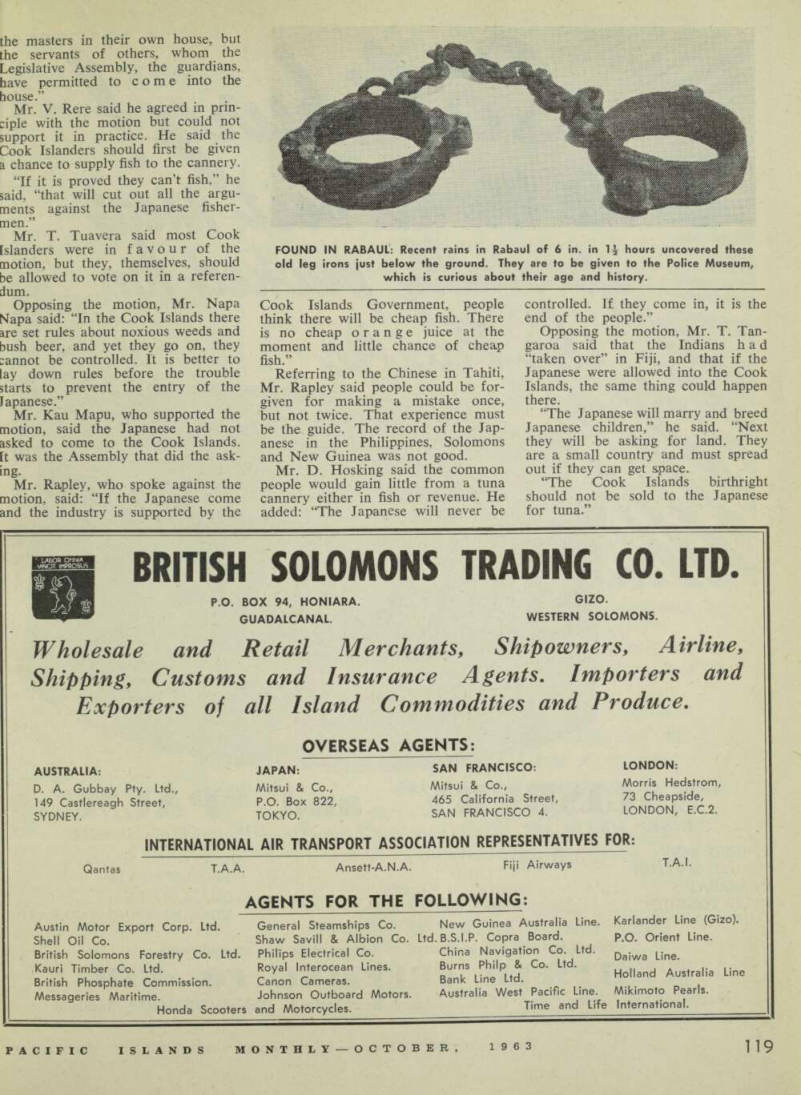
FOUND IN RABAUL: Recent rains in Rabaul of 6 in. in hours uncovered these old leg irons just below the ground. They are to be given to the Police Museum, which is curious about their age and history.