Schooner In Lively Drama
pp. 101-109 · Read in the full issue
The Cook Islands trading schooner Taveuni figured in a lively drama between Tahiti and Rarotonga in late August.
LEAKING badly, she was involved in a collision, a fire broke out on board, the radio operator collapsed, and she was finally towed into Rarotonga after a radio call for help was sent out.
Donald Budge, a Glasgow journalist, who is working his way across the Pacific, was aboard the Taveuni during the drama, and he has sent PIM the following account of it: The Taveuni, he says, was leaking badly while at her moorings in Tahiti on August 26. The French port authorities allowed her to sail for Rarotonga only on condition that she was convoyed by the MV Bodmer, which was being delivered to Rarotonga from Jamaica for Mr.
D. C. Brown under Captain Peter Scott, of Auckland.
The Taveuni, also owned by Mr.
Brown, was under the command of American yachtsman, Mr. L. C.
Smith, owner of the 25-ft ketch Tahiti.
Twelve hours out from Papeete, the two ships ran into a heavy squall and collided.
Only the fact that Mr. Smith— better known to Cook Islanders as “Smithy”—saw the Bodmer at the last moment saved the frail, wooden Taveuni from being smashed into matchsticks.
The schooner’s wheel was swung hard to port, and the two ships merely grazed each other and escaped with a shuddering jar.
The next emergency came within two hours when the Taveuni’s temporary radio operator, Mr. Doug Cunnold, who is a retired superin tendent of Rarotonga Radio Station, collapsed over the microphone.
A sick man, he had to be trans ferred by open boat to the Bodmer, and I took his place in the radio room.
Next day, there was a fire in the Taveuni’s engine room.
The lifeboat was lowered in case the Taveuni had to be abandoned, but after a two-hour fight the crew succeeded in extinguishing the flames.
But the schooner now had no power, and was drifting at the mercy of rising wind and waves.
The Bodmer then offered to tow the schooner, and 23-year-old Captain Scott crossed the 20-ft swell in an open boat to supervise the fixing of the lines.
However, the strain was too great for the Bodmer's cables, and they snapped four times. But the Bodmer did manage to pull the schooner 150 miles nearer safety before running out of towing equipment.
Meanwhile, the Taveuni was taking water at a fast rate, and only con stant pumping kept the engine room from being flooded.
Then, in reply to a radio call, the NZ Government ship Moana Roa came racing to the Taveuni’s aid from Rarotonga under 37-year-old Captain Tony Thompson, of Auck land.
The Moana Roa arrived on the
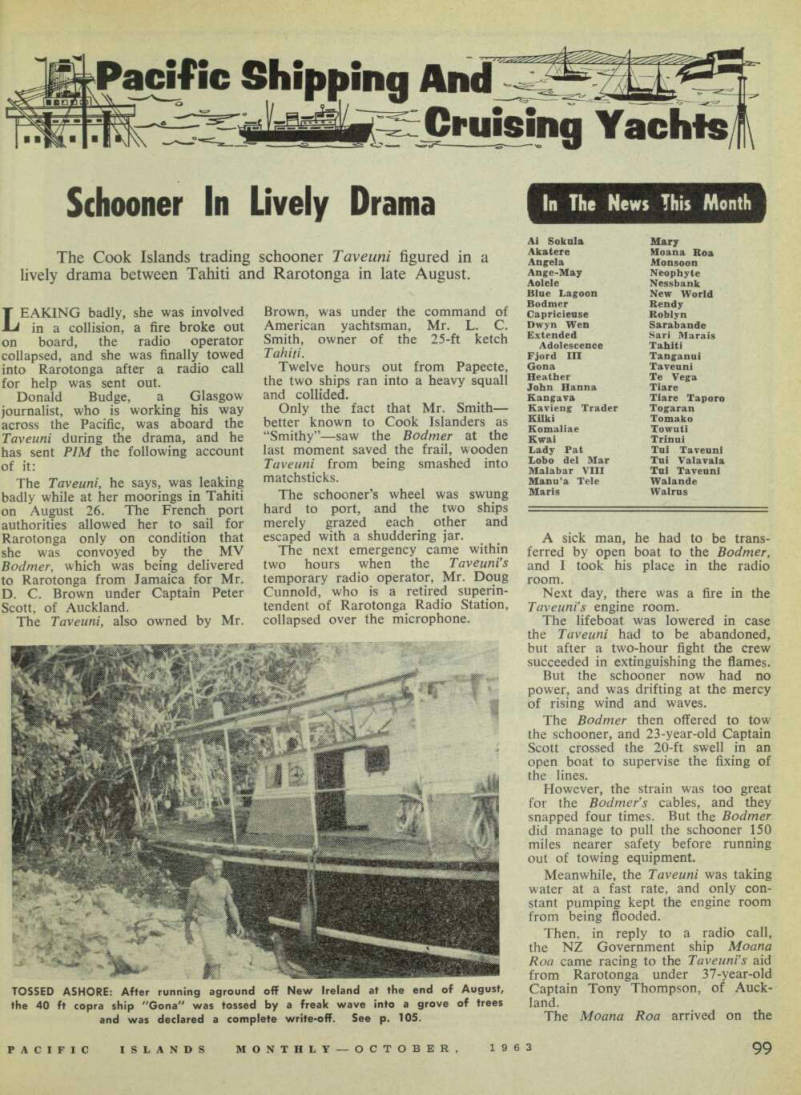
TOSSED ASHORE: After running aground off New Ireland at the end of August, the 40 ft copra ship "Gona" was tossed by a freak wave into a grove of trees and was declared a complete write-off. See p. 105.
scene with two hours of daylight to go. The seas were then rough and the Taveuni was taking in water at an even faster rate.
After a tremendous effort, the exhausted Taveuni men succeeded in hauling in the deadweight tow lines and making them fast.
Then, it was plain sailing to Rarotonga—except that the crippled Taveuni was pumping water con tinually.
“Smithy,” whose home is in Ohio, plans to sail his ketch Tahiti from Rarotonga to Honolulu after recover ing from his Taveuni ordeal.
“In future, I sail in nothing bigger than 25 ft,” he says. “They are by far the safest in the Pacific.”
• To Be Built At Auki:
An inter-island vessel, the Walande, is to be built at the BSIP’s Auki Boat Building School. She will be 52-ft long and will have a Gardner engine.
Her carrying capacity will be four saloon passengers and 15 deck pas sengers. She is expected to be com pleted by late next year.
• Aolele Still On Reef:
The American Samoa inter-island vessel Manu’a Tele called at Swains Island in September to pick up 50 tons of copra from the plantations of the Jennings family, who own the island.
While there, the Manu’a Tele tried without success to help get the cutter Aolele off the reef.
The Aolele, formerly owned by Burns Philp, of Apia, ran aground on July 23. ( PIM, Sept., p. 103).
The Rendy, of Apia, which had also been trying to shift the Aolele, left Swains at about the same time as the Manu’a Tele.
• New Ship For Cooks:
The name of the ship that A. B.
Donald Ltd. has bought in Holland for the Cook Islands ( PIM, Sept., p. 99) is Abatere. She is a steel vessel of 190 tons, and will replace the 50-year-old Tiare Taporo.
Formerly called the Starpoint, the Abatere has been undergoing altera tions in Holland to suit the demands of Islands trading. The work in cluded the construction of accom modation for 12 passengers.
Until her sale to Donalds, the Starpoint had been engaged in the coasting trade around Holland and the Baltic since being built in 1948.
The master of the Tiare Taporo, Captain A. J. Pickering, will take over the new ship when she arrives in the Cooks, probably in November.
The Abatere can carry about 250 tons of cargo and has a service speed of eight knots. Her name means to lead, navigate or sail a ship.
When the Abatere goes into service, the Tiare Taporo will be laid up until sold. She was refitted in Auckland in August, and sailed for Rarotonga late that month.
• Cutter Goes Aground:
The small Fiji inter-island cutter Mary was favoured by the wind when she went aground on the reef off Draiba Village, near Levuka, on September 16.
When she grounded the wind was blowing from the south-east and the sea was rough. But almost immedi ately the wind veered round to the north and the sea became calm.
Had the wind remained from the south-east the cutter would have been smashed to pieces.
The Mary was on her way to Buca Bay, in Vanua Levu, with general cargo when her engine broke down off Nairai Island. The crew put out a small sail, but it was not of much use and the cutter was carried on to the reef by the tide and wind about a mile from the passage into Levuka Harbour. About 10 per cent, of her cargo was dam aged by water. Two Levuka launches, the Ange-May and Angela, salvaged the remainder of the cargo and the engine.
The Mary was making a lot of water when she was refloated and towed into Levuka.
• FOR THE BSIP: A new vessel, the 70-ft Kwai, is expected to be delivered to the BSIP in the second half of next year.
She will have two Gardner engines and room for eight saloon passengers and 26 deck passengers.
The Kwai will be a modified version of the Komaliae and Kangava, and will be used in the outer islands.
• Indonesia-New Guinea
SERVICE: A regular monthly cargo service has been established between Indonesia and Papua-New Guinea by the Indonesian national shipping line Pelni. The first ship, the Tomako, of 2,300 tons, arrived in Port Moresby on August 27. It was the first Indonesian cargo ship ever to visit that port.
A second ship, the Towuti, left Singapore on July 31 and after calling at Djakarta and West New Guinea ports, is scheduled to arrive at Port Moresby on September 25. She will be followed by the Togaran on October 26 and the Tomako.
The Tomako, Towuti and Togaran are of the same size. Their route is the same as that operated by the Dutch line KPM, which ran to Port Moresby when West New Guinea was under Dutch control.
A representative of Pelni in the Tomako told reporters in Port Moresby that most cargo taken by Pelni from Port Moresby to West New Guinea would be foodstuffs.
Goods brought to Port Moresby by Pelni probably would include transhipment cargoes from Singapore and other ports, including textiles, general cargo and rubber machinery.
Normally Pelni ships would stay only one day in Port Moresby.
• Captain Warned: No
formal inquiry will be held into the grounding of the Fiji launch, Tui Taveuni. The Fiji Marine Board decided this at a preliminary inquiry early in September.
The Tui Taveuni grounded on a
reef between Goat Island and Yaqaqa, off the southern coast of Vanua Levu, on February 20.
The board, however, issued a warning to the captain, Viliame Kolinisau, about exercising caution in reef-strewn waters. They told Viliame that they considered he had not taken enough care in sailing along such coasts, of which he had no knowledge.
• When Time Stood Still:
A Fiji Marine Board of inquiry into the loss of the inter-island cutter,
Tui Valavala, off Gau Island in the Lomaiviti area, on May 12, revealed some aspects of the Fijian way of life which, if the consequences had not been so serious, would have been amusing.
For example, when the cutter ground on Mabulica Reef, just off the island, she was 30 deg. off her intended course. Then the captain, Mesake Kilinisava, said he had given instructions that he was to be called from his bed at 2 a.m., which was about an hour before the cutter stranded.
But he was not called, and later when he made inquiries he was told that the clock had stopped at 1.45 a.m., but the men watching it did not realise that.
Apolisi Tacage, who was on duty as helmsman at 1.45 a.m. admitted he was told to call the captain then, and when asked why he did not call the captain at 2 a.m., he said: “I was waiting for 2 o’clock, but it didn’t come”.
Further questioning revealed that he did not pay much attention to the clock as his attention was on the compass and wheel.
According to the captain’s evidence there had been a change in the wind, and the sea was rough when the Tui Valavala stranded. The wind was astern at the time and pushed the cutter on to the reef.
Asked how the ship came to be so much off course, Mesake said it was possible that the strong wind was moving the rear of the ship in
Link With The Carolines: Now On
a frequent service between Ponape, Caroline Islands, and Rabaul is the 111ton "Tungaru" owned by Carlos
Etscheit, and skippered by Captain
Rudolph Muller. It is expected that the "Tungaru" will call at Rabaul every two months. The trip takes about six days.
the wrong direction all the time, and the men might not have known the cutter was off course.
About half an hour after the ship struck, he told the crew to lighten the cutter by throwing the cargo out. But before they could do that rough waves struck the stern of the ship and broke it. He sent some passengers ashore, and later another ship arrived to pick up the rest of the passengers.
Mesake said he and the crew stayed on board until 3 p.m. on May 12, and then went ashore in a small dinghy. Three days later, they re turned to the reef and found that half the Tui Valavala had vanished, and there was no sign of any cargo.
The ship was a total wreck.
The inquiry was adjourned because a material witness had to be found.
• New Maritime Aids; A
new and powerful light has been established at Auki, BSIP, and a light beacon has been placed to mark the starboard entrance to Auki Harbour. A light buoy has been moored to mark Sylvia Shoal in the approaches to Tulagi, The passage through the Diamond Narrows has been beaconed and the entrances across Munda Bar marked by beacons and leading marks.
Navigable channels in Munda Harbour and the approaches to Taroniara have been beaconed. It is hoped to beacon the Mboli Passage in the vicinity of Siota later this year.
Day beacons fitted with radar reflectors were sited to mark the extremities of Alite Reef late in 1962. If these continue to with stand weather conditions there, con sideration will be given to installing lights on the beacons. Meanwhile, the red sector of the new Auki Light covers the full extent of Alite Reef.
• Inquiries Unnecessary:
The Fiji Marine Board has decided that formal inquiries are “neither requisite nor expedient” into two small ship mishaps.
The ships concerned are Trevor Withers’ luxury tourist cruiser, Blue Lagoon, which ran into Lautoka Wharf on May 16, and the Roblyn, a small cutter, which ran aground 3n Nadi Reef on June 28 when on a voyage from Makogai to Togalevu.
The Blue Lagoon, operates between Lautoka and the Yasawas. • BOTTLED UP: There are too Tiany bottlenecks in Madang Harbour : or the safety of shipping, according :o a Liberal Senator in Australia’s Parliament, Senator Cormack.
He said in the Senate recently that ;he only guiding lights for ships
berthing at night were 201 empty gin bottles.
Two hundred of them strung be tween two palm trees and, faintly lit, were used as a leading light.
The fairway light was one empty gin bottle, filled with silver foil and wired to a palm tree in such a way that it caught the light flash from a beam on top of the Coastwatchers’
Memorial nearby.
Senator Cormack asked whether, m view of the increasing value of ships and cargoes using the port, the Government would consider replacing the lights at Madang.
The Minister for Civil Aviation, Senator Paltridge, who represents the
Minister for Shipping, Mr. Opperman, in the Senate, promised to refer the matter to Mr. Opperman.
• Freak Wave Tosses Ship
ASHORE: A freak wave tossed the 40-ft copra ship Gona into a grove of trees on Lamassa Island, off New Ireland, at the end of August, The ship, which was insured by her owner Pat Roberts, an Aus tralian, for £6,000, was a complete write-off.
The Gona was returning to Rabaul from Maritsone Plantation with a
full load of copra when she ran into a zero-visibility storm, which drove her on to the reef at Cape Waum, about 45 miles from Rabaul.
“When the ship showed signs of breaking up we all shook hands and dived into the water,” a crew mem ber said in Rabaul later.
“To keep together we shouted to each other while we had breath left.
“We all got ashore and spent a miserable night on the storm drenched island.
“We were astounded in the morning when we found the ship 30 yards inland among the trees.
“It had been tossed there by a freak wave.”
Pat Roberts bought the Gona only a few months ago for £2,300.
She was a light hospital ship dur ing the war.
• Fiji Trader Sold: The
400-ton trader Ai Sokula has been sold by W. R. Carpenter & Co. (Fiji) Ltd. to Milne Bros., who trade in the Marshalls. The brothers took her over at Suva on September 2 for refit before taking her to Kwajalein.
One of the conditions of the sale was that the name Ai Sokula be changed within two months.
The Ai Sokula was operated in
Fiji waters, on the Taveuni-southern Vanua Levu to Suva copra run.
She ran aground on Mabualau Reef early on March 10.
A marine court of inquiry decided in September that the master, Robert Gabriel Croker, should be severely censured, and that the second mate,
Frederick David Corrie, should be censured.
The court president, Mr. A. J.
Jeddere-Fisher, a Senior Magistrate, added a rider that consideration should be given to regulating the use of uncertificated officers (such as Corrie) on inter-insular services.
“Until such regulations are made this court recommends that all masters should personally supervise all alterations in course made by un certificated officers,” he said.
The evidence revealed that Croker left the wheelhouse about 11.30 p.m. the night before the stranding, while on a voyage from Savusavu to Suva.
Croker gave instructions to Corrie to alter course to 210 deg. on reach ing Wakaya lighthouse.
Tomasi Lakeba, a member of the crew, said that on reaching the light house Corrie told him to change course to 230 deg.
He repeated that course to Malani Noa, who relieved him at midnight.
Under cross-examination he said that he had asked Corrie if the proper course was 210 deg., but Corrie had told him it was 230 deg. He knew it was wrong, but it was his business to follow instructions.
Corrie told the court that he was second mate, but had no certificate of competency.
The court found that the Ai Sokula had stranded through steering the wrong course, and that the ship had been seriously damaged.
Repairs to the damaged hull of the Ai Sokula cost £2,190.
REFITTED: Soon to be back on the run again is the bulk fuel carrier "Kavieng Trader" which ex ploded and burnt near New Ireland a year ago, with the loss of two lives.
She has been refitted in Rabaul.
Dredged Up; Mys
tery surrounds this large anchor which was dredged up in
Rabaul recently
when the "Ness bank" weighed anchor. Attached to the anchor, which weighs almost a ton, was about 100 ft of chain. A smaller anchor, with chain attached, was pulled up at the same time.