It’s A Queer World,
pp. 85-87 · Read in the full issue

The South Pacific
By a Staff Writer
It’s a queer world, the South Pacific. Things are always happening there that never seem to happen anywhere else.
In recent weeks, for example, we've heard about an oblong snake that is alleged to have been found in a megapode hatchery on the island of Savo in the Solomon Islands . . . about a whale that rammed a ship off the coast of South Pentecost, New Hebrides . . . about a man who catches fish with coconuts on the island of Niue . . . and about an extremely rare cowrie shell being found in the body of a fish caught off the coast of North Malaita, BSIP.
THE story about the square snake comes from Mrs. Gabrielle Lawson, of Honiara, BSIP. She says that it is supposed to have been found recently by a party of Pamueli villagers on their way to the megapode hatcheries on Savo. Savo is a volcanic island about 20 miles north-west of Honiara, and easily seen from there. Megapodes are a species of bird closely allied to the tallegalla, or scrub turkey, of Australia, and the New Britain megapodes.
On Savo, megapodes are found in great abundance, and their large eggs form an important item in the people’s daily diet. In fact, on the shore west of the village of Pamueli,
the people maintain megapode hatcheries to keep themselves well supplied with eggs.
The megapodes burrow into the sand to lay their eggs, and cover them as they come to the surface.
According to legend, Savo was originally made by a shark which brought the stones together and placed upon them a man, a woman, a yam and a megapode. All went happily for a time and the people and megapodes increased.
However, eventually, the birds began to create havoc by burrowing in the yam gardens to lay their eggs; so the people asked the shark to take the birds away.
When this was done, the people found they missed the eggs, so they asked the shark to bring the megapodes back, but to confine them to one place. The shark did this, and that is why there are special hatcheries today.
Legend also says that there is always a snake at the place where the megapode eggs hatch—and the villagers who allegedly found the oblong snake claim it is the one in the legend.
According to Bartholomew Tapoa, of Monago village, the oblong snake is about 28 in. long and 26 in. in girth. It is like a block of wood and has a small head and a short thorn-like tail which sticks up.
Bartholomew says the snake is now dead and buried, which is a pity, for if it had been sent to Honiara to be photographed, it might have caused quite a stir in the scientific world.
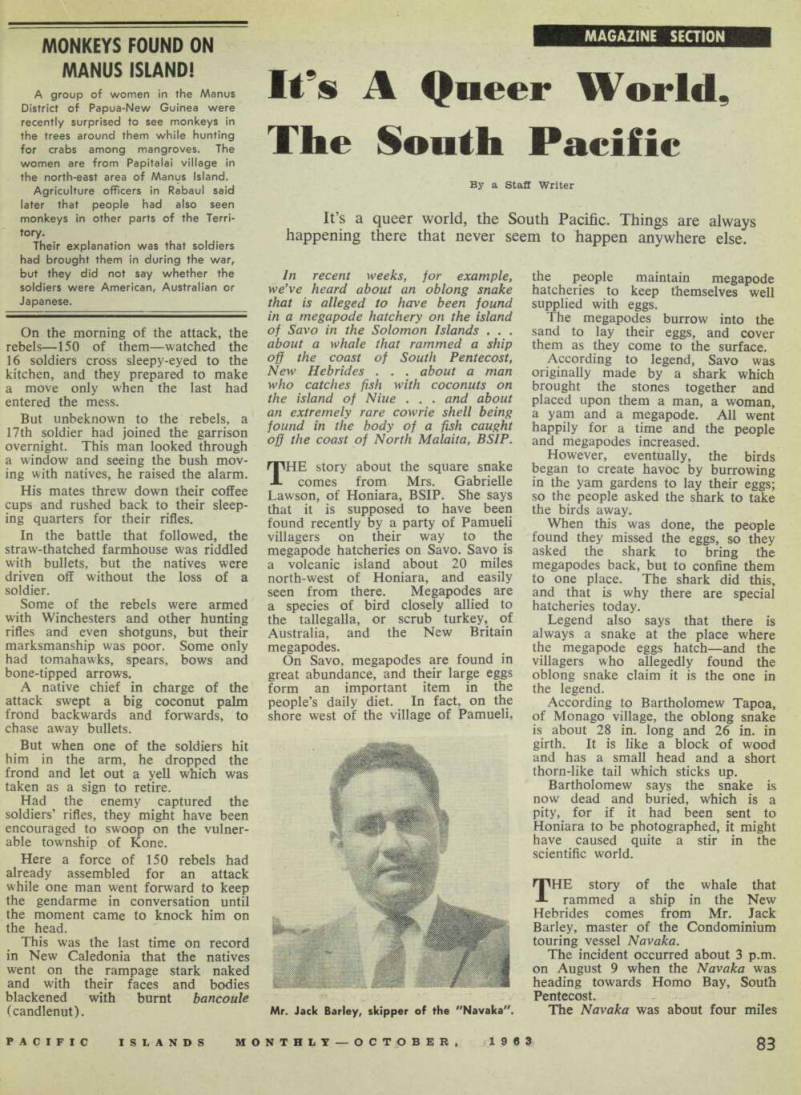
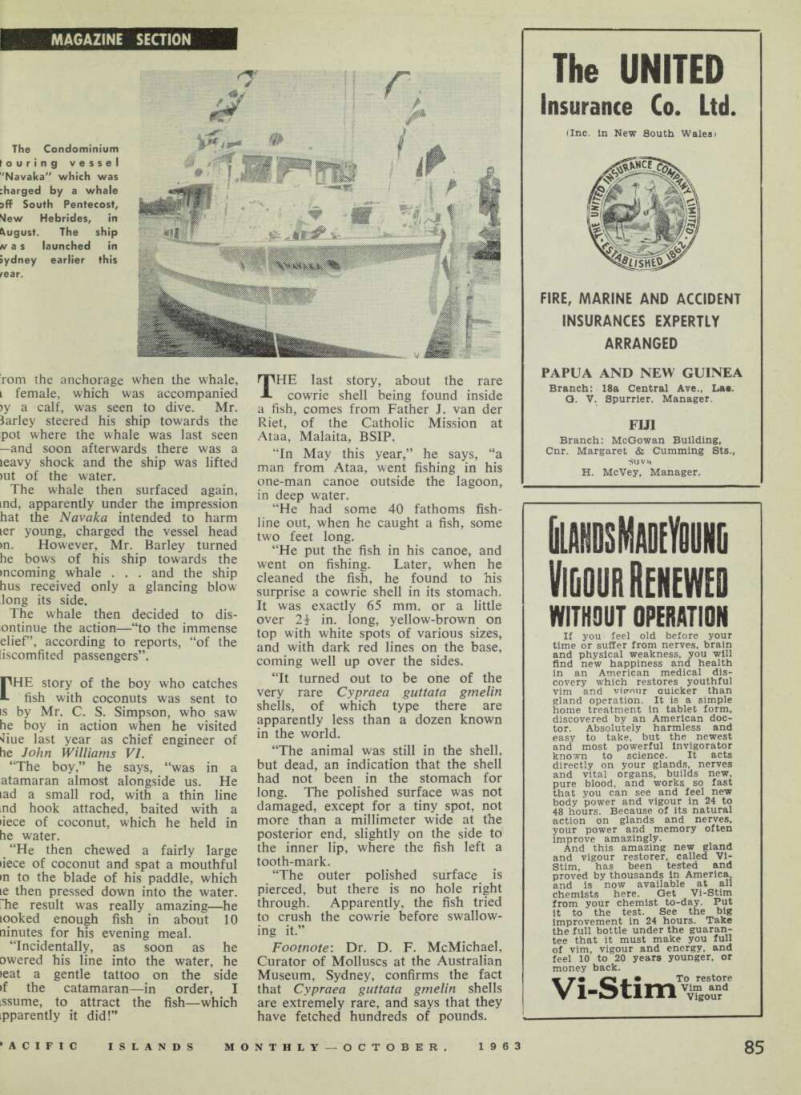
THE story of the whale that rammed a ship in the New Hebrides comes from Mr. Jack Barley, master of the Condominium touring vessel Navaka.
The incident occurred about 3 p.m. on August 9 when the Navaka was heading towards Homo Bay, South Pentecost.
The Navaka was about four miles
Mr. Jack Barley, skipper of the "Navaka".
rom the anchorage when the whale, i female, which was accompanied )y a calf, was seen to dive. Mr.
Parley steered his ship towards the pot where the whale was last seen —and soon afterwards there was a teavy shock and the ship was lifted >ut of the water.
The whale then surfaced again, md, apparently under the impression hat the Navaka intended to harm ter young, charged the vessel head hi. However, Mr. Barley turned he bows of his ship towards the incoming whale . . . and the ship hus received only a glancing blow long its side.
The whale then decided to dis ontinue the action—“to the immense elief”, according to reports, “of the liscomfited passengers”. rHE story of the boy who catches fish with coconuts was sent to is by Mr. C. S. Simpson, who saw he boy in action when he visited 4iue last year as chief engineer of he John Williams VI.
“The boy,” he says, “was in a atamaran almost alongside us. He lad a small rod, with a thin line nd hook attached, baited with a •iece of coconut, which he held in he water.
“He then chewed a fairly large liece of coconut and spat a mouthful m to the blade of his paddle, which ic then pressed down into the water.
Tie result was really amazing—he looked enough fish in about 10 ninutes for his evening meal.
“Incidentally, as soon as he owered his line into the water, he >eat a gentle tattoo on the side if the catamaran —in order, I issume, to attract the fish—which ipparently it did!”
THE last story, about the rare cowrie shell being found inside a fish, comes from Father J. van der Riet, of the Catholic Mission at Ataa, Malaita, BSIP.
“In May this year,” he says, “a man from Ataa, went fishing in his one-man canoe outside the lagoon, in deep water.
“He had some 40 fathoms fish line out, when he caught a fish, some two feet long.
“He put the fish in his canoe, and went on fishing. Later, when he cleaned the fish, he found to his surprise a cowrie shell in its stomach.
It was exactly 65 mm. or a little over 2i in. long, yellow-brown on top with white spots of various sizes, and with dark red lines on the base, coming well up over the sides.
“It turned out to be one of the very rare Cypraea guttata gmelin shells, of which type there are apparently less than a dozen known in the world.
“The animal was still in the shell, but dead, an indication that the shell had not been in the stomach for long. The polished surface was not damaged, except for a tiny spot, not more than a millimeter wide at the posterior end, slightly on the side to the inner lip, where the fish left a tooth-mark.
“The outer polished surface is pierced, but there is no hole right through. Apparently, the fish tried to crush the cowrie before swallow ing it.”
Footnote : Dr, D. F, McMichael, Curator of Molluscs at the Australian Museum, Sydney, confirms the fact that Cypraea guttata gmelin shells are extremely rare, and says that they have fetched hundreds of pounds.
The Condominium louring vessel "Navaka" which was "harged by a whale off South Pentecost, Mew Hebrides, in August. The ship Was launched in Sydney earlier this rear.