Magazine Section
pp. 83-85 · Read in the full issue
Pacific Islands Monthly
Sixteen Europeans Died In Last Native Revolt In New Caledonia
By Lew Friday
In New Caledonia in the 1940’5, I used to swap reminiscences with Mr. Auguste Mitride, a Frenchman, who had an official notification of his own death hanging on a wall of his farmhouse dining room at Hienghene, on New Caledonia’s east coast.
MR. MITRIDE’S “death certificate” had a part in the stories he used to tell me about New Caledonia’s last native revolt, which occurred in 1917.
At least 16 whites, a few Javanese and a Tahitian soldier were killed in this revolt, and in some cases they were eaten by the rebels.
Mr. Mitride and his “death certificate” came into the story in this way. . . .
Early in 1917, Mr. Mitride was serving with the French Army on the Monastir front under General Sarrail.
One day, after he had been three times cited for bravery in action, his platoon was attacked by the enemy.
All but two members of the platoon—Mr. Mitride and an Arab — were killed, and Mr. Mitride, himself, was wounded. That night, having spent the day in a shellhole, Mr.
Mitride managed to crawl back to the French lines. By mistake, he took with him the haversack of a dead comrade.
Later, when French troops moved into the area where the action had taken place, Mr. Mitride’s own haversack was found, and this was accepted as proof of his death.
Eventually, his parents in New Caledonia were officially notified of his death, and it was not until after his mother received a letter from him
(dated the day after he was supposed to have died) that the error was dis covered.
Meanwhile, Mr. Mitride had been evacuated to hospital; and in July, 1917, he returned to New Caledonia on 25 days’ convalescent leave.
He was getting ready to return to the front when he received orders to remain where he was because of a native revolt that had broken out at Hienghene and at Kone on New Caledonia’s west coast.
This revolt, according to Mr.
Mitride, was caused by native vindictiveness and hatred of the whites, and was a hangover into this century of the big native revolt of 1878.
Among those killed were a Mr.
Grassin and his wife, who kept a small store at Houe-Hawa, a few kilometres up the Tipindje River on the east coast. The natives entered the store as if they wanted to buy something, and struck Mr. Grassin down when his back was turned.
Mr. Grassin had formerly sold guns and ammunition to the natives for hunting, and he was taken in by their apparent friendliness.
On being struck he let out a great cry, which brought his wife from a back room.
Native Axes She, likewise, went down under the blows of native axes. Her head was afterwards discovered, but her husband’s corpse was never found— only his entrails in a dish. (At a trial in Noumea a year and a half later, several natives admitted having eaten portion of their victims).
The killers of the Grassins were of the Ouenkaute tribe. They com pleted their deed with loud shouts and war cries; then they pillaged and burnt down the Grassins’ house and
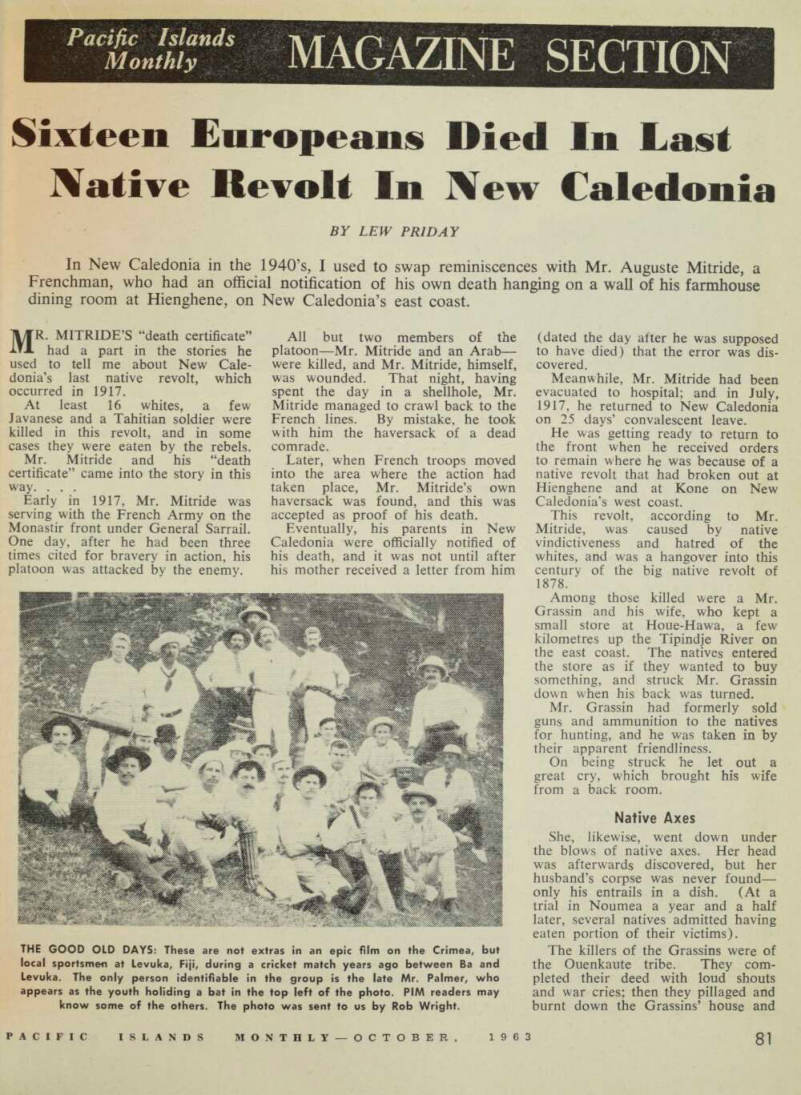
THE GOOD OLD DAYS: These are not extras in an epic film on the Crimea, but local sportsmen at Levuka, Fiji, during a cricket match years ago between Ba and Levuka. The only person identifiable in the group is the late Mr. Palmer, who appears as the youth holiding a bat in the top left of the photo. PIM readers may know some of the others. The photo was sent to us by Rob Wright.
store. Their shouts brought a white neighbour, Mr. Papin, to the scene, He, too, was killed.
Mr. Grassin’s son, who was in France with the Pacific battalion when his parents were killed, took his revenge on his return.
With his service rifle, he went into the Houe-Hawa region and shot down the first native he saw.
A Noumea court later acquitted him of murder after he declared that the blood of his mother and father called for vengeance.
At the same time as the murders of the Grassms and Papin, there were similar massacres m the Kone region.
As a result, white people of the interior were brought into coastal villages on both sides of the island, garrisons were posted at strategic points, and 300 loyal natives, half as warriors and half as porters, were recruited in the Houailou region.
They were led m pursuit of the rebels by Mr. Ratzel, Chief Surveyor of the Colony. The chase lasted more than a year.
White Volunteers Mr. Mitride told me that he to join the scanty punitive force that was raised among the few whites of military age still left in the Colony.
Some 40 or 50 Tahitian soldiers, who called at Noumea on their way to the European front, were ordered to stay in the Colony as reinforcements.
One of the Tahitians was killed and eaten in the Tipindje region. (At the subsequent trial in Noumea, the natives who had eaten him, said he was “as tough as an old bull”).
Mr. Mitride told me that he spent nine months in New Caledonia’s northern region with 15 other white volunteers until the revolt was over.
For six months he was at a post among the tribe of Tendo in the Chaine Centrale. The other three months were spent at Nehouyou, eight miles inland from Tipindje, where the natives had burnt a cattle station.
The rebel tribes, mostly from the savage and mountainous interior were hunted through the bush and over broken ridges, necessitating con tmuous patrols.
Mr. Mitride said that the biggest affair, in which they killed 16 natives an( j ro unded up 50 men and women an( j a f ew children, took place in the region of t he tribe of Coulna, be tween Voh on the west coast, and Hienghene. Here 150 rebels were concentrated.
The whites and the Houailous attacked them from three sides—the whites being split up into parties of 10.
“The rebels were known to be on a great mountain, and did not know °f our presence,” Mr. Mitride re called. We had timed our attack for 8 o clock in the morning, and had taken U P positions during the night.
“But plans to surround the rebels did not work out with complete success because, instead of waiting until zero hour, one party, sighting some natives, opened fire an hour too soon, enabling a lot of the enemy to get through a gap in the bush which had not been properly closed, Otherwise, many more rebels would have been killed.
, , th ® Attack” 1 deener ’among 111 the
backless mountain? and cantured
c e mou an ’ d P re « T , , , , •
hiiL' J*St dy JSSS
without onenine fire S .. Althou p gh g we ' cont inued our patr ols, the back of the resistance £ as b ’ ok and the rebels b to give themselves up as we approached.”
Noel, the bearded chief who led the revolt, was killed later, when he crept back to his home at Koniambo.
A former friend of his, an Arab, attacked and killed him for the 800 francs reward offered by the French, and cut off his head, The head was afterwards stuck on a pole by gendarmes. Picture post cards of the head were still being sold in the stores when I went to Noumea in 1939.
During the revolt, it was the natives habit always to attack at dawn after watching their objective through the night, They thus attacked the Poue station owned by a Mr. Martin, well up in the mountains between Voh and Hienghene. But the attack misfired, The rebels knew there were 16 New Caledonian and Tahitian soldiers there, that their kitchen was 50 yards from their sleeping quarters, and that each morning they crossed about dawn for a cup of coffee and a hunk of bread.
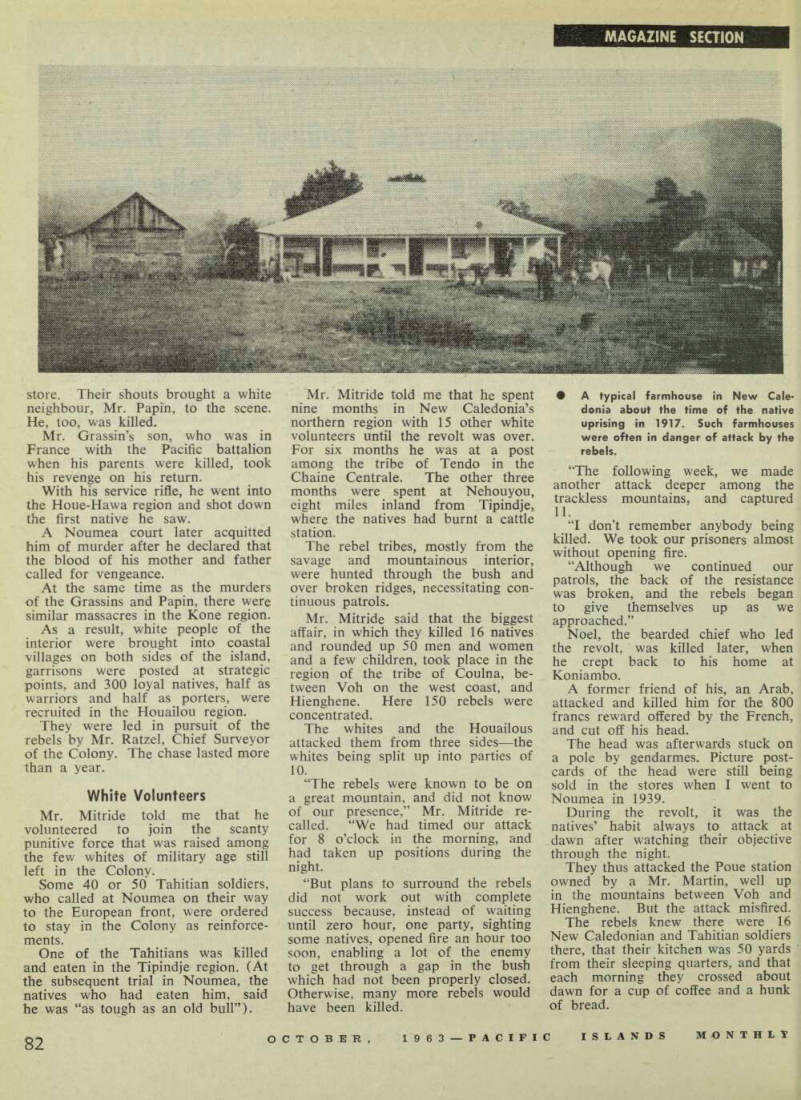
A typical farmhouse in New Cale donia about the time of the native uprising in 1917. Such farmhouses were often in danger of attack by the rebels.
On the morning of the attack, the rebels—lso of them —watched the 16 soldiers cross sleepy-eyed to the kitchen, and they prepared to make a move only when the last had entered the mess.
But unbeknown to the rebels, a 17th soldier had joined the garrison overnight. This man looked through a window and seeing the bush mov ing with natives, he raised the alarm.
His mates threw down their coffee cups and rushed back to their sleep ing quarters for their rifles.
In the battle that followed, the straw-thatched farmhouse was riddled with bullets, but the natives were driven off without the loss of a soldier.
Some of the rebels were armed with Winchesters and other hunting rifles and even shotguns, but their marksmanship was poor. Some only had tomahawks, spears, bows and bone-tipped arrows.
A native chief in charge of the attack swept a big coconut palm frond backwards and forwards, to chase away bullets.
But when one of the soldiers hit him in the arm, he dropped the frond and let out a yell which was taken as a sign to retire.
Had the enemy captured the soldiers’ rifles, they might have been encouraged to swoop on the vulner able township of Kone.
Here a force of 150 rebels had already assembled for an attack while one man went forward to keep the gendarme in conversation until the moment came to knock him on the head.
This was the last time on record in New Caledonia that the natives went on the rampage stark naked and with their faces and bodies blackened with burnt bancoule (candlenut).