With Tolala
pp. 63-65 · Read in the full issue
1914, and Rabaul was occupied on the 13th.
In 1934, Sir Walter McNicoll took over the administratorship of TNG from Tom Griffiths on September 13 and then there was the glorious 13 th of September, 1945, when Charlie Bates and his “company” brought peace and freedom to Ramale Valley where some 330 missionaries and refugees gave them a tremendous welcome.
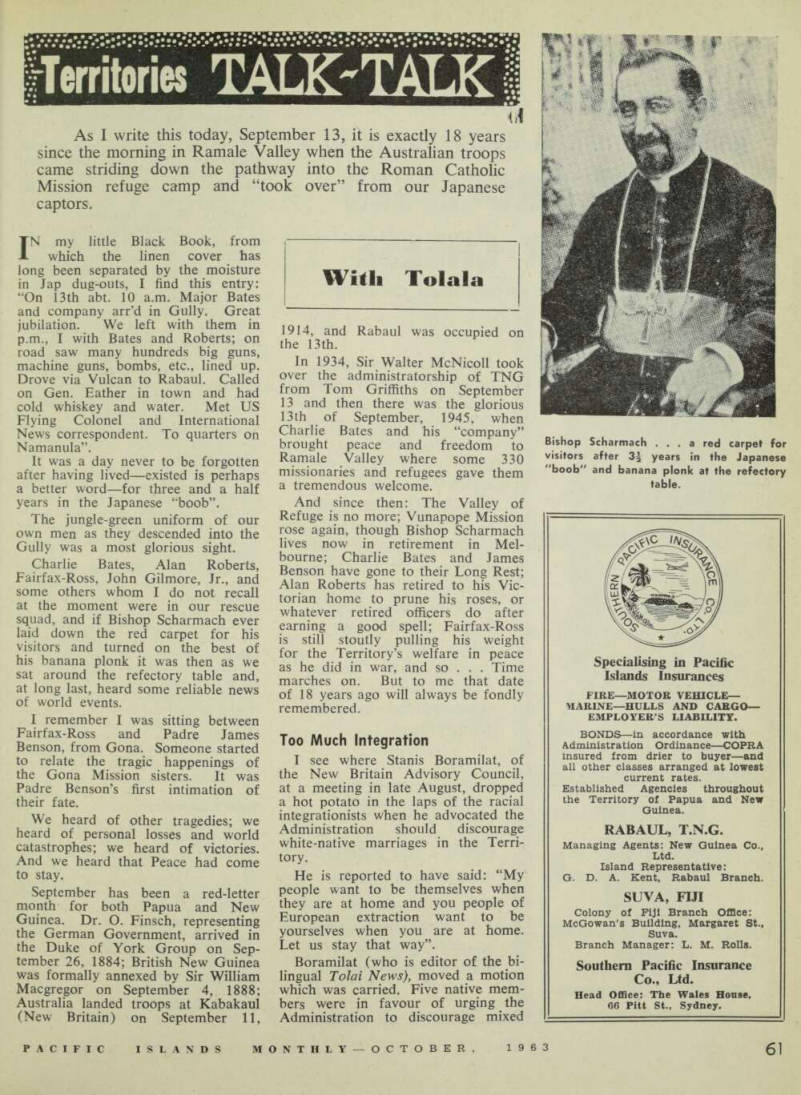
And since then: The Valley of Refuge is no more; Vunapope Mission rose again, though Bishop Scharmach lives now in retirement in Mel bourne; Charlie Bates and James Benson have gone to their Long Rest; Alan Roberts has retired to his Vic torian home to prune his roses, or whatever retired officers do after earning a good spell; Fairfax-Ross is still stoutly pulling his weight for the Territory’s welfare in peace as he did in war, and so . . . Time marches on. But to me that date of 18 years ago will always be fondly remembered.
Too Much Integration I see where Stanis Boramilat, of the New Britain Advisory Council, at a meeting in late August, dropped a hot potato in the laps of the racial integrationists when he advocated the Administration should discourage white-native marriages in the Terri tory.
He is reported to have said: “My people want to be themselves when they are at home and you people of European extraction want to be yourselves when you are at home.
Let us stay that way”.
Boramilat (who is editor of the bi lingual Tolai News), moved a motion which was carried. Five native mem bers were in favour of urging the Administration to discourage mixed
Bishop Scharmach ... a red carpet for visitors after years in the Japanese "boob" and banana plonk at the refectory table.
marriages, three Europeans voting against it and three other whites and one native abstaining.
This is an interesting facet of changing opinion in New Guinea where a native “leader” condemns inter-racial marriage while his white colleagues condone it.
Not that it will make the slightest impression upon the Establishment Pooh-Bahs in Moresby, who stubbornly refuse to deviate from the course as laid down in the Canberra Sailing Directions.
It does, nevertheless, give an in dication of a cross-section of native opinion .on an important issue and may foreshadow one of the changes which may be implemented when the Legislative Council becomes the House of Assembly.
Talking of mixed marriages reminds me of the time (it was in the early thirties, I think) when an ordinance was introduced in TNG making it an offence for a non native to live with a native woman “without benefit of clergy”.
The practice had been common during the German days, especially on plantations, and accounted for the multiple number of guest-houses to be seen surrounding old German plantation homes, where male visitors travelling through were enabled to house their retinue apart from the home of the planter and his Euro pean wife.
The first old-time resident to con form to the New Order was old Peter Hansen, who was then living in Rabaul. He married the Witu Island woman who had saved his life some 30 years previously when the local natives there “did him over” at the time he was “King of the French Islands”.
Peter, I suppose, was one of the most colourful characters among New Guinea old-timers, but today his identity has been lost. He was the one trader who got into Queen Emma’s hair—and that was no mean feat, believe me.
Kuhn's Bungalow
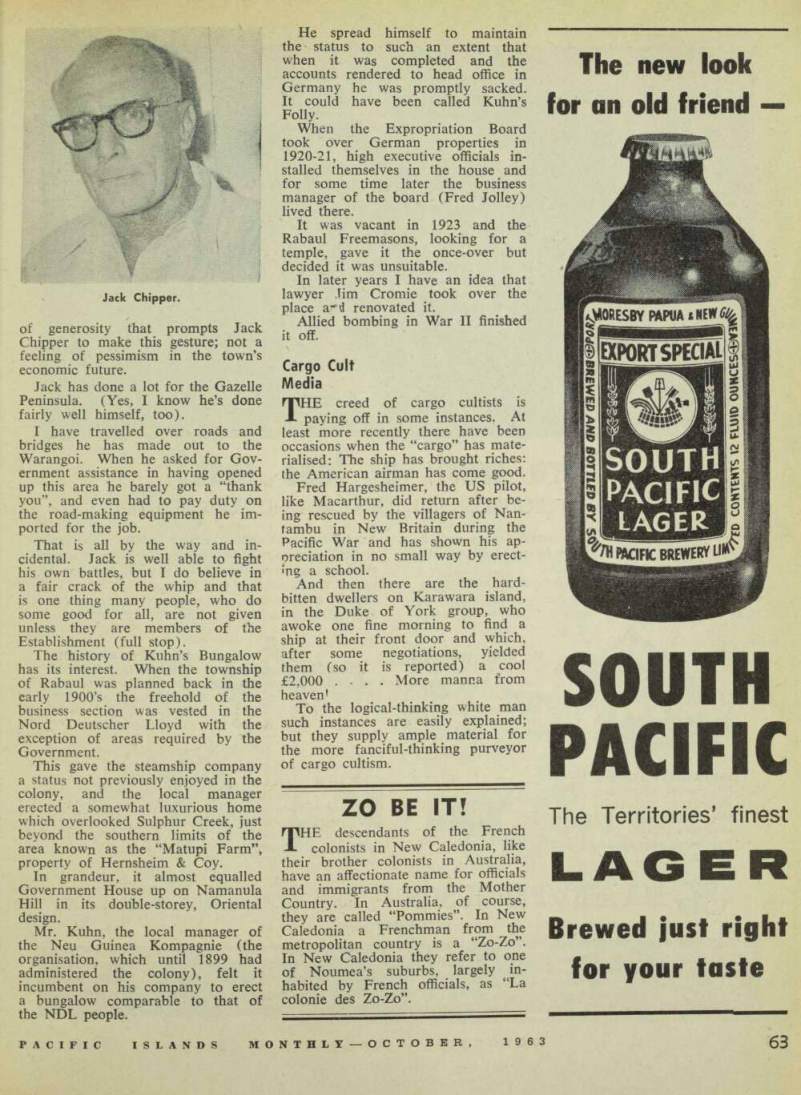
Four acres of Rabaul residential land “sold” for one shilling is the somewhat surprising headline in the New Guinea Times-Courier of August 28 reporting Jack Chipper’s gift to the Methodist Mission people of that site—at one time known as Kuhn’s Bungalow—back off the Malaguna Road and shown on the old-time German Town Plan (com piled in June, 1913) as Lot 92, lying cosily within the “Crown Land” boundary, but not far from the “Native Land” area.
One naturally assumes it is a spirit
of generosity that prompts Jack Chipper to make this gesture; not a feeling of pessimism in the town’s economic future.
Jack has done a lot for the Gazelle Peninsula. (Yes, I know he’s done fairly well himself, too).
I have travelled over roads and bridges he has made out to the Warangoi. When he asked for Gov ernment assistance in having opened up this area he barely got a “thank you”, and even had to pay duty on the road-making equipment he im ported for the job.
That is all by the way and in cidental, Jack is well able to fight his own battles, but I do believe in a fair crack of the whip and that is one thing many people, who do some good for all, are not given unless they are members of the Establishment (full stop).
The history of Kuhn’s Bungalow has its interest. When the township of Rabaul was planned back in the early 1900’s the freehold of the business section was vested in the Nord Deutscher Lloyd with the exception of areas required by the Government.
This gave the steamship company a status not previously enjoyed in the colony, and the local manager erected a somewhat luxurious home which overlooked Sulphur Creek, just beyond the southern limits of the area known as the “Matupi Farm”, property of Hernsheim & Coy.
In grandeur, it almost equalled Government House up on Namanula Hill in its double-storey, Oriental design.
Mr. Kuhn, the local manager of the Neu Guinea Kompagnie (the organisation, which until 1899 had administered the colony), felt it incumbent on his company to erect a bungalow comparable to that of the NDL people.
He spread himself to maintain the status to such an extent that when it was completed and the accounts rendered to head office in Germany he was promptly sacked.
It could have been called Kuhn’s Folly, When the Expropriation Board took over German properties in 1920-21, high executive officials in stalled themselves in the house and for some time later the business manager of the board (Fred Jolley) lived there.
It was vacant in 1923 and the Rabaul Freemasons, looking for a temple, gave it the once-over but decided it was unsuitable.
In later years I have an idea that lawyer Jim Cromie took over the place renovated it.
Allied bombing in War II finished it off.
Cargo Cult
Media THE creed of cargo cultists is paying off in some instances. At least more recently there have been occasions when the “cargo” has mate rialised: The ship has brought riches: the American airman has come good.
Fred Hargesheimer, the US pilot, like Macarthur, did return after be ing rescued by the villagers of Nan tambu in New Britain during the Pacific War and has shown his ap oreciation in no small way by erect ing a school.
And then there are the hard bitten dwellers on Karawara island, in the Duke of York group, who awoke one fine morning to find a ship at their front door and which, after some negotiations, yielded them (so it is reported) a cool £2,000 ... More manna from heaven f To the logical-thinking white man such instances are easily explained; but they supply ample material for the more fanciful-thinking purveyor of cargo cultism.
Jack Chipper.